

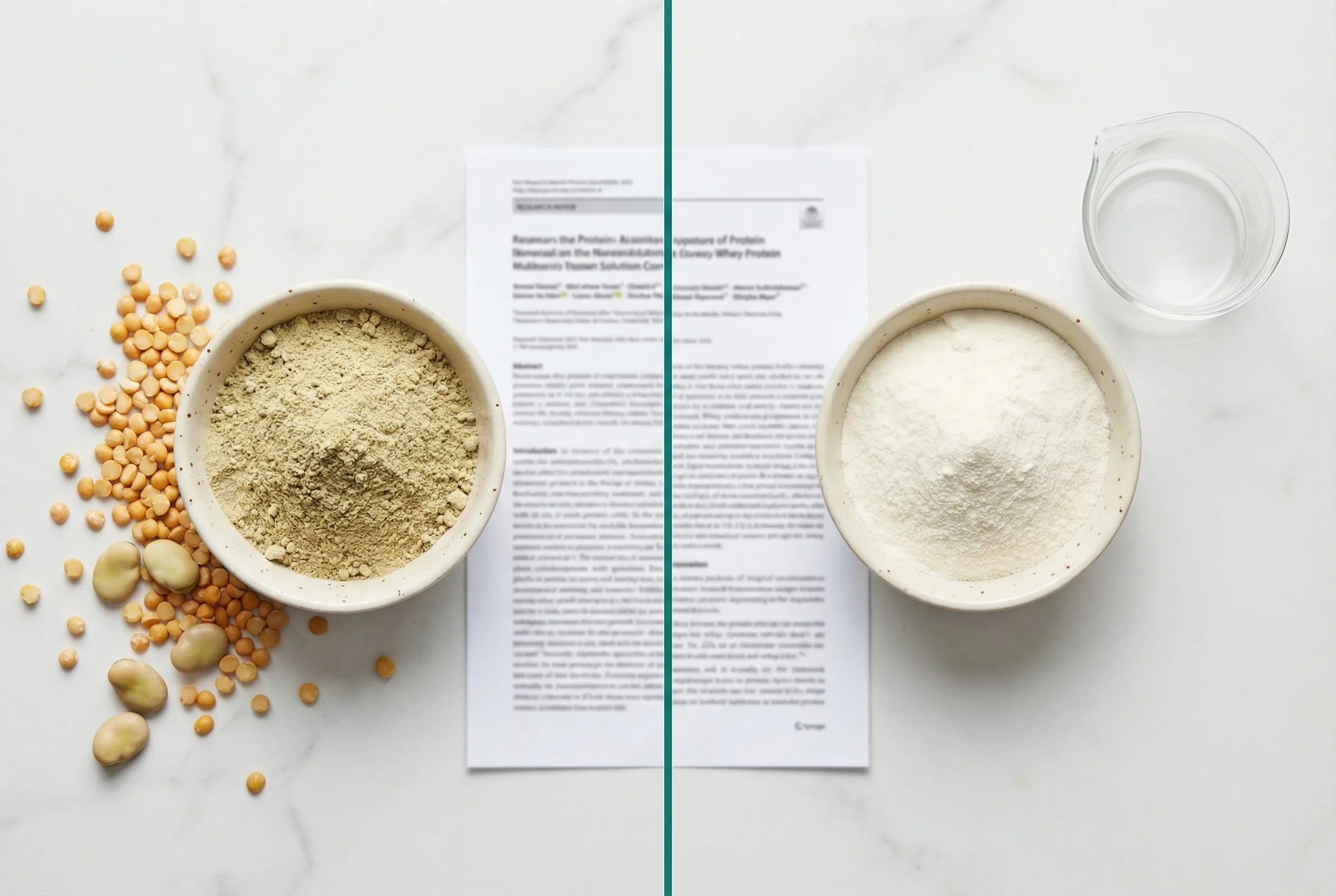
Plant protein doesn't build muscle. Too little leucine, poor bioavailability, incomplete amino acid profile. If you've heard that more than once over the past few years, you're not alone. This narrative is remarkably persistent.
And it sounds logical. Whey has more leucine per gram, a higher DIAAS score, and faster absorption. On paper, animal protein wins. But paper doesn't train. People train. And what happens when real people consume plant protein for weeks and months while lifting heavy? The uncomfortable truth that almost no supplement brand will admit: the difference disappears.
Current research paints a far more nuanced picture than the headlines suggest. That's what this article is about.
- McKendry et al. (2024) measured identical myofibrillar protein synthesis rates for pea protein and whey: 1.59 %/d vs. 1.59 %/d over three days in older men (72 ± 4 years).
- Babault et al. (2015): across 12 weeks of resistance training with n = 161, pea protein and whey produced comparable bicep muscle thickness gains, with no significant difference.
- Two variables matter most: total protein intake of 1.6 g/kg/day or above and a leucine content within the discussed reference range (about 2.5 to 3 g per meal, age-dependent), not the protein source itself.
- Plant protein blends (e.g. pea + fava bean) compensate for the limiting amino acids of single sources and deliver a complete amino acid profile.
- Plant powder advantages: better tolerance for the 15 to 70 % of Europeans with lactose intolerance, integrated fibre content, and higher ingredient transparency.
Contents
What separates plant protein and whey at the nutrient level
Before we talk studies, we need to set the baseline. Whey and plant protein sources differ in three areas relevant to muscle building: amino acid profile, leucine content, and digestion speed.
Whey protein isolate delivers roughly 11 % leucine relative to its protein content. Pea protein isolate sits at 8 to 8.5 %. That sounds like a clear win for whey, and at the level of a single amino acid, it is. Leucine is the strongest known trigger for muscle protein synthesis (MPS), and research discusses a reference value of about 2.5 g per meal, around which MPS responds strongly in studies (age-dependent, not a universal cutoff).
| Criterion | Whey Protein Isolate | Pea Protein Isolate |
|---|---|---|
| Leucine per 25 g protein | ~ 2.7 g | ~ 2.0 g |
| BCAAs per 25 g protein | ~ 5.5 g | ~ 4.5 g |
| DIAAS score | ~ 1.09 | ~ 0.82 |
| Limiting amino acid | None | Methionine |
| Absorption rate | Fast (~ 20 g/h) | Moderate (~ 15 g/h) |
Comparison based on typical isolate values. Actual numbers vary by manufacturer and processing method.
At first glance, the picture looks clear. Whey wins in every category. But this table only shows one slice: the isolated nutrient composition per serving. What it doesn't show is what actually happens in your body when you consume 30 or 40 g of protein from different sources spread across the day. And that's where it gets interesting.
Biological value and older scoring systems have systematically underestimated plant proteins. They measure under lab conditions with a single protein source in a single meal. No one eats like that.
McKendry et al. (2024) compared pea protein isolate and whey across three days in older men (72 ± 4 years) using a deuterium tracer. Integrated myofibrillar protein synthesis rates were identical: 1.59 %/d vs. 1.59 %/d. Conditions: protein intake above the recommended daily allowance (RDA plus 50 g supplement per day) and leucine per meal within the discussed reference range (~2.5 g).
Muscle protein synthesis: what current studies actually show
The most exciting development in recent years: researchers are no longer just measuring the acute MPS response a few hours after a meal. They're measuring integrated protein synthesis over multiple days. That comes much closer to real life than a lab protocol with a single protein dose.
McKendry and colleagues did exactly that in 2024. Older men (72 ± 4 years) received either pea protein isolate or whey in addition to a controlled diet, without accompanying resistance training. The measurement: integrated myofibrillar protein synthesis via deuterium tracer.
Identical myofibrillar protein synthesis rates for pea protein and whey: 1.59 %/d vs. 1.59 %/d. No statistical difference. First study to measure integrated MPS over multiple days in older men (72 ± 4 years).2
1.59 versus 1.59. Not approximately equal, not trending similar: identical. That's remarkable, because pea protein delivers less leucine on paper than whey. But the subjects consumed 50 g of supplemental protein on top of the recommended daily allowance, and individual meals contained enough leucine to sit within the discussed reference range (~2.5 g). Under those conditions, the protein source becomes secondary.
One objection is fair: this was a short-term study over three days. What about weeks?
Babault et al. investigated that in 2015. 161 men, 12 weeks of resistance training, randomized to pea protein, whey, or placebo. The primary outcome: bicep muscle thickness.
Comparable gains in muscle thickness for pea protein and whey over 12 weeks of resistance training (n = 161). Pea protein showed a slightly stronger trend in untrained subjects (not statistically significant).3
No significant difference. Among the untrained group, pea protein even came out slightly ahead, though the difference wasn't statistically robust. What matters more is the bigger picture: over 12 weeks, with real training and real people, both protein sources delivered comparable results.
The measurement method distorts the picture more than the protein source. Acute studies (a few hours, one dose) show advantages for whey. Studies over days and weeks under realistic conditions show no difference.
And then there's the meta-analysis by Messina et al. from 2018: 9 RCTs pooled, soy protein versus animal protein. No significant difference in muscle strength or lean mass.1 The authors reach a clear conclusion: the narrative that plant protein is fundamentally inferior doesn't hold up against the data.
An important caveat: most of these studies work with subjects who consume enough total protein (1.6 g/kg or above). If you're well below that, protein source can play a bigger role because every gram of leucine counts. For most people who train and eat enough protein, though, the difference between plant and animal is measurably irrelevant.
Why protein blends compensate for individual source weaknesses
Pea protein alone has a limiting amino acid: methionine. Rice protein is low in lysine. Soy protein has lower leucine levels. Every single plant protein source has a profile with weak spots.
But here's the thing: no one has to rely on a single source. Protein blends from two or more plant sources can deliver a complete amino acid profile that matches whey. The combination of pea and fava bean works particularly well: pea protein provides ample lysine, while fava bean protein brings a broader amino acid spectrum.
Govindasamy et al. confirmed this in a 2025 systematic review.
Multi-source plant protein blends achieve comparable MPS rates to whey at sufficient doses (30 g+) and a leucine content within the discussed reference range (~2.5 g per serving). Total dose and leucine matter, not the individual source.4
Two factors determine whether plant protein can keep up: total dose and leucine. Both are controllable. Choosing a protein blend that delivers a leucine content within the discussed reference range (about 2.5 to 3 g per serving) directly addresses the most common weak spot of single plant sources.
(discussed reference value)
for muscle growth
optimal above this
Kerksick et al. confirm this in their 2021 review: plant proteins adequately support athletic performance as long as leucine intake falls within the discussed reference range.6 And Putra et al. (2021) discuss whether plant protein sources can achieve effects similar to animal proteins at sufficient intake, but emphasize the need for long-term research.5
An honest point: the research on plant protein blends is younger than the research on whey. Whey has decades of study data behind it, plant combinations only a few years. The results so far are clearly positive, but the evidence base is still growing. That's not an argument against plant protein. It's an argument for keeping an eye on the field.
Anyone switching to plant protein powder should verify three criteria: a leucine content within the discussed reference range (about 2.5 to 3 g per serving, calculable from the published amino acid profile), a blend of two or more sources such as pea + fava bean, and 24 g+ protein per serving. Under these conditions, plant protein achieves a comparable anabolic effect to whey.
Who benefits from switching to plant protein
Not everyone needs to switch. If you're happy with whey, have no digestive issues, and see no reason to change, you don't need a plant protein powder. The research doesn't say plant is better. It says: "equivalent, under the right conditions."
But there are concrete situations where plant protein has advantages.
Digestive issues with whey. Bloating, intolerances, feeling off after your shake. Lactose intolerance affects 15 to 70 % of adults in Europe depending on the region. Even whey isolate contains traces of lactose. Plant protein powders with an integrated enzyme complex can further improve digestibility.
Fibre intake. Most protein powders deliver zero grams of fibre. Plant protein powders that integrate a fibre complex combine two nutrient groups in one product. 95 % of Germans don't meet the recommended daily intake of 30 g of fibre.
Ingredient transparency. If you want to know exactly what's in your protein powder: a published amino acid profile, no hidden ratios, no artificial sweeteners. For a systematic walkthrough of every line on the back of a tub, see how to read protein powder labels.
If you're making the switch, look for three things: a leucine content within the discussed reference range (about 2.5 to 3 g per serving, verifiable from the amino acid profile), a combination of two or more protein sources (pea + fava bean, pea + rice), and a serving size that delivers 24 g+ protein. That way you make sure you're not compromising on muscle building.
The Bottom Line
Current studies show: at sufficient protein intake (1.6 g/kg per day or above) and enough leucine per meal (within the discussed reference range, about 2.5 to 3 g), plant protein blends deliver comparable results to whey. The difference disappears once you nail total dose and leucine. What matters isn't the source, it's the formulation.
Frequently Asked Questions
Not at sufficient doses. Meta-analyses and RCTs show: at a daily protein intake of 1.6 g per kg body weight and a leucine content within the discussed reference range (about 2.5 to 3 g per meal), plant protein blends and whey deliver comparable results for muscle strength and lean mass. What matters is the formulation, not the source.
Not necessarily, if the formulation is right. A protein blend with optimized leucine content (within the discussed reference range, about 2.5 to 3 g per serving) can trigger the same MPS stimulation at equal serving sizes. If you're using a single plant source without leucine optimization, increasing the serving size to 35 to 40 g is a good idea.
Biological value is a 70-year-old rating system that systematically underestimates plant proteins. Newer methods like DIAAS provide more realistic scores, and current training studies confirm: at sufficient total protein intake, the DIAAS score has no practically relevant impact on muscle building. More on that in our article about biological value.

Share: