
Turn the container over. Look at the ingredient label of your protein powder. Sucralose, acesulfame-K, aspartame. Nine out of ten protein powders on the market contain at least one of these. A protein powder without artificial sweeteners? It's the exception. Most people accept it. The shake tastes good, after all.
But then the question comes. Usually after your third, fourth, or fifth shake of the week: Is it actually a problem if I'm drinking artificial sweeteners every day? The answer isn't as simple as either side wants it to be.
Neither the doomers nor the dismissers have the whole story. Here's what the research actually shows.
- Nine out of ten protein powders on the market contain sucralose, aspartame, or acesulfame-K because these sweeteners are cheap, heat-stable, and 600 times sweeter than sugar.
- The 2022 Suez RCT (n=120, Cell) showed significant gut microbiome changes and worsened glucose tolerance after two weeks of sucralose. Stevia and aspartame showed no comparable effects.
- At moderate consumption levels, risks are small according to Ahmad et al. 2020 and Thomson et al. 2019. Cumulative exposure from shakes, diet drinks, and bars is where it gets critical.
- Natural alternatives are no perfect replacement. Stevia has a bitter aftertaste, erythritol is no longer uncontroversial after Witkowski et al. 2023, monk fruit lacks long-term data.
- SYNTYZE Plant Protein contains zero added sweeteners. The sweetness comes from baobab fruit powder and natural flavours.
Why is sucralose in almost every protein powder?
The answer is less glamorous than you'd think. It comes down to three things: cost, shelf stability, and taste expectations.
Sucralose is 600 times sweeter than sugar. That means you need only tiny amounts to make a shake sweet. A few milligrams per serving. It costs almost nothing. At the same time, sucralose is heat- and pH-stable, so it survives the entire production process and storage without degradation. For a manufacturer producing hundreds of thousands of units per month, that's a clear economic advantage.
Then there's the market itself. Over the years, the industry has built a taste expectation. Protein powder should be sweet. Really sweet. That's because whey protein naturally tastes bitter. Plant-based proteins from pea and fava bean have their own earthy flavour. Both are easiest to mask with intense sweetness.
The EFSA has approved sucralose, aspartame, and acesulfame-K and set an ADI (Acceptable Daily Intake). For sucralose, that's 15 mg per kilogram of body weight per day. That's not controversial. What is controversial: What happens with daily consumption over months and years, even if you stay below the ADI?
The 2022 Suez RCT (Cell, n=120) showed significant microbiome changes and worsened glucose tolerance after two weeks of sucralose. Romo-Romo et al. 2025 (Clinical Nutrition ESPEN) reported a 20.3 percent decrease in insulin sensitivity at 30 percent of the ADI over 30 days. At moderate consumption, however, effects remain small per Ahmad et al. 2020.
What the current research really shows
The research landscape is more nuanced than most fitness blogs claim. There's neither a clean bill of health nor a guilty verdict. There's data, and it paints a picture with shades of gray.
The most significant study in recent years comes from Suez and colleagues, published in 2022 in Cell. It matters because it's not an observational study, but a randomized controlled trial with 120 participants.
Suez et al. divided healthy adults into six groups: saccharin, sucralose, aspartame, stevia, glucose (control), and no supplementation. After two weeks, the saccharin and sucralose groups showed significant changes in gut microbiota and worsened glucose tolerance. Aspartame and stevia showed no comparable effects.1
That sounds definitive. It's not.
Because another RCT, published in 2020 by Ahmad and colleagues in Nutrients, found a far less dramatic result. In this crossover study, 17 participants consumed aspartame (14% of the ADI) and sucralose (20% of the ADI) over 14 days. The outcome: no significant changes in gut microbiota or short-chain fatty acid production.2
How do you reconcile that?
The key lies in dose and individual variability. Suez et al. used doses that, while still below the ADI, exceeded typical daily consumption levels. Ahmad et al. worked with amounts matching typical daily consumption. Thomson et al. (2019) confirmed this in another RCT with 34 participants: 780 mg of sucralose daily over seven days, no effects on glycemia or microbiota. But here too, there was enormous individual variation.3
Dose makes the risk. At typical consumption levels, the measured effects are modest. But if you're drinking a protein shake daily and also consuming diet drinks and protein bars, you're adding up faster than you realize.
This is exactly where protein powder users come in. A single shake per day stays well under the ADI. But if you regularly consume protein-enriched foods, low-calorie beverages, and sweetened snacks, you're closer to the ADI than you think.
Romo-Romo et al. provided another data point in 2025 in Clinical Nutrition ESPEN. In their triple-blind RCT, participants consumed sucralose at 30% of the ADI over 30 days. The result: a 20.3% decrease in insulin sensitivity and a rise in inflammatory markers.4
This isn't reason to panic. But it's reason to honestly assess your cumulative exposure. And it's part of why some manufacturers are taking a completely different approach now.
The WHO made its position clear in 2023 too. In its guidelines on non-nutritive sweeteners, it recommends against using them for weight control, since long-term benefits haven't been proven. This isn't a warning about acute danger. It's a statement about missing evidence for the supposed benefit.5
Conz et al. summarized the current knowledge in Nutrients: there's no consensus on the long-term effects of non-nutritive sweeteners on the microbiome. Preclinical data show mixed results, and many clinical RCTs find no significant effects. The authors call for larger, longer studies.6
In summary: the evidence shows that artificial sweeteners at moderate consumption are probably fine for most people. But "probably fine" is not the same as "proven safe." And with daily protein powder consumption over years, we're talking about something more than occasional exposure.
Natural alternatives: stevia, erythritol, monk fruit. No perfect replacement.
If artificial sweeteners raise questions, the natural impulse is obvious: just switch to natural alternatives. Stevia, erythritol, monk fruit. It sounds like a clean solution. Reality is messier.
Stevia (steviol glycosides) is EFSA-approved and considered safe. In the 2022 Suez study, stevia, unlike sucralose and saccharin, showed no significant effects on glucose tolerance or microbiota. A systematic review and meta-analysis by Chowdhury et al. (2022) in Food Science & Nutrition documented glucose-lowering effects in animal studies at doses of 200 to 400 mg/kg.7 Human clinical data here are still limited; the authors explicitly call for further human studies.
The problem with stevia is different. It has a taste. More specifically: it has a bitter, licorice-like aftertaste that increases with concentration. In a protein shake that already has earthy notes, that's a real formulation challenge. So many "stevia-sweetened" protein powders actually use a blend of stevia and other sweeteners.
Erythritol is a sugar alcohol that occurs naturally in fruits. It has virtually no calories and no effect on blood sugar or insulin. Teysseire et al. (2023) confirmed this in a crossover RCT (n=18, acute intragastric administration of 50 g erythritol): no effects on lipids, uric acid, or CRP. The study only tested acute single-dose administration, not long-term consumption.8
Then Witkowski et al. (2023) came along in Nature Medicine.
Witkowski et al. found an association between elevated plasma erythritol levels and increased risk of major adverse cardiovascular events (MACE). In-vitro and in-vivo data also showed enhanced platelet aggregation and thrombotic tendency.9
Before you throw the erythritol out of your cabinet: context matters. The study was observational. Mazi et al. argued in a 2023 review that elevated plasma levels are probably a marker of a disrupted pentose phosphate pathway, not the cause. In other words: people with metabolic disease produce more erythritol themselves. That would be reverse causation, not a causal link.10
That's not settled. What's clear: erythritol isn't the risk-free replacement we once thought.
Monk fruit (Mogroside V) is the newest option. Almiron-Roig et al. (2023) showed in a crossover RCT with 60 participants with overweight that all three sweetener blends tested (including Mogroside V with stevia) reduced the insulin response compared to sucrose. However, the stevia blend showed a slight LDL increase, the sucralose blend an HDL decrease, and none affected actual energy intake.11 But the data are still sparse, and approval as a food ingredient in the EU is limited.
Each of these alternatives solves one problem and creates another. Stevia has an aftertaste, erythritol has open questions, monk fruit lacks long-term data. There's no drop-in replacement that perfectly mirrors artificial sweeteners.
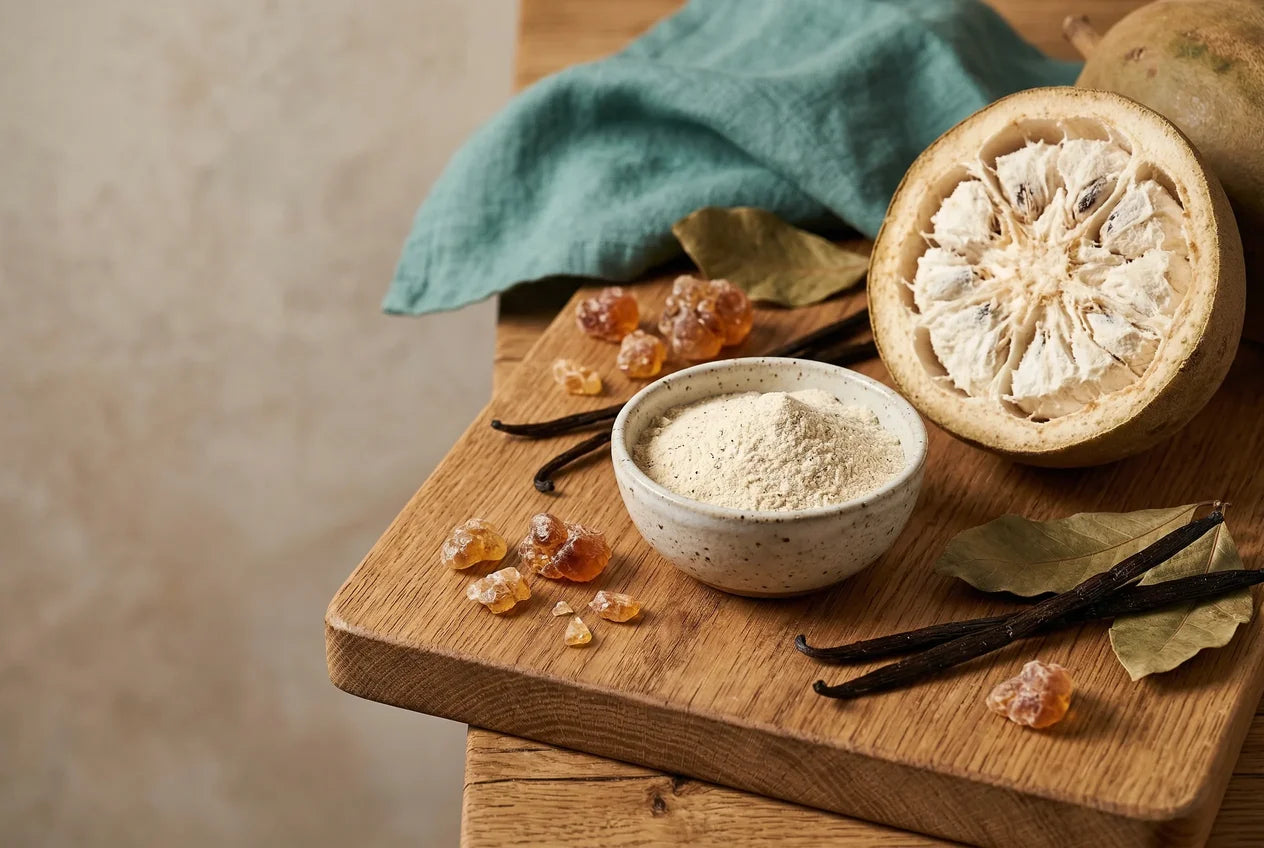
SYNTYZE Plant Protein contains zero added sweeteners: no sucralose, no stevia, no erythritol, no sugar. The mild sweetness comes from baobab fruit powder inside the inavea fibre complex and the natural flavours. Acacia fibre rounds out the flavour profile. The shake is therefore free of synthetic sweeteners.
Protein powder without artificial sweeteners: The third way
There's one more option, and hardly anyone talks about it. That's because it's the most difficult to formulate: skip added sweeteners entirely. No sucralose, no stevia, no erythritol, no sugar.
That sounds like a shake with no taste. Or worse: like pea.
That's exactly the challenge we faced when developing SYNTYZE Plant Protein. And the solution came from a direction we'd originally included for completely different reasons: baobab fruit powder.
Baobab is part of our inavea fibre complex. It delivers soluble fibre, vitamin C, and potassium. What we discovered in the formulation: it brings a natural, subtle fruit sweetness with it. Not the aggressive sweetness of a sweetener, but something more understated that works with the natural flavours to carry the taste profile.
Then there are the natural flavours that carry the taste profile. Combined with the acacia fibre, they create a rounded, mild sweetness that works without any added sweetener.
The sweetness in SYNTYZE comes from baobab fruit powder and natural flavours. No sugar, no sweetener, no sugar alcohol. The acacia fibre rounds out the flavour profile.
Is that a compromise? In a way, yes. SYNTYZE doesn't taste as sweet as a shake with sucralose. If you expect the classic, intensely sweet protein shake flavour, you'll need to adjust. But once you experience the difference, once you realize a shake can work without the synthetic sweetness bomb, most people don't go back.
This isn't a criticism of sweeteners. The research we summarized above shows: at moderate consumption, the risks are low for most people. We chose differently anyway. Not because sweeteners are proven dangerous, but because we wanted a product with as few unnecessary additives as possible. And because the formulation allowed it.
With other products, that might not have been possible. With a pea, fava bean, baobab, and acacia fibre blend: it was.
Why don't more manufacturers do this? The honest answer: because it costs more, because it's technically harder to formulate, and because many consumers expect the intensely sweet taste that sucralose delivers. Selling a protein powder with zero sweeteners means swimming against market expectations. We decided to do it anyway.
What this means for your daily routine
No ultimatum. No fear-mongering. Instead, three scenarios.
One or two shakes a week, no significant sweetener from other sources. Your cumulative exposure is so low that the research gives no reason for concern. Whether it has sweetener or not hardly matters here.
One shake a day, plus Coke Zero or similar, maybe a protein bar. Your daily sweetener intake adds up. You're probably still under the ADI, but closer than you think. In this scenario, reducing total exposure pays off, and the easiest lever is your protein powder, since you're consuming it every day anyway.
Regardless of risk assessment: you prefer products with a short, understandable ingredient list. A protein powder without artificial sweeteners isn't a health decision then, it's a quality decision. And that's just as legitimate.
In our article on digestive enzymes in protein powder, we showed why we take this approach with other ingredients too: fewer additives, more function. The sweetener question is another example of that.
If you're wondering what goes into a protein powder without artificial sweeteners instead: in our case, it's pea protein, fava bean protein, baobab fruit powder, acacia fibre, DigeZyme enzyme complex, and natural flavours. That's it. The full ingredient list is published on the product page.
If you want to know how to systematically spot sweeteners and E-numbers on any protein powder label, our label guide walks through the entire back panel in two minutes.
FAQ: Sweeteners in protein powder
Are artificial sweeteners in protein powder dangerous?
Short answer: At typical consumption and below the ADI, there's no evidence of acute danger. But the long-term effects of daily consumption over years aren't fully settled. The Suez study (2022) shows some people respond more sensitively than others. If you want to reduce your intake, your protein powder is an effective lever.
Is stevia healthier than sucralose?
In the Suez study, stevia showed no significant effects on microbiota or glucose tolerance, while sucralose did. Stevia's safety profile looks more favorable in the current data. The downside: the bitter aftertaste, especially at higher concentrations.
Can a protein powder without sweetener actually taste good?
Yes, but differently. Not the aggressive, immediate sweetness of a sweetener. More a subtle sweetness that comes from the ingredients themselves. Some describe it as "less sweet but more natural." It's an adjustment most people stop missing after a week or two.
The Bottom Line
Artificial sweeteners are probably fine for most people at moderate consumption. But "probably fine" is not the same as "proven safe," especially with daily use over years. Natural alternatives (stevia, erythritol, monk fruit) have their own limitations. The most consistent option: a protein powder that skips added sweeteners entirely and gets its sweetness from the ingredients themselves.



Share: