
Ninety percent. That's how many whey protein powders the German consumer watchdog Verbraucherzentrale NRW examined that gave no information about where their main ingredient actually came from.1 And yet EU law is clear: if a product's packaging makes claims about origin, the source of the primary ingredient must be disclosed. Most manufacturers ignore this. And that's not the only gap.
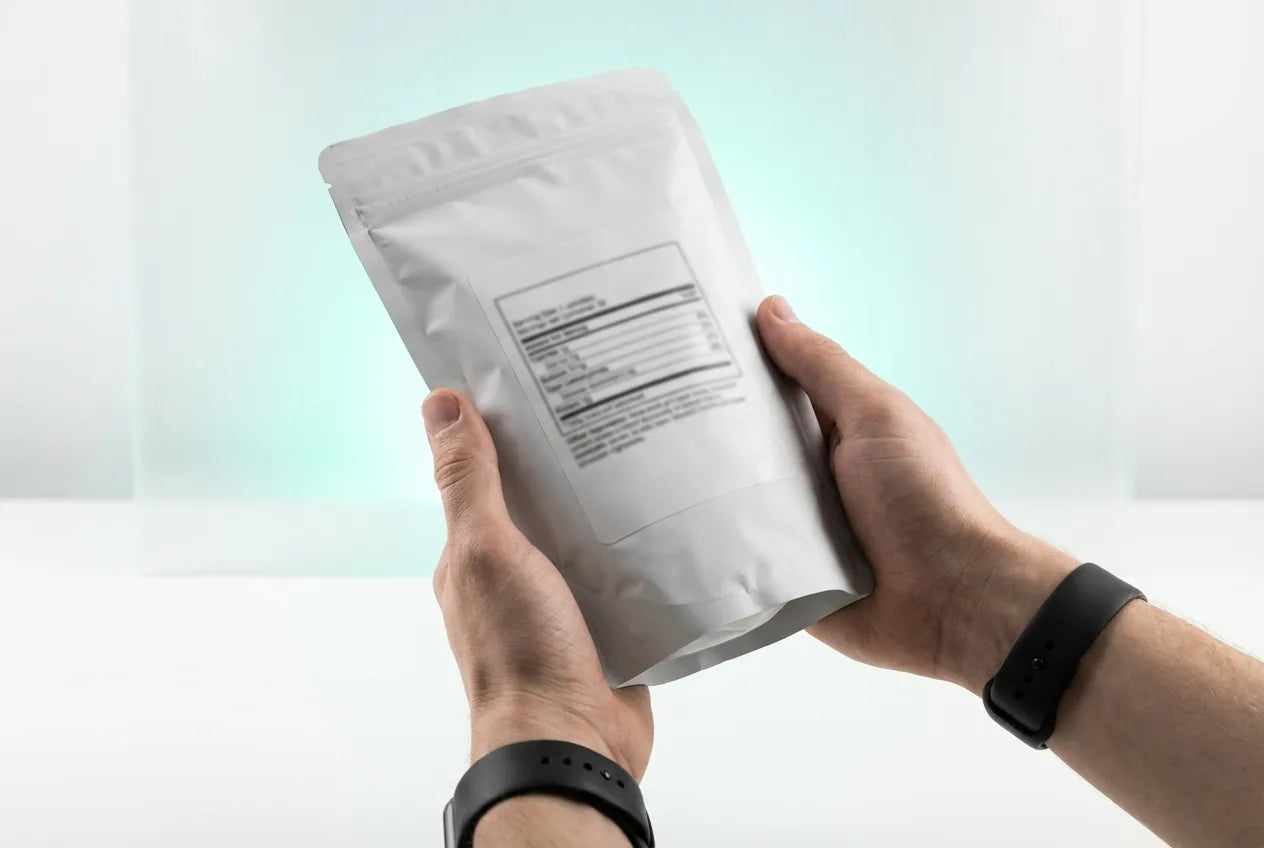
The front of a protein powder is advertising space. "Clean Formula," "Premium Quality," "Natural Protein": all permitted, none of it legally defined. The back is a different story. The EU Food Information Regulation (Reg. 1169/2011, EU-FIR) spells out exactly what must appear on every food label: ingredients in descending order by weight, nutrition values per 100 g, allergens highlighted, manufacturer listed.2 That mandatory section tells you more about a product than anything on the front. Here's why that matters in practice.
What follows isn't a call to distrust every brand. It's a concrete guide that lets you read, interpret, and evaluate a protein powder label in under two minutes.
- Verbraucherzentrale NRW (2025): 26 of 29 whey powders advertising "Made in Germany" (90 %) gave no information on the origin of the primary ingredient, despite EU law requiring it.
- Under EU-FIR (Reg. 1169/2011), ingredients are listed in descending order by weight. What appears first dominates the product.
- Marketing terms like "Clean Label", "Premium" or "Ultra-Quality" are neither legally defined nor independently certified. Only the back of the pack is regulated.
- Clean Label Project (2018): plant protein powders contained, on average, more lead than whey-based products, with significant variation between manufacturers. Lab testing and raw material control matter.
- Compare protein per serving, not per 100 g. Full-formula products with fibre or enzymes land at 60 to 65 g per 100 g and still deliver the same protein dose per shake.
Contents
Why the ingredient list reveals more than the front of the package
There are two kinds of text on a protein powder package. One is written by the marketing team. The other is written by food law.
The front belongs to marketing. "Premium protein sources," "Clean Label," "Ultra-Premium Blend": sounds good, but none of it is verified or legally defined. Any brand can print these phrases on any product. The back operates under EU law.
The EU Food Information Regulation (Reg. 1169/2011, EU-FIR) mandates exactly what must appear on every food label: ingredients listed in descending order by weight, nutrition values per 100 g, allergens highlighted, and the manufacturer identified.2 That required section tells you more about the product than everything on the front combined. A quick look at real-world data shows why:
Verbraucherzentrale NRW examined 29 whey protein powders that advertised "Made in Germany" or similar origin claims on their packaging. Finding: 26 of the 29 products (90 %) provided no information about the origin of their whey protein as the primary ingredient, even though EU law requires exactly that when origin claims are made on the label.1
The front is a sales pitch. The back is the truth.
The EU Food Information Regulation (Reg. 1169/2011) requires ingredients to be listed in descending order by weight. If "maltodextrin" or "sugar" appears immediately after the protein source, fillers dominate the product. If the protein source only shows up third, the product is essentially a sweetener with some protein in it.
How to read a protein powder ingredient list
The most important rule comes straight from the EU-FIR: ingredients are listed in descending order by weight.2 What appears first makes up the largest share of the product. What appears last is present in the smallest amount.
Simple enough. But that single principle immediately cuts through a lot of noise:
If "maltodextrin" or "sugar" appears immediately after the protein source, you're looking at a product with a high filler content. If the protein source only shows up third on the list, it's not really a protein product. It's a sweetener with some protein in it.
A few more things worth knowing:
Compound ingredients are broken down in parentheses. "Flavoring (vanillin, natural flavours)" means the flavoring itself consists of several individual ingredients. That's standard practice and not a red flag, but it does mean a short ingredient list can be misleading at first glance. Five entries can contain ten individual substances.
Allergens must be highlighted under EU-FIR rules: bold, italic, or in capital letters. If you're lactose intolerant or avoiding soy, that's your first stop. The most common allergens in protein powders are milk (in whey and casein), soy, and gluten.
Quantitative ingredient declarations (QUID): If an ingredient is highlighted in the product name or advertising (e.g., "with leucine"), the percentage must be declared in the ingredient list. Brands that voluntarily extend QUID declarations to additional ingredients are signaling they have nothing to hide.
Then there's the "Clean Label" question. The term implies that a product with fewer, recognizable ingredients is better for you. Often true. Not always.
Asioli et al. carried out a review of the research on the topic in 2017 in Food Research International. Their finding: consumers interpret short, familiar ingredient lists as a quality signal, even though "Clean Label" is neither legally defined nor independently certified. The authors explicitly caution that a short label says nothing about the dosage of individual ingredients or the quality of the raw materials used.3
A short ingredient list isn't a guarantee of anything. What's on it matters more than how much is on it.
Which additives are harmless and which deserve a closer look?
E-numbers have a bad reputation. Often undeservedly so.
E330 is citric acid (found in lemons). E471 refers to mono- and diglycerides of fatty acids, typically derived from plant oils and used as emulsifiers to help powders dissolve more easily. E500ii is sodium bicarbonate (baking soda). These substances appear on the EU's positive list for food additives because they've been assessed as safe at the quantities used in food. The E-number itself says nothing about toxicity.
Other entries warrant more attention.
Artificial sweeteners: Sucralose (E955) and acesulfame K (E950) appear in many budget protein powders. Whether and to what extent they cause negative effects is still not fully settled scientifically. If you want to avoid them, you can. If you accept them for cost reasons, that's your call. But it should be a conscious decision, not an accidental one. And for that, you need to be able to read the label. (More on this in our article on protein powders without artificial sweeteners.)
Health claims on the packaging: "Contributes to the maintenance of muscle mass" is an EU-approved health claim for protein, used correctly.4 Statements like "maximizes your recovery" or "improves gut flora," on the other hand, are either not approved or could be considered misleading, because they go beyond what the Health Claims Regulation (EC 1924/2006) has authorized for those ingredients.
That's not a minor technicality. The Health Claims Regulation (EC 1924/2006) protects you from unsubstantiated health promises. Any health claim appearing on a food product must either be EFSA-assessed and listed on the positive register, or it's not permitted.
One more thing that tends to fly under the radar:
The U.S.-based Clean Label Project tested 134 protein powders across different categories for heavy metals, bisphenol A, and other contaminants. Finding: plant-based protein powders contained, on average, more lead than whey-based products, with significant variation between manufacturers. Some products came in well below concern thresholds; others tested surprisingly high. The decisive factor was the quality of raw material controls and third-party lab testing.5
This isn't an argument against plant-based protein powders. It's an argument for lab testing and transparency. Brands that publish their test results prove they have nothing to hide. Those that don't give you no reason to trust them and plenty of reasons to ask questions. DigeZyme® enzymes, used in products like SYNTYZE, can similarly be evaluated for their source and mechanism of action (more on that in our article on digestive enzymes).
Manufacturers vary serving sizes (25, 30, 40 g), which makes per-serving protein numbers look more attractive. The fair comparison runs on protein per serving plus the amino acid profile. Pure isolates reach 80 to 90 g per 100 g, while full-formula products with fibre or enzymes land at 60 to 65 g per 100 g and still deliver the same protein dose per shake.
What the nutrition facts table actually tells you
The nutrition facts table is mandatory. It shows energy, protein, carbohydrates, fat, sugars, and fibre, always per 100 g, and optionally per serving. That optional per-serving column is where things get interesting.
Many manufacturers work with smaller serving sizes: 25 g instead of 30 g or 40 g. This makes the per-serving protein number look more attractive even when the per-100-g value is identical. Try it yourself: compare two labels using only the per-serving column, then switch to per 100 g. The ranking sometimes flips.
Using the per-100-g figure as your only benchmark is too blunt. Pure isolates reach 80 to 90 g protein per 100 g because there's almost nothing else in them. Full-formula products that include fibre, enzymes, or other ingredients land closer to 60 to 65 g per 100 g yet can still deliver the same protein dose per serving. The more meaningful comparison: protein per serving, not per 100 g.
What the nutrition label won't show you: the amino acid profile.
Protein is not just protein. The quality of any protein source depends on its amino acids -- which ones it contains and in what ratio. Leucine is the most important one: research discusses a reference value of about 2.5 to 3 g leucine per serving, around which muscle protein synthesis responds strongly (age-dependent); a universal threshold is not firmly established. Does that appear on the nutrition label? No. SYNTYZE Plant Protein delivers 3 g leucine per serving, which you can verify from the published amino acid profile. With most other products, you'd have to ask or guess.
This is the real transparency problem in the industry. You can read the nutrition table to find out how much protein is in a product. But whether that protein will actually support muscle growth is something you can't determine from there. For that, you need the complete amino acid profile. And most brands don't publish it.
Ask your manufacturer for the complete amino acid profile, including the leucine content per serving. Anyone who won't share that either doesn't have the data or isn't proud of it.
One last thing on the nutrition table: sugar values. "Sugars" in this context is a subcategory of carbohydrates referring to simple sugars (mono- and disaccharides). A value below 2 g sugars per 100 g is realistic and solid for a protein powder with no added sweetening sources. Higher values on a product claiming "no added sugar" are worth investigating.
Common questions about protein powder labels
E-numbers are approved food additives on the EU's positive list. The number alone says nothing about safety or harm. E330 (citric acid) is unproblematic; E955 (sucralose) is an artificial sweetener whose long-term effects are still under scientific discussion. The right first step: look up the E-number and understand what it does. Blanket avoidance of all E-numbers rules out many harmless compounds. Blanket acceptance means you might miss entries worth knowing about.
"Clean Label" is not a protected term and has no legal definition. A product carrying that label doesn't have to meet any specific requirements. What you can actually check: How many ingredients are listed on the back? Are they recognizable and describable? Are there unnecessary fillers or flavours that add no value? A short, understandable ingredient list is a practical starting criterion. Not a guarantee. The dosage and quality of what's in there matter just as much.
No. The EU-FIR does not require the amino acid profile as a mandatory declaration. Manufacturers can disclose it voluntarily -- most don't. That's legally fine, but it's also a quality marker you're entitled to ask for. Request the complete amino acid profile, including leucine per serving, from any brand you're considering. Brands that take transparency seriously hand over that data without hesitation. When others find the question uncomfortable, that says something too.
The Bottom Line
The ingredient list is the only legally regulated statement on a protein powder. The first ingredient makes up the largest share. A leucine content around 3 g per serving is considered a favorable stimulus for muscle protein synthesis, and it never appears on the nutrition table. Ask your manufacturer for the complete amino acid profile. Anyone who won't share it either doesn't have it or isn't comfortable with what it shows.

Share: