

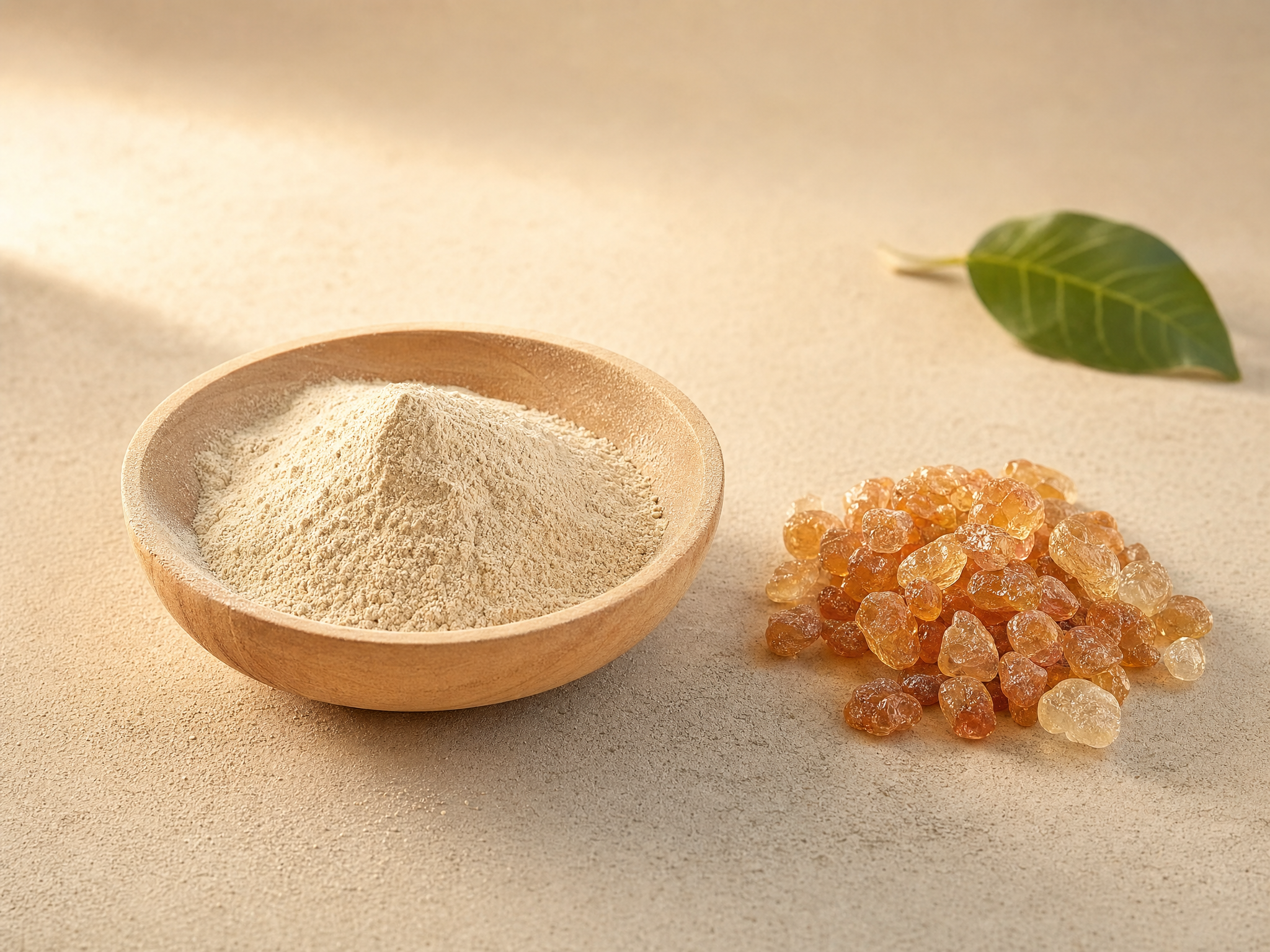
The question comes up regularly the first time someone takes a proper look at the ingredient list on a plant protein pouch: what do those fibres in there actually do? Baobab, acacia gum, sometimes a "complex" of both. Read around online, and you'll hit microbiome talk, short-chain fatty acids, an effect that supposedly upgrades everything. The research is markedly more cautious than the marketing language, and that is the more interesting story.
Three findings from the last two years tell it well. A 12-week RCT with acacia fibre shifted the microbiome significantly but found no rise in faecal short-chain fatty acids.2 A comparative trial on infant gut microbiota explicitly classified acacia gum as not significantly prebiotic in that population.4 And for baobab, the first larger human study is in progress, with results still pending.5 The picture is not "prebiotic yes or no", it is "depends on the substance, the population, the dosage".
What does that mean for you as an athlete drinking a shake with 5 to 6 g of soluble fibre from an inavea baobab-acacia complex? What role do short-chain fatty acids really play, where does the measurable effect stop, and when is it worth raising soluble fibre deliberately? Six sources answer that honestly, one of them is a meta-analysis, one is a robust mechanistic review.
- Soluble, fermentable fibres like baobab fruit powder and acacia gum are broken down in the colon by gut bacteria into short-chain fatty acids (Parada Venegas 2019, review).1
- Eveleens Maarse 2024 (RCT, 65 adults, 12 weeks acacia fibre): significant shift in microbiome beta-diversity (p < 0.001), but no measurable rise in faecal SCFA.2
- Momo Cabrera 2024 (ex vivo, infant microbiota): acacia gum was not significantly prebiotic in this population, while inulin and GOS/FOS were clearly fermented.4
- Yu 2025 (meta-analysis, 12 inulin animal studies): SCFA increase significant (SMD acetate 3.50, propionate 3.08, butyrate 4.47), but pre-clinical.6
- Practical anchor: 25 to 30 g of total fibre per day, of that 5 to 6 g from soluble fibre. More is not automatically better.
Contents
- What "prebiotic" really means in research terms
- Baobab: what the fruit fibre does in your gut, as far as anyone knows
- Acacia fibre: soluble fibre with a mixed evidence base
- Short-chain fatty acids: what the studies actually show on the biochemistry
- What athletes get out of it, and where the limits sit
- FAQ: prebiotic vs. fibre-rich, dose, IBS
What "prebiotic" really means in research terms
A prebiotic fibre is not, in the scientific definition, every soluble fibre. A substance qualifies as a prebiotic fibre when it is selectively fermented by beneficial gut bacteria and produces a measurable health effect.1 That sounds formal, but it has consequences: not every fibre marketed as "prebiotic" meets these criteria in every population.
The mechanism is well understood. Soluble, fermentable fibres pass through the small intestine undigested. In the colon, bacteria such as Bifidobacterium or Lactobacillus metabolise them. Among the end products are short-chain fatty acids, mainly acetate, propionate and butyrate. These SCFAs serve as an energy source for colonic epithelial cells and modulate immune and metabolic signalling through specific receptors (GPR41, GPR43, GPR109A). That is the biochemistry from the standard review by Parada Venegas and colleagues.
Parada Venegas et al. summarised the role of SCFAs comprehensively. Acetate, propionate and butyrate strengthen the gut barrier and modulate inflammatory signalling through G-protein-coupled receptors. Butyrate provides a substantial share of the energy used by colonic epithelial cells and is the most-studied SCFA in mechanistic terms.1
The decisive caveat: whether a given fibre measurably works for a given person depends on baseline microbiome, dose, duration and the rest of the diet. A heavily processed eating pattern with little plant matter reacts differently to 5 g of added fibre than an already fibre-rich plan does.
This is the distinction that goes missing in most marketing copy, and it decides whether a product makes a noticeable difference or simply contributes a biochemically plausible building block without measurable individual effects. If the broader context interests you, how fibre fits into a protein-focused diet: we covered it in our piece on fibre in protein powder.
Baobab: what the fruit fibre does in your gut, as far as anyone knows
Baobab is the fruit of the African baobab tree. The dried fruit powder is roughly 50 per cent fibre, about half of it soluble. In marketing copy, baobab often arrives with promises of improving the gut milieu. Look more closely and there is little direct human evidence and one trial that is only just running.
Riedel et al. registered a randomised, placebo-controlled trial in 50 adults with obesity. Intervention: 16 g of baobab fruit powder per day over 45 days versus placebo. Outcomes measured: intestinal permeability (lactulose/mannitol test), LPS markers, microbiome composition, cardiometabolic risk markers. Status: protocol published, results pending.5
The detail that matters from the Riedel protocol: the test dose is 16 g of baobab per day. That is more than three times what you get from a 5 to 6 g fibre complex in a shake. Even if the trial shows clean effects in 2026, those effects cannot be transferred one-to-one to smaller amounts. This is not an argument against baobab in a shake, it is an honest framing of the dose-response question.
Preliminary studies suggest that baobab fibre can be fermented by gut bacteria. Whether that produces relevant effects in humans under everyday conditions is exactly the question Riedel 2025 is built to answer. Until then, the human evidence for baobab sits on plausible, not on confirmed.
Acacia fibre: soluble fibre with a mixed evidence base
Acacia fibre, also known as gum arabic or acacia gum, is the resin of Acacia senegal. It consists of more than 90 per cent soluble fibre, mainly arabinogalactan proteins, and has been used in the food industry as a thickener for decades. Compared with baobab, the human evidence base is broader, but the result picture is mixed, and that mix belongs in any honest framing.
Eveleens Maarse et al. ran a 12-week RCT in 65 adults with increased metabolic risk (BMI 25 to 30, low fibre intake; aged 45 to 70). Intervention: acacia fibre plus carrot powder versus placebo. Result: significant shift in microbiome beta-diversity (p < 0.001), but no change in faecal SCFA concentrations and no measurable effect on metabolic resilience markers.2
This study matters for two reasons. It confirms that acacia fibre changes microbiome composition in humans, and it makes clear that this does not automatically translate into higher SCFA concentrations in stool. A plausible explanation: SCFAs are rapidly absorbed by the colonic mucosa, so a stool measurement underestimates actual production. That explanation is not yet firmly established.
A second analysis from the same group (Hogenelst et al. 2024) showed a sex-specific effect. Women improved on daily-life affect scores under the acacia-carrot prebiotic, men did not. The effect correlated with higher microbiome diversity.3 Interesting, preliminary, no reason to market acacia fibre as a mood booster.
Counter-position from the same research landscape: Momo Cabrera et al. (2024, ex vivo) compared GOS/FOS, inulin and acacia gum on Kenyan infant gut microbiota. Acacia gum was not significantly prebiotic in this population, neither in terms of Bifidobacterium increase nor SCFA boost. That does not fit the marketing narrative, but it belongs in any honest framing. Fibre effects are population-dependent, not universal.4
If you want the wider context on the broader trend of integrating more soluble fibre into the daily plan: we covered it in our piece on fibermaxxing. That article also addresses the question of how much soluble fibre is realistic within a daily 25 to 30 g target.
Short-chain fatty acids: what the studies actually show on the biochemistry
SCFAs are the supposed endpoint of every fibre conversation. Acetate, propionate, butyrate. Three short molecules with a long list of effects in basic research. The operative question is: how much of that can be shown clinically, and how much is extrapolation from cell and animal models?
Yu et al. systematically reviewed 12 animal studies on inulin (a related soluble, fermentable fibre). Inulin significantly increased SCFA levels: acetate SMD 3.50, propionate SMD 3.08, butyrate SMD 4.47 versus control. Limit: entirely pre-clinical. The effect sizes are impressive, but they cannot be transferred one-to-one to humans.6
A typical picture: in animals the effects are clean and large, in humans things get fuzzier. Eveleens Maarse 2024 illustrated it well: microbiome shift yes, faecal SCFA increase no. A plausible explanation is the rapid absorption of SCFAs by the colonic mucosa, which makes stool measurement a weak proxy. That explanation has not been definitively established.
What this means in practice: anyone taking in soluble, fermentable fibre regularly is very likely producing SCFAs biochemically. How large that effect ends up depends on baseline microbiome, dose and the rest of the diet. A reliable effect in the sense of "your gut milieu measurably improves" is not guaranteed by the available human data.
What athletes get out of it, and where the limits sit
The honest answer: there is currently no RCT showing that 5 or 6 g of soluble fibre per day measurably improves recovery, performance or training adaptation in athletes. That is not an argument against these ingredients, it describes the state of the evidence precisely.
What athletes can realistically take from the data fits in four lines.
| Lever | What is sensible | What gets oversold |
|---|---|---|
| Total fibre | Hit 25 to 30 g per day, of that 5 to 6 g from soluble fibre | "Microbiome reset" through a single product |
| Tolerance | Ramp up gradually, 5 to 30 g over 2 to 4 weeks | Jumping to 30 g straight from a 12 g baseline |
| Microbiome diversity | Consistency across weeks, varied fibre sources | Expecting a reset from a 12-week phase |
| Sport effects | Indirect via slower gastric emptying, glucose dynamics, digestive comfort | Direct performance promises without human data |
Framing soluble fibre for athletes against current evidence. Values reference EFSA fibre guidance and the doses used in Eveleens Maarse 2024 and the Riedel 2025 protocol.
Digestive enzymes, by the way, play a different and clearer game from fibre. If you want to go deeper into that side: we covered the role of DigeZyme and friends in our piece on digestive enzymes in detail.
Interim conclusion: soluble fibres from baobab and acacia are not a wonder lever for performance, they are a sensible contribution to the daily fibre target and a biochemically plausible building block for the microbiome. Serious research does not promise more than that right now.
FAQ: prebiotic vs. fibre-rich, dose, IBS
Every prebiotic is a fibre (or another fermentable substance such as an oligosaccharide). But not every fibre is prebiotic. Prebiotic means selective fermentation by beneficial bacteria with a measurable health effect. Fibre-rich merely describes the fibre share of a food product. Marketing copy often uses the terms interchangeably, the scientific definition is narrower.
Studies that show effects at all typically use 5 to 20 g per day across 12 weeks or more. Eveleens Maarse 2024 used roughly 10 g of an acacia fibre complex, Riedel 2025 is testing 16 g of baobab. Dose-response curves for individual sub-effects have not yet been established. More is not automatically better, especially without a gradual adjustment.
If your daily target of 25 to 30 g of fibre is comfortably met through vegetables, legumes, wholegrains and fruit: not necessary. If your eating pattern is protein-heavy and fibre-light, added soluble fibre can be a sensible bridge. Rule of thumb: start low (3 to 5 g extra per day), watch tolerance, then build up. Anyone with an IBS diagnosis should run this past a clinician or a registered dietitian first.
The Bottom Line
Soluble fibres from baobab and acacia gum are classified as fermentable and partly prebiotic in research. The biochemistry is plausible, human studies show microbiome shifts, but by no means every trial finds a faecal SCFA increase, and population matters in a way the marketing rarely admits. For athletes the takeaway is straightforward: fibre-containing shakes are a useful contribution to the daily target and a biochemically reasonable building block for the microbiome. Performance promises go further and are not currently supported by human data. Consistency over weeks beats one-off large doses.



Share: