

You reach for your daily protein shake. You know the ingredients: protein, maybe a few vitamins. Fibre? Nowhere to be found. Practically all major manufacturers leave it out. Yet research has shown for years that soluble fibre and protein together can influence the satiety effect more strongly than protein alone.
The reason almost nobody does this isn't because fibre is useless. It's technically complicated. And expensive. But there are ways to solve it.
- The vast majority of Germans miss the DGE recommendation of 30 g fibre per day (averaging roughly 18–19 g per day).8
- Soluble fibres ferment in the colon and boost satiety via GLP-1 and PYY release. Insoluble fibres only stimulate gut transit.
- A 2001 meta-analysis (Howarth et al.) shows: 14 g additional fibre per day reduces energy intake by an average of 10 %.9
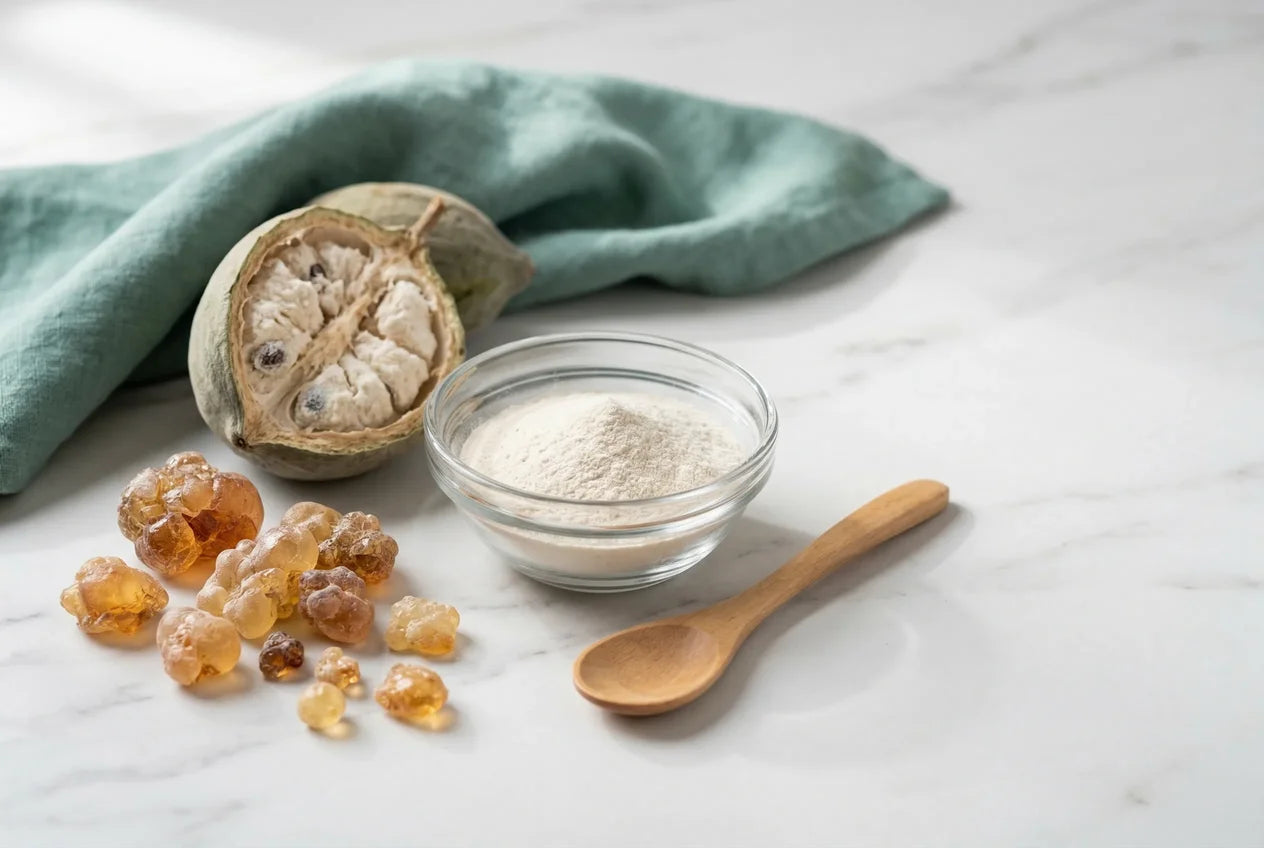
- Acacia fibre (inavea) and baobab are technically compatible with protein powder: dissolve clearly in the shaker, low-FODMAP, EFSA-compliant as "high in fibre".5
- Practice: 2–4 g additional soluble fibre per serving complements protein satiety – without lumps, without bitterness.
Soluble vs. Insoluble Fibre: Why Only One Type Works
Fibre isn't created equal. There are two categories.
Soluble fibre (acacia, baobab, inulin) dissolves in water, becomes viscous, and slows gastric emptying. This leads to a stronger and longer-lasting satiety effect. Insoluble fibre (cellulose, whole grain fibres) doesn't slow that down. It works differently, but in a shake it's a problem: it makes the texture unpleasant.
So only one type makes sense for a protein powder. How quickly the soluble fibre ferments in the colon also decides how tolerable it is. We covered the mechanism in Soluble fibre and fermentation speed.
The recommendation is 30 grams of fibre per day. Sounds doable. Reality looks different: Germans consume an average of only 18–19 grams daily, according to current data from the Federal Center for Nutrition. That's a deficit of over 11 grams. More than a third below the target value.
The Fibre Deficit in Protein Powders: Why Manufacturers Ignore It
When you routinely work soluble fibre – inulin, psyllium – into a protein shake, they thicken it significantly. The shake becomes sticky, the mouthfeel becomes unpleasant. The texture suffers.
There are also practical reasons: high-quality soluble fibre costs more than what most manufacturers budget for their mix. And then the entire formulation has to be redone. Emulsifiers, thickeners, the flavour profile – everything has to work with a new variable.
That's tedious. It often fails in practice. The easiest way: just leave it out.
The challenge is real. The solution is too – with the right material.
Soluble fibres ferment in the colon to short-chain fatty acids that can release GLP-1 and PYY (satiety hormones). Combined with protein, the CCK effect in the small intestine can amplify. The satiety mechanism discussed here is, however, not consistently supported in studies.1
What research shows about satiety
Clark and Slavin conducted a systematic review of soluble fibre in 2013.1 In some studies soluble fibre showed a satiety effect, but it was inconsistent: Clark and Slavin found that the majority of acute fibre interventions did not significantly affect satiety or energy intake. The effect varies by fibre type and study design; Clark and Slavin could not confirm a general dose dependency.
Where it gets interesting: the combination of protein and fibre.
A 2018 RCT published in Current Developments in Nutrition examined a beverage with 17 grams of protein and 6 grams of fibre compared to an isocaloric beverage with 1 gram of protein and 3 grams of fibre, tested in overweight adults. The higher-protein, higher-fibre version significantly reduced hunger and desire to eat (p<0.05); total energy intake was only a trend towards lower (p=0.09).2
That's practically relevant: a beverage with protein and fibre can curb hunger and desire to eat – though in this study the effect on the amount of energy actually consumed was only a trend.
Gill et al. (2021) summarized how soluble fibre influences satiety through its physical properties: it increases viscosity in the digestive tract and slows gastric emptying.3
Acacia fibre (gum arabic) delivers ~85 % soluble fibre with minimal taste impact. Baobab combines fibre with vitamin C. Both are low-FODMAP and ferment slowly in the colon – reducing the bloating risk that inulin or FOS often cause.
The solution exists: Acacia and baobab
Acacia fibre has a property that other soluble fibres don't: extremely low viscosity.
In practice, this means you can add meaningful amounts without ruining the shake texture, since acacia fibre is, according to manufacturer and product data, soluble to a large extent. The shake stays drinkable, the mouthfeel stays pleasant.
That's why acacia works in modern blends: it's the fibre source that meets these specific technical requirements.
Baobab is also soluble, but with different properties: it contains vitamin C, potassium, and other micronutrients. The combination of baobab and acacia addresses two requirements: technical functionality plus expanded nutrient profile.
Both fibres are over 90% soluble and optimize viscosity in the gastrointestinal system without blocking passage.
Unlike most other soluble fibres, they don't thicken the shake. The shake keeps its smooth consistency.
Acacia and baobab are better tolerated by most people than other fibres. They cause fewer gas or stomach issues. Prebiotic properties have been described for acacia gum in clinical studies.47
With acacia and baobab, there's a raw material combination that meets both requirements: the scientific basis for soluble fibre and the technical feasibility in a shake.
The objection: Isn't more vegetables enough?
Fair point. And the honest answer is just as direct: yes, vegetables should be your primary fibre source. A big salad, broccoli, carrots, whole grain bread – that's better than any shake because it's real food, with micronutrients and complex structures.
But here's the problem: the average German doesn't eat enough of it.
Data from the Federal Center for Nutrition makes clear that actual consumption is just 18–19 grams per day. That's 11–12 grams below the target. A third of the recommended amount is missing. That's not a small deficit.
A protein shake with fibre doesn't replace vegetables. It's the puzzle piece that complements your other meals. If you're already consuming 18–20 grams from vegetables, whole grains, and legumes, and your shake adds 3–5 grams, then you're covering a real part of your daily need – through something that's on your shopping list anyway. That's simple math. And it makes sense.
Fibre in Daily Life: How to Make It Work
Theory is one thing. How does it work in real everyday life?
Track for a week how much fibre you're currently consuming. Most people are surprised it's under 20 grams. Then the deficit is no longer abstract – it becomes concrete.
Not all fibre is equal. A mix from different sources brings a variety of fibre types and maximizes nutrient potential. The shake is one of four or five sources – not the only one.
If you tend toward bloating, your digestive system tolerates some fibre sources better than others. Acacia and baobab are generally better tolerated than inulin or chicory root.
The practical part is: if your protein powder already contains soluble fibre from acacia and baobab – like SYNTYZE PLANT PROTEIN with 24 g protein, 3 g leucine, and DigeZyme® enzyme complex – then the shake handles part of your daily fibre need for you.
If you want to understand why a protein powder with fibre shows a lower protein percentage per 100 g on the nutrition label – and which value actually matters when comparing products: our label guide explains the difference.
Further reading: what's behind the fibermaxxing trend, how digestive enzymes support protein absorption, why plant proteins are supplemented, and what to look for in a protein powder without artificial sweeteners.
Conclusion: Why Protein and Fibre Belong Together
Fibre in sports nutrition addresses a real problem: the deficit in fibre intake. The combination acacia plus baobab offers a solution without compromise – good texture, good mouthfeel, broad tolerance.
Available research shows that protein and soluble fibre together strengthen the satiety effect. Practically speaking: a smaller amount of protein with fibre achieves the same satiety effect as a larger amount without.
Most manufacturers don't solve this problem because formulation is technically demanding. That it reliably works with acacia and baobab isn't new science – it's craftsman-like design that implements scientific insight.
The Bottom Line
Germans consume an average of only 18–19 g instead of the recommended 30 g of fibre daily. Most protein powders contain none because soluble fibre ruins texture. Modern raw materials like acacia and baobab solve this problem. Science shows that soluble fibre and protein work synergistically to strengthen satiety. A well-formulated shake can cover a measurable part of this deficit.



Share: