

Germany's nutrition society (DGE) recommends at least 30 g of fibre per day, yet ~70% of Germans fall short and almost nobody hits that target.1 On average, women get around 18 g, men around 19 g. That's not a small shortfall.
At the same time, a term is popping up on social media that sounds like a fitness trend but actually describes a nutrition principle: fibermaxxing. The idea: deliberately maximize your fibre intake. For satiety, for your gut, for how you feel in your body. Major health outlets have covered it. The question is: is there actual substance behind the trend?
And more importantly: what does it mean for you if you're already watching your protein intake? That's exactly what we're breaking down here.
- Fibermaxxing means deliberately raising daily fibre intake well beyond the 30 g recommendation, often to 40 to 60 g per day.
- In Germany, around 75% of women and 68% of men fall short of the 30 g target; the average sits at just 18 to 19 g per day.
- In a review of older adults with sarcopenia and obesity, protein and fermentable fibre act synergistically on satiety and amino acid profiles, according to Prokopidis et al. (2020).
- Fibre type matters: insoluble grain fibres cut type 2 diabetes risk by 20 to 30% in cohort studies (Weickert & Pfeiffer 2018).
- Increase intake by no more than 5 g per week and drink enough water, otherwise bloating replaces the benefits.
Contents
What's behind the fibermaxxing trend?
Fibermaxxing describes the deliberate choice to dramatically increase your daily fibre intake. Not to 30 g (that would just be meeting the recommendation), but to 40, 50, sometimes 60 g and more. The trend comes from English-language nutrition communities, spread through TikTok and Instagram across the DACH region in 2025, and hit the mainstream in 2026.
The motivation behind it: fibre keeps you full longer, supports digestive function, and might help with weight management. That's the short version. What most fibermaxxing posts leave out: not all fibre works the same way, and more isn't automatically better.
Germany's nutrition society recommends 30 g of fibre per day. Actual intake averages around 18 g for women and 19 g for men, which means 68 to 75% of the population fall short. Quagliani and Felt-Gunderson (2016) documented that in the United States, only about 5% of people meet the recommended intake at all.
Why the fibre gap is so large
Before we talk about trends, let's look at where we actually stand. Germany's nutrition society recommends 30 g of fibre per day. That's not an ambitious goal. It's a minimum.1
Reality looks different. In Germany, about 75% of women and 68% of men fall short of this recommendation. Globally, the picture isn't much better: Quagliani and Felt-Gunderson documented in 2016 that in the US, only about 5% of the population actually meets the recommended fibre intake.2 They identified three main barriers: people don't realize they're not eating enough, they're unsure how to implement it, and the assumption that high-fibre eating is complicated.
per day
women (DE)
men (DE)
So the fibermaxxing trend has a real foundation. Most people really are eating too little fibre. The problem was never the evidence. It was getting people to actually do it.
How protein and fibre work together in your body
This is where it gets interesting for protein users. Most articles about fibermaxxing treat fibre in isolation, as if nutrition was a single discipline. In reality, nobody eats fibre alone. You combine it with protein, fat, and carbs. And that combination is what matters.
Prokopidis et al. examined this in a 2020 review of older adults with sarcopenia and obesity, looking at how protein and fibre actually interact. The result is remarkably clear.
In a review of older adults with sarcopenia and obesity, the combination of protein and fermentable fibre shows synergistic effects on satiety perception and gut microbiota. Plant-based proteins with fibre improve amino acid profiles and promote a favorable composition of gut microbiota.3
Synergistic means: The overall effect is bigger than the sum of its parts. Protein alone already keeps you full (that's well-known). Fibre alone slows down stomach emptying (also well-known). Both together? They amplify each other. Studies suggest this combination affects how full you feel more strongly than either component on its own, possibly through longer-lasting satiety signals and more gradual amino acid uptake.3
Huwiler et al. came to a similar conclusion in a 2022 meta-analysis of 27 randomised controlled trials: soluble fibre supplements showed a significant reduction in body weight (-1.25 kg) as well as in BMI and waist circumference.4 If you're already using protein for satiety, adding fibre might be that missing second piece of the puzzle.
Studies suggest that protein and fermentable fibre act synergistically on satiety signals (Prokopidis et al. 2020).3
But (and this matters): not every combination works equally well. Too much insoluble fibre can actually slow down protein digestion. It's not about maxing out the amount. It's about getting the balance right. More on that in a moment.
The evidence is broad on the gut side too. Lai et al. (2023, double-blind RCT) compared fibre directly to probiotics in functional constipation: both interventions improved stool consistency comparably versus placebo.5 De Vries et al. (2019, meta-analysis) confirm it: short-chain β-fructans in particular (e.g., short-chain inulin fructans) significantly increased stool frequency (+0.36 bowel movements/day), while long-chain ones showed no significant frequency effect.6 Two meta-analyses, one RCT. The direction is clear.
And the EFSA-approved claim? "Fibre contributes to normal bowel function" is correctly stated and regulatory solid. Anything beyond that (microbiome optimization, prebiotic effects) stays in the research realm, not consumer communication.
Weickert and Pfeiffer (2018) showed that insoluble grain fibres from whole grains reduced type 2 diabetes risk by 20 to 30% in cohort studies. Soluble, viscous fibres shine in satiety and gut function. JanssenDuijghuijsen et al. (2024) demonstrated in an RCT with 180 IBS patients (constipation-predominant) that just 10 g of acacia fibre per day significantly improves stool frequency.
Why fibre type matters more than quantity
This is the gap in the fibermaxxing conversation. Most content talks about amount: 30 g, 40 g, 50 g. But the type influences the effect just as much as the gram count.
Weickert and Pfeiffer made this clear in a widely-cited 2018 review.
Insoluble grain fibre (whole grains) reduced type 2 diabetes risk by 20 to 30% in cohort studies. Soluble, viscous fibre showed mixed results in the same endpoint category. The blanket conclusion that all fibre effects can be explained through soluble fibre mechanisms should be "called into question."7
Does that mean soluble fibre is useless? No. It means different types, different strengths. Insoluble fibre from whole grains wins for long-term metabolic health. Soluble fibre wins for satiety, digestive function, and as fuel for your gut bacteria.
Acacia fibre is a well-researched example of soluble fibre. JanssenDuijghuijsen et al. showed in a 2024 RCT with 180 IBS patients (constipation-predominant) that just 10 g of acacia fibre per day significantly improved stool frequency (p < 0.001), numerically outperforming the probiotic approach.8 Combined with baobab fibre, early lab studies suggest synergistic effects for supporting gut health, though this data is currently only in vitro.9
The practical takeaway: if you want to fibermax, don't just dump a spoonful of psyllium husk into your shake. The mix of soluble and insoluble fibre makes the difference. Our article on fibre in protein powder goes deeper into the differences between fibre types.
How to reach 30 g of fibre per day
Enough theory. What does this look like in practice? 30 g of fibre sounds abstract, but it's doable if you know which levers to pull.
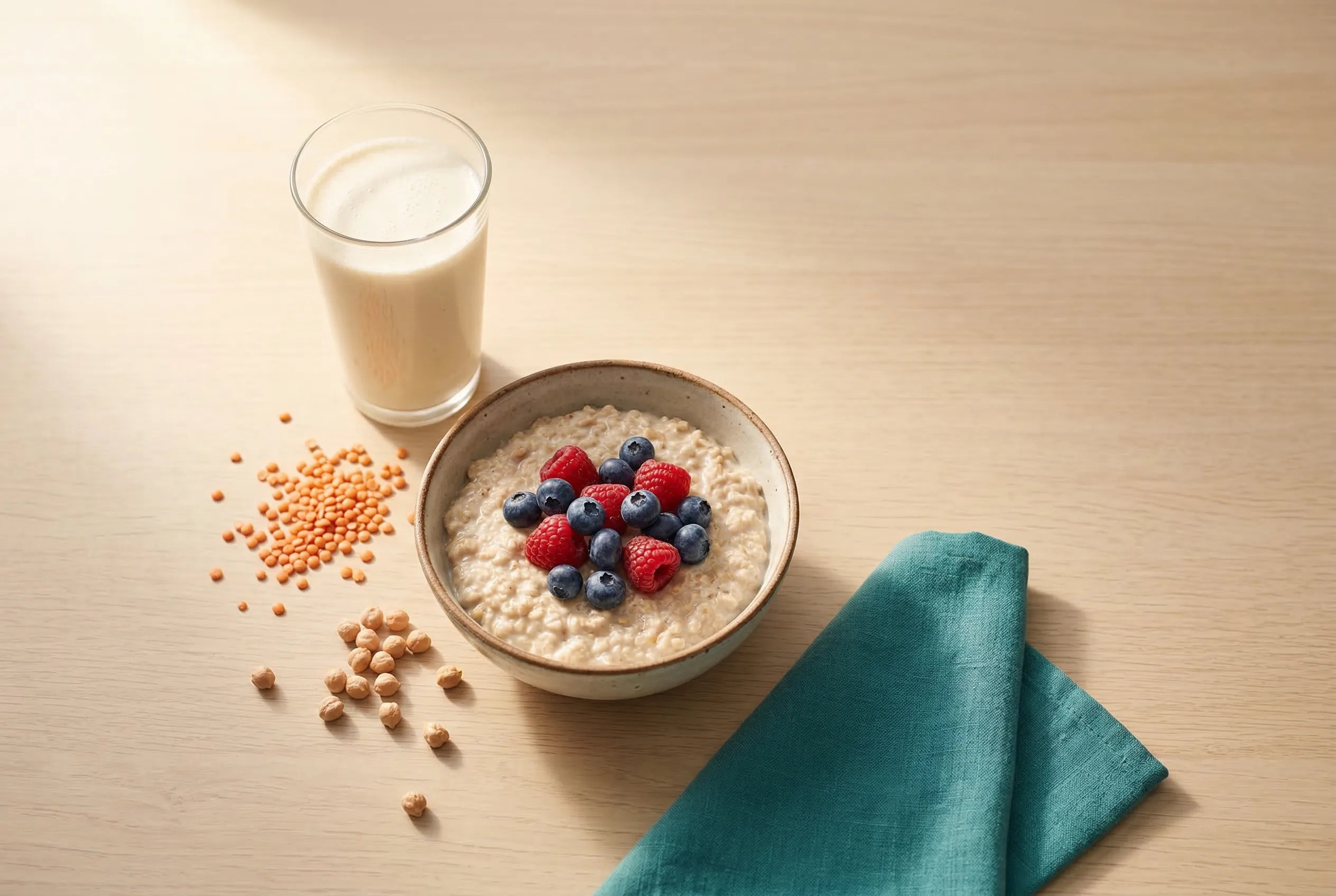
Legumes, oats, whole grain bread, and vegetables form your foundation. One serving of cooked lentils (200 g) delivers 8 to 10 g of fibre. Oatmeal for breakfast: another 4 to 5 g. You're already at 15 g without thinking.
Your protein shake can do more than just deliver protein. If your shake already contains soluble fibre (like the baobab-acacia fibre in SYNTYZE Plant Protein), one serving covers both your protein needs and part of your fibre target. Combined with digestive enzymes, it stays easy on your system.
The most common fibermaxxing mistake: going too fast, too much. If you jump from 15 g to 40 g in a week, you'll risk bloating, cramping, and ironically, constipation. The recommendation: increase by 5 g per week. And drink water. Fibre binds water. Without enough fluid, nothing much happens.
Short on meal prep time? The combination of a protein shake with built-in fibre plus one meal with legumes or whole grains gets you realistically to 25 to 30 g. No fibermaxxing needed. Just a solid foundation.
The Bottom Line
Fibermaxxing has real roots: the fibre gap in Germany is significant, and fibre works synergistically with protein on satiety and gut health. But blindly eating more doesn't help. The type of fibre matters, the combination with protein makes the difference, and increases should be gradual. 30 g a day is the goal, not 60.
Common questions about fibermaxxing
Fibermaxxing describes the deliberate approach of pushing your daily fibre intake well above official recommendations (30 g per day). The trend comes from English-language nutrition communities and spread through the DACH region in 2025/2026. The idea: more fibre for more effective satiety, gut function, and weight management. What makes sense, though, isn't maxing out quantity. It's about the right mix of soluble and insoluble fibre, increased step by step.
The DGE recommends at least 30 g per day. Most Germans hit around 18 to 19 g. So 30 g is a worthwhile, realistic target. Whether 40 or 50 g brings real additional benefits is scientifically unclear. What matters more than the number: variety in fibre sources (legumes, whole grains, vegetables, soluble fibre) and gradual increases.
Yes, especially if you increase too fast. Too much fibre at once can cause bloating, cramping, and ironically, constipation. Adequate water is critical because fibre binds fluids. The recommendation: increase by no more than 5 g per week and pay attention to how you feel. If you already deal with IBS symptoms, be extra careful about fibre type.

Share: