

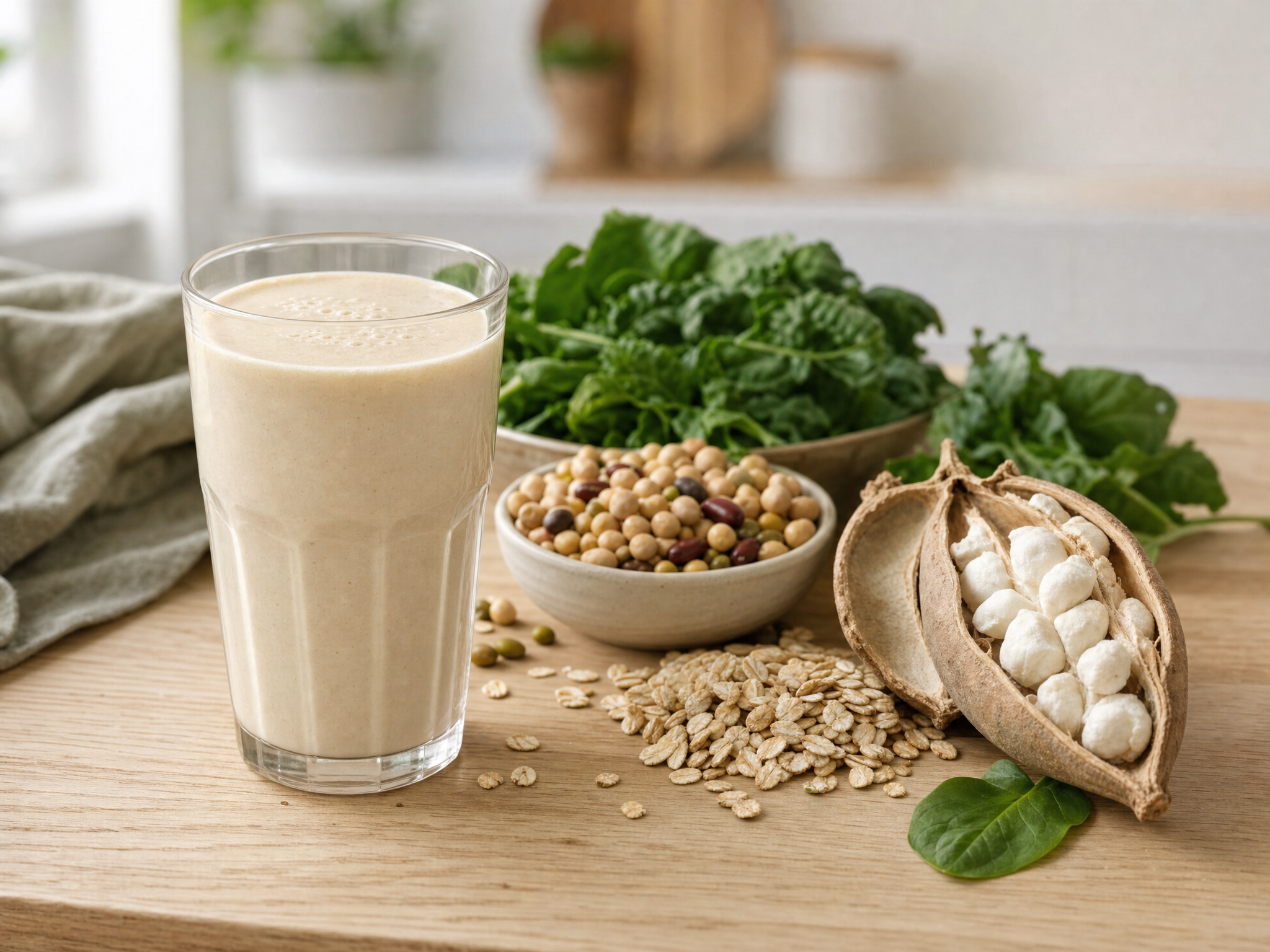
You finished your shake, added quark, lentils, maybe a slice of chicken or a second serving of tofu on top. By evening you are on the couch with a heavy, bloated belly, and a suspicion creeps in: is this from all the protein?
The question turns up in every forum the moment someone pushes their protein intake higher. The answers swing between alarm ("protein putrefies in the gut") and reassurance ("nothing to worry about"). Both camps are partly right and partly wrong, and the reason has less to do with protein itself than with something most high-protein days are simply missing.
What really happens in the colon when a lot of protein arrives, and why a single counterweight changes the whole equation, can be described with surprising precision.
- A share of the protein you eat reaches the colon undigested and is fermented there by bacteria. At very high intakes without fibre, proteolytic by-products such as ammonia and amines rise.1
- For athletes with a normal intake the effects are small. What matters is the substrate balance in the gut, not protein on its own.2
- Fibre shifts the gut flora in measurable ways: a meta-analysis of 64 controlled trials reports more bifidobacteria and higher faecal butyrate values compared with placebo.3
- The type of fibre matters: soluble, well-tolerated sources like baobab and acacia deliver substrate without overloading the gut.
Contents
What does a high protein intake do to your gut?
Most of the protein you eat is broken down to amino acids in the small intestine and absorbed there. What is not taken up, roughly 5 to 10 % on a mixed diet, reaches the colon and is fermented by bacteria. As protein intake climbs, that share grows, and with it the microbial protein fermentation.1
That sounds alarming at first glance, but it is initially just a normal process. Your colon is not a sterile tube. It is a bioreactor housing hundreds of bacterial species that work on whatever slips through from above. Carbohydrates and fibre are their preferred substrate. When they do not get enough of either, they shift onto leftover protein.
This is exactly where the lever sits. Not the absolute amount of protein decides what happens in the gut, but the ratio between protein residues and fermentable carbohydrates. A high-protein day with plenty of vegetables, pulses and whole grains looks completely different in the colon than the same protein load paired with shake, chicken and white rice.
A review on protein fermentation describes that very high-protein diets leave more undigested protein in the colon, where it is broken down to amines, ammonia and sulphur compounds in larger amounts. At moderate intakes with adequate fibre, this effect stays small.1
This is, by the way, one of the reasons some people tolerate plant proteins less well. The mechanisms behind protein-powder bloating are unpacked in detail in our piece on protein-powder bloating. The article you are reading sits a layer below: what the bacteria themselves do with the protein.
Protein fermentation in the colon: when it becomes a problem
Protein fermentation only turns critical when very high, sustained protein intake meets a low fibre intake at the same time. Reviews on animal protein intake describe that proteolytic metabolites such as ammonia, biogenic amines and hydrogen sulphide can rise in the colon under those conditions.1
That is the alarming side. Online it gets shortened to a headline: "too much protein poisons the gut." That reading is wrong, because the evidence paints a more nuanced picture.
Cai et al. reviewed the evidence on high animal protein intake and the gut microbiome. Their core message: very high-protein diets without enough fibre push fermentation toward protein breakdown and raise potentially unfavourable metabolites. In people with a normal protein intake and a high fibre intake at the same time, the measurable effects are small, because fibre and physical activity work as counter-regulators.1
This is the decisive framing. "Lots of protein" is rarely the real risk in a sports context. Someone eating 1.6 to 2.2 g of protein per kg of body weight on an otherwise low-fibre diet does not have a protein problem, they have a fibre problem. Protein is just the more visible part of the equation.
A second review on macronutrients and the microbiome arrives at the same conclusion from the other direction: plant-forward, high-fibre eating patterns promote saccharolytic (sugar-degrading) fermentation, while individual responses vary widely.2 There is no blanket protein threshold past which "the gut tips over." There is a ratio that can be steered.
A review on diet and the microbiome notes that plant-based, fibre-rich patterns promote saccharolytic fermentation, while the individual response varies widely. Not the protein amount on its own, but the balance of substrates shapes the fermentation profile in the colon.2
Why fibre is the real counter-regulation
Fibre shifts the composition of the gut flora in measurable ways. A meta-analysis of 64 controlled trials with more than 2,000 participants found a markedly higher abundance of bifidobacteria and lactobacilli plus higher faecal butyrate values under fibre intervention compared with placebo.3 That is the quantitative basis for everything that follows.
The mechanism behind it is well understood. Soluble, fermentable fibres are the preferred substrate of saccharolytic bacteria. When these bacteria get enough of it, they multiply and produce short-chain fatty acids, butyrate among them. At the same time they compete with the protein-fermenting bacteria for space and resources. More substrate for one side means less room for the other.
This is not a one-off finding. A second meta-analysis, this one focused on RCTs in type 2 diabetes, also found a significantly higher bifidobacteria count and a rise in total short-chain fatty acids under fibre intervention (for butyrate specifically, the effect was not significant in this diabetes population).4 Two independent meta-analyses, two different populations, the same direction.
So et al. analysed 64 randomised controlled trials with roughly 2,099 participants. Fibre intervention led to a significantly higher abundance of Bifidobacterium (standardised mean difference 0.64) and Lactobacillus (0.22) and to higher faecal butyrate concentrations versus placebo. The shift toward saccharolytic bacteria was consistent across the included trials.3
Why is butyrate the recurring keyword here? Short-chain fatty acids form when bacteria ferment fibre. Butyrate is the main energy source of the colonic mucosa. As butyrate production rises, the whole fermentation milieu shifts away from protein breakdown and toward carbohydrate fermentation. That is exactly the counter-regulation Cai et al. point to when they say fibre offsets the protein-induced shift.1
One honest caveat belongs here. Most of these trials measure bacterial abundances and metabolites, not hard endpoints like "fewer symptoms." The jump from "more bifidobacteria" to "you feel better" is plausible but not directly shown in every study. An RCT with 250 adults with functional constipation supplies one of the more practice-relevant findings: stool consistency improved significantly within the fibre groups over four weeks (the direct between-group comparison on the primary endpoint was not significant), accompanied by measurable shifts in the gut flora.5
Two independent meta-analyses, spanning healthy adults and type 2 diabetes populations, consistently report more bifidobacteria and higher short-chain fatty acids under fibre intervention versus placebo.34 An RCT with 250 participants (people with functional constipation) adds a functional endpoint on top: stool consistency improved significantly within the fibre groups across four weeks (the direct between-group comparison on the primary endpoint was not significant).5
How much fibre does this take? A review on fibre mechanisms gives a rough orientation: more than 25 g per day for women and more than 38 g for men. From that level onward, observational studies show the clearest metabolic effects, which are driven mainly by insoluble cereal fibres.6 Average intake in Western diets sits clearly below that. Anyone pushing their protein intake up without changing the fibre side widens exactly the ratio that tips the balance in the colon.
meta-analysis3
bifidobacteria3
day (target)6
How differently fibres behave depends a lot on their type. The point that not amount alone, but also fermentation speed decides tolerability, is something we covered in our article on soluble fibre and fermentation.
How to spot a protein powder that takes the fibre side seriously
The practical takeaway from the research is straightforward. A protein powder that also delivers fibre closes exactly the gap that a high protein intake opens in the colon. Reviews show that substrate balance, not the protein amount on its own, sets the fermentation profile.12 Three criteria are decisive.
Because the substrate balance in the colon shapes the fermentation profile, the fibre source sits alongside protein content as a quality criterion in its own right. Soluble, well-tolerated fibres deliver substrate for saccharolytic bacteria without overloading the gut at higher doses.2
| Criterion | What to look for |
|---|---|
| Fibre content | Is there a meaningful amount of fibre per serving listed on the nutrition panel, or only protein? |
| Type of fibre | Soluble, slowly fermented sources such as baobab and acacia stay well tolerated even at higher amounts. |
| Protein quality | Well-absorbed protein leaves fewer residues behind in the colon. Amino acid profile and tolerability both count. |
A starting point, not a buying guide. Individual tolerability still varies.
The point is not to buy more powder. The point is that a shake delivering protein and soluble fibre in one closes the typical gap of a high-protein day instead of widening it. If you want the deeper case for why fibre belongs in protein powder, it is worth a look at our article on the forgotten ingredient in protein powder.
Frequently Asked Questions
Yes, that is possible. Part of the protein reaches the colon undigested and is fermented there. At high intakes paired with low fibre, this can produce more gas and more proteolytic by-products.1 Protein quality and single ingredients often play a role too. A sufficient fibre intake and a slow ramp-up of the amount tend to help in practice.
A review on fibre mechanisms gives a rough orientation of more than 25 g per day for women and more than 38 g for men. From that level onward, studies show the clearest effects for metabolic and diabetes endpoints, driven mainly by insoluble cereal fibres.6 As a public-health benchmark, the German Nutrition Society recommends at least 30 g per day. Actual average intake in Germany sits well below that.
The research shows that fibre counters the protein-induced shift in the colon and moves the gut flora measurably toward saccharolytic bacteria.13 A protein powder with soluble fibre contains fermentable substrate and thereby delivers protein and fibre in a single product. It does not replace a fibre-rich diet, but it closes a common gap on high-protein days.
The Bottom Line
The honest answer to "is all that protein hard on my gut?" is this: rarely the protein on its own, almost always the missing counterweight. Anyone increasing protein should let the fibre side grow with it, because in the colon it is the ratio that decides, not a single number. Sobering, because there is no simple protein threshold. Freeing, because that lever sits squarely in your own hands. Gut health does not start with the next supplement; it starts with the ratio you put on your plate every day.



Share: