

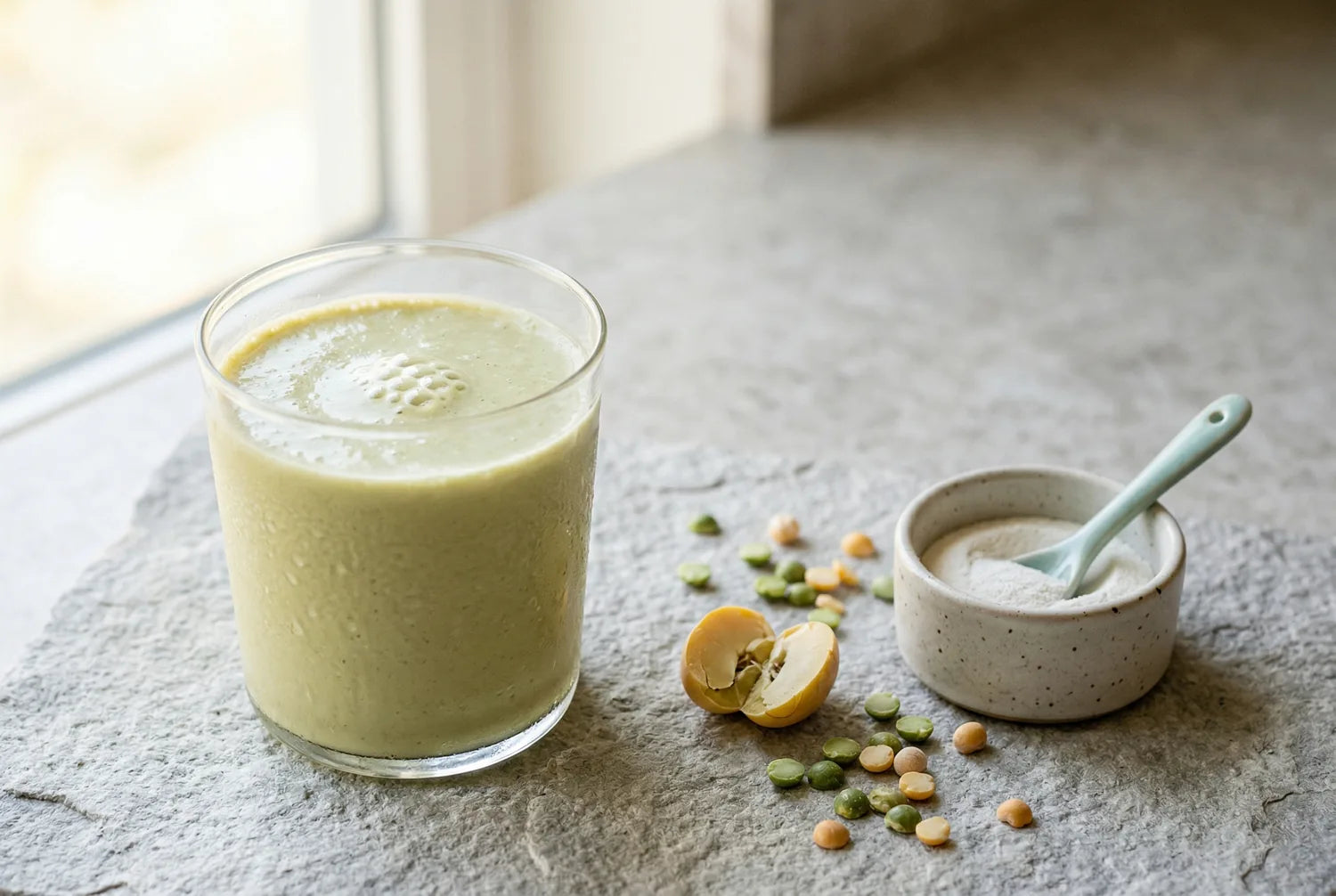
The shake tastes good. The ingredient list looks clean. You drink it after training, same as always. Then, somewhere between changing and the walk home, it starts: a low rumble, pressure in your stomach, sometimes worse.
Most people assume the protein is to blame. In fact, protein is about the least likely culprit. The real mechanism sits deeper, and it has little to do with the protein itself and a lot to do with a handful of accompanying compounds that ride along with the plant-based raw material.
This article walks through the mechanism from start to finish, names the actual cause honestly, and shows which levers genuinely help, including what role the enzymes in your shake play in that, and what role they don't.
Key Takeaways
- Bloating after a protein shake is almost never caused by the protein itself. It comes from certain multiple sugars (raffinose, stachyose) that ride along with plant-based raw materials and ferment in the colon.
- Humans lack the enzyme alpha-galactosidase needed to break these sugars down. They pass into the colon unchanged, where bacteria ferment them, producing gas.
- The biggest lever sits in the raw material itself: these sugars concentrate mainly in cheaper concentrates and flours. Pure protein isolates are washed during processing, which removes most of them. SYNTYZE uses pea and fava bean isolates.
- Practical measures such as smaller portions, enough fluid, and drinking slowly often reduce symptoms noticeably on their own.
- DigeZyme® combines five enzymes (protease, amylase, cellulase, lactase, lipase) that break down protein, carbohydrates and fat and support absorption, a microbial protease significantly increased postprandial amino acid availability from pea protein (p = 0.010) in a crossover RCT.2 It does nothing against the bloating sugars, because it lacks alpha-galactosidase.
Contents
Why does the shake cause bloating – and why not the protein?
Let's start with what protein does not do. Protein is broken down in the stomach and small intestine and absorbed as amino acids, plant-based protein included. In a head-to-head comparison of five non-animal protein sources (pea, lupin, mycoprotein, spirulina, chlorella) against milk as the animal reference, pea protein ranked among the sources with the highest postprandial availability of essential amino acids (van der Heijden et al., 2024).1 So the protein is well utilised. It doesn't sit around as a large mass of undigested material waiting to ferment.
The real trigger is sugar, not peptides. Legumes like pea and fava bean bring along certain multiple sugars, mainly raffinose and stachyose. Humans are missing a single enzyme needed for these sugars: alpha-galactosidase. Without it, the small intestine cannot break them apart. They travel unchanged into the colon, where they become an ideal food source for your gut bacteria. Fermentation produces hydrogen, carbon dioxide, and sometimes methane, which is exactly the rumble that follows.
A second, smaller channel is antinutrients. Raw peas and fava beans contain trypsin inhibitors and phytates that can bind digestive enzymes. Processing (heat, isolation) reduces these factors substantially in finished protein powders. In a ready-made shake, they only play a supporting role.
None of this is an argument against plant protein. It's an argument for knowing the actual cause, because only then do the right levers work.
It isn't the protein that causes bloating, it's the multiple sugars that ride along with the plant-based raw material. Humans lack the alpha-galactosidase needed to break down raffinose and stachyose, so they ferment in the colon instead. If you want to reduce bloating, you need to address these sugars, not the protein.
Van der Heijden et al. tested five non-animal protein sources (pea, lupin, mycoprotein, spirulina, chlorella) plus milk as the animal reference in 22 participants (12 young, 10 older) in a crossover design. Pea protein, spirulina, and mycoprotein delivered the highest postprandial plasma EAA availability (statistically tied with each other); the gap to the lowest source, chlorella, was significant (p < 0.001). The takeaway for us: plant protein, pea in particular, is absorbed well, the protein isn't what causes bloating.1
Pea protein delivered among the highest postprandial EAA availability of five tested plant sources in a head-to-head crossover trial. The protein itself is well utilised, it is not the bloating trigger. (Van der Heijden et al., British Journal of Nutrition, 20241)
Why the purity of the raw material is what matters
If bloating comes from the accompanying sugars, the real question isn't "pea or whey" but "how pure is the raw material". Whey barely contains these multiple sugars, which is why it bloats less often, not because it's inherently "more digestible". With plant protein, almost everything depends on how thoroughly the raw material has been purified.
Concentrate and flour versus isolate. Raffinose and stachyose are water-soluble. Cheaper, less-processed raw materials, protein concentrates and legume flours, still carry a large share of them. Making a protein isolate involves washing and purifying the raw material, which removes most of the soluble sugars and fibre. A purer isolate simply carries less of what causes bloating.
This is exactly where SYNTYZE starts: we use pea and fava bean isolates, never concentrates or flours. Combining the two also closes the amino acid gaps of the individual sources, why that works and how it solves the methionine problem is explained in detail in the linked article.
It can't be pushed all the way to zero. Even pure isolates can retain residual amounts of these sugars, depending on batch and process. "Bloat-free" is therefore a promise no plant protein can honestly make. The fair claim: significantly less bloating potential thanks to a purer raw material, plus a few adjustments you control yourself.
The bloating sugars are water-soluble and concentrate mainly in cheaper concentrates and flours. Purifying a raw material into a protein isolate washes out most of them. A pure raw material is the strongest, and the most honest, lever against bloating, with no overreaching promise attached.
What the enzymes actually help with – and what they don't: DigeZyme
Now to the enzymes, this is where the most common misunderstanding happens. Digestive enzymes like those in DigeZyme® target the macronutrients: protease breaks down protein, amylase breaks down carbohydrates, cellulase breaks down plant cell walls, lipase breaks down fat, lactase breaks down lactose. What they can do is support the digestion, and with it the absorption, of these nutrients.
For protein absorption specifically, this is well documented. A double-blind, placebo-controlled crossover RCT with 24 participants (Paulussen et al., 2024) showed that a microbial protease blend taken alongside 25 g of pea protein significantly increased total plasma amino acids over 5 hours compared with placebo (p = 0.010), with especially strong effects on EAA, BCAA and leucine in the early phase (0–2 h, all p < 0.05).2 A second team found the same effect for whey protein (Huang et al., 2025): plus 14% EAA and plus 15% BCAA in the early phase.3
Paulussen et al. tested a microbial protease blend (P3) alongside 25 g pea protein in 24 healthy adults (27 ± 4 y). Result: total plasma amino acids significantly higher over 0–5 h (p = 0.010); EAA, BCAA and leucine in the 0–2 h window all p < 0.05 vs. placebo. Research group at the University of Illinois, with involvement from the enzyme manufacturer BIO-CAT.2
Huang et al. replicated the design with 25 g whey protein instead of pea. The same protease blend increased EAA by 14% (p = 0.025) and BCAA by 15% (p = 0.021) in the iAUC over 60 minutes. Ghrelin came in 12% lower (p < 0.001). The takeaway: enzymes improve absorption beyond plant protein alone.3
And now the point where a lot of marketing messaging gets it wrong. As good as enzymes are at supporting absorption: they do nothing against the bloating. That comes from raffinose and stachyose, and those would need alpha-galactosidase.
DigeZyme® contains alpha-amylase, protease, cellulase, lactase and lipase, but no alpha-galactosidase. That's exactly the enzyme needed to break down raffinose and stachyose. The enzymes in the shake simply can't touch the bloating sugars. They support nutrient absorption; what actually reduces bloating is the pure raw material, not the enzyme complex.
Differentiation pays off here too. Deutz et al. (2026) tested a 6-enzyme complex alongside a mixed meal in 30 middle-aged and older adults. Leucine reached its plasma peak 20 minutes earlier (p = 0.047), but there was no significant group difference for total amino acids, the benefit depended heavily on the individual.4 Rathi et al. (2024) found significant improvements for only two amino acids in a pilot study (n = 15).5
Fairly assessed: the absorption mechanism is biologically plausible and backed by solid RCTs, though enzyme manufacturers were involved in several of them, which is worth factoring in. The people most likely to benefit tend to be those with larger portions or more sensitive digestion, not automatically everyone.
DigeZyme® contains enzymes (protease, amylase, cellulase, lactase, lipase) that play a role in digesting protein, carbohydrates and fat and support absorption. There are no EFSA-approved health claims for enzyme complexes; the evidence comes from RCTs (some involving the manufacturer). These aren't product promises, and explicitly not a remedy for bloating.
For completeness, the only human RCT specifically on the DigeZyme complex (Majeed et al., 2018): 40 patients with functional dyspepsia received 50 mg DigeZyme three times daily for 60 days, and all five dyspepsia scores improved significantly versus placebo.6 Two caveats: the lead author and co-authors are founders and employees of Sabinsa, the manufacturer of DigeZyme, and dyspepsia patients aren't healthy athletes. Whether this transfers to a normal shake is therefore an open question, no bloating benefit for healthy people can be derived from it.
Microbial protease increased EAA availability from whey protein by 14% (p = 0.025) and BCAA by 15% (p = 0.021, early phase) in a double-blind crossover RCT. Enzymes improve absorption, that's their documented benefit, not a reduction in bloating. (Huang et al., The Journal of Nutrition, 20253)
What you can do yourself: portion, timing, fluids
Bloating after a shake is often a question of practice, not protein quality. If you want to improve how well protein powder digests, you have more control than you might think: a few simple adjustments often do more than any supplement, and they cost nothing. As a rough portion guideline, the widely cited review by Schoenfeld and Aragon (2018) suggests around 0.4 g protein per kg body weight per meal.7 Larger single portions ask your digestive system to handle more at once; smaller ones tend to sit better.
Here are the five most effective adjustments:
1. Portion size. 25–30 g protein per shake instead of 40 g. At 80 kg body weight and 0.4 g/kg, that works out to 32 g. In practice, 25–28 g is enough for most people, and smaller amounts are gentler on the stomach.
2. Fluids. At least 250–300 mL of water per serving. Concentrated shakes with too little liquid slow gastric emptying. More water means a thinner consistency and a quicker passage into the small intestine.
3. Drinking speed. Drink slowly, don't down it in two gulps. Fast drinking swallows air along with it, a bloating factor entirely on its own that has nothing to do with the protein.
4. Easing in. If you're new to plant protein powder, or restarting after a break, begin with half a dose in the first week. Your gut flora needs time to adapt to the new substrate.
5. Temperature. Mix at room temperature or cold, not with boiling liquid. This is more pleasant for most people anyway, and it protects any added enzymes, if you're taking some alongside.
The practical guideline per meal, according to Schoenfeld & Aragon (2018), is roughly 0.4 g/kg body weight. For a 75 kg person, that's about 30 g of protein per shake. Smaller portions are usually the gentler choice for your stomach. (Journal of the International Society of Sports Nutrition, 20187)
One more thing: if you've had noticeably stronger-than-normal bloating every day for weeks, it's worth talking to a doctor, lactose intolerance, irritable bowel syndrome, or an intolerance to certain carbohydrates (FODMAPs) can have their own causes that are only indirectly connected to protein powder.
FAQ: Common questions about protein shakes and digestion
Not because of the protein, but because of certain multiple sugars. Pea and fava bean bring along raffinose and stachyose, sugars that humans lack the enzyme alpha-galactosidase to break down. These sugars reach the colon unchanged and serve there as a direct fermentation substrate for bacteria, producing gas. Whey barely contains these sugars, which is why it bloats less often. It isn't a matter of "worse digestibility" of the protein.
How much of this ends up in the powder depends on the raw material: well-purified isolates have washed out a large share, while cheaper concentrates and flours carry more. Depending on the batch, residual amounts can't be removed entirely.
Not against the actual cause. The bloating comes from the multiple sugars raffinose and stachyose, and those would need the enzyme alpha-galactosidase. That isn't in DigeZyme®, which contains protease, amylase, cellulase, lactase and lipase. The enzymes in the shake support the absorption of protein, carbohydrates and fat (that's their documented benefit, e.g. Paulussen et al., 2024, for amino acid availability from pea protein), but they aren't a remedy for bloating.
There's also no large, direct RCT that measures bloating as a primary endpoint while specifically testing sports-nutrition enzyme complexes in healthy athletes. The best available DigeZyme study was conducted in patients with functional dyspepsia, by researchers with a conflict of interest.
What actually helps against bloating is the pure raw material plus the practical adjustments: smaller portions, enough fluid, drinking slowly, easing in gradually.
Most people report noticeably better tolerance after 2–4 weeks of regular use. An adaptation of the gut flora to the new substrate is considered a plausible explanation: the composition of bacterial strains likely shifts with sustained exposure.
Easing in with half a dose in the first week speeds up this adaptation and meaningfully reduces initial discomfort. If you still have strong symptoms after four weeks at a normal dose, it's worth considering other causes (IBS, FODMAP intolerance).
The role of digestive enzymes in protein powder, and why DigeZyme covers all five enzyme classes, is explained in more mechanistic depth in our longer article on digestive enzymes in protein powder.
The Bottom Line
Bloating after a protein shake is a solvable problem once you know the real cause. It doesn't come from the protein, but from multiple sugars like raffinose and stachyose that ride along with plant-based raw materials and ferment in the colon because humans lack alpha-galactosidase. The strongest lever sits in the raw material: pure isolates carry far less of these sugars than concentrates or flours. Add the simple adjustments, smaller portions, enough fluid, drinking slowly, easing in, and you're most of the way there. The enzymes in the shake support nutrient absorption; they do nothing against the bloating sugars, because they lack the enzyme for the job. Honest, rather than a big marketing promise.

Share: