
The label says "Protein" in big letters. What it doesn't say: how much of that protein is actually essential.
In whey isolate, essential amino acids (EAAs) make up around 58% of the total amino acid profile.3 In pea protein isolate, it's only about 46%.1 That sounds like a minor numbers game. It isn't.
Essential amino acids are exactly the building blocks your body cannot produce on its own – and the ones that drive muscle protein synthesis. If even one is present in insufficient amounts, the entire process slows down. Think of it like an assembly line: one missing part stops everything.
With pea protein, methionine is the classic bottleneck. That's not a manufacturing defect – it's a natural property of nearly all legumes.
This is where it gets interesting: Does fava bean protein solve this problem? Why is the often-cited comparison with rice protein more complicated than most people think? And what role does L-leucine actually play in all of this?
This article delivers the answers – with concrete numbers straight from the primary literature.
Key Takeaways
- Pea protein covers only 46% of the essential amino acid spectrum (Gorissen et al., 2018)1 – methionine is the limiting factor
- Fava bean protein has its own EAA distribution that weights the pea's profile differently – not a perfect complement, but a broader spectrum
- Rice protein closes the methionine gap – but opens a new gap at lysine
- Added L-leucine directly targets mTOR activation without relying on source complementation
- Well-dosed plant protein combinations achieve comparable muscle mass gains to whey in current RCTs – total dose and leucine content matter more than the source2
Contents
Why pea protein falls short as a single source
Pea protein is good – but not optimal as a standalone source. Gorissen et al. (2018) make this clear: 46% of amino acids in pea protein isolate are essential.1 In whey it's 58%.3 The difference comes down to one amino acid: methionine. And methionine is no minor player.
Methionine belongs to the sulfur-containing amino acids. It is a precursor for cysteine and for S-adenosylmethionine, a central methyl group donor in metabolism. In the context of muscle building directly: low methionine availability limits the efficiency with which your body synthesizes new muscle proteins – not because methionine alone flips the switch, but because protein synthesis requires all essential amino acids simultaneously. When one is missing, the process stalls.
That's the physiology. What practice shows is more nuanced:
Gorissen et al. analyzed the amino acid composition of commercially available plant protein isolates. Pea protein contained 46% essential amino acids (EAA) of the total amino acid profile, fava bean protein 42%.1 A crossover study by Kozior et al. measures an EAA share of 58% for whey.3 Methionine was the limiting amino acid in both pea and fava bean. Authors' conclusion: lower EAA content and specific methionine deficiency can limit the anabolic capacity of plant proteins.1
Worth noting. Gorissen et al. only analyzed amino acid profiles, however – they did not measure muscle mass gains. What happens when people actually consume pea protein over weeks is a different question.
Babault et al. (2015) answered exactly that: 161 subjects, 12 weeks of resistance training, daily supplementation with either pea protein or whey. The result? Comparable muscle thickness and strength gains in both groups.2 That sounds like a contradiction of Gorissen. It isn't.
Babault N et al. (J Int Soc Sports Nutr): Randomized controlled trial over 12 weeks of resistance training. The pea protein group (25 g twice daily, 50 g/day) showed comparable bicep muscle thickness and strength gains to the whey group. No statistically significant between-group difference.2
The reason pea protein works in RCTs: at sufficient total doses, bottlenecks in individual amino acids are partially compensated. That doesn't change the fact that a broader source would be more efficient. This is exactly where the question of combination comes in.
Pea protein isolate contains 46% essential amino acids (EAA) of the total profile – compared to 58% in whey. Methionine is the limiting amino acid. At sufficient total doses, 12-week RCTs (n = 161) show comparable muscle mass gains to whey.123
What fava bean protein brings: EAA complementation with real numbers
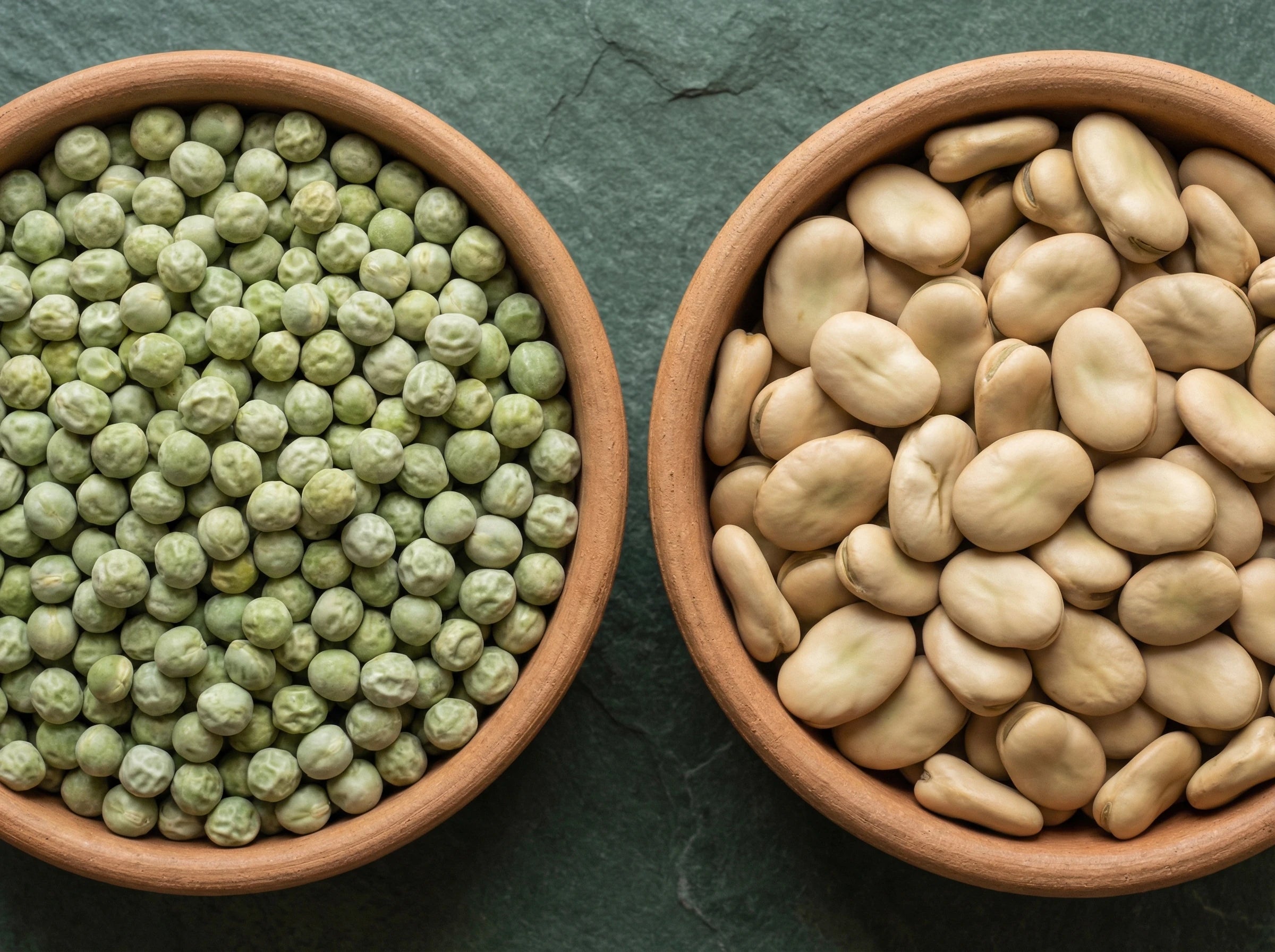
Fava bean protein has an EAA share of 42% – slightly below pea protein.1 If that were the only number, nobody would think to combine the two. But the total EAA share is just one dimension. What matters is how the individual essential amino acids are distributed within that share.
Both legumes are limited in methionine. That's where they're similar. But for threonine, tryptophan, isoleucine, and branched-chain amino acids overall, the ratios differ. The combination of pea and fava bean protein therefore produces a more broadly distributed EAA spectrum than either source can deliver alone.
What this means in practice was examined by a 2023 crossover study – the most direct head-to-head comparison of all three sources to date:
Kozior et al. gave healthy young men equivalent protein doses from whey, pea, and fava bean and measured how much EAA actually appeared in the bloodstream (area under the curve, 0–180 minutes post-ingestion). As a single source, whey exceeded pea by 41% in EAA AUC. Pea protein exceeded fava bean protein by 28%.3
As a single source, pea protein measurably outperformed fava bean protein. So why talk about combining them?
Because the authors themselves point this out: the single-dose measurement shows how an isolated source performs under standardized lab conditions. A protein supplement consumed daily over weeks works differently. Cumulative EAA supply throughout the day, total dose per meal, and amino acid distribution across all protein sources are what determine the outcome. Here, fava bean protein offers a complementary EAA ratio that broadens the spectrum – even if it doesn't close any single bottleneck on its own.
In a crossover study (n = 9, 2023), EAA bioavailability from pea protein was 28% higher than fava bean protein as a single source. The combination of both legumes nonetheless produces a broader essential amino acid spectrum than either source alone.3
Pea protein + rice protein: better – but not the full story
Pea and rice is the established plant protein combination. And there's a real biochemical reason: rice protein is rich in methionine. Exactly where pea protein is weaker, rice compensates.1 In theory, this combination closes the most significant gap in the pea profile.
In theory, it works well. In practice, the question is more complicated.
| Property | Pea Protein | Fava Bean Protein | Rice Protein |
|---|---|---|---|
| EAA share | 46% | 42% | Lower |
| Strongest EAA | Lysine | Lysine, Arginine | Methionine, Cysteine |
| Weakest EAA | Methionine | Methionine | Lysine |
| Combined with pea | Base | Broader EAA spectrum | Closes methionine gap, opens lysine gap |
Sources: Gorissen et al. (2018)1, amino acid profile literature comparison
The catch with rice protein: it's a grain-based protein, not a legume. Where pea protein is strong in lysine, rice is weak. So switching from pea protein to pea + rice trades one bottleneck for another. For most people that's a reasonable trade, since methionine is the anabolic bottleneck – but it's not a free pass.
There's another consideration: rice protein tends to have a lower DIAAS than pea protein isolate. Delivering an equivalent EAA amount requires more grams of rice protein – one more parameter to keep in mind.
The approach that sidesteps this dilemma elegantly is not a different plant combination. It's a third building block.
Pea protein + rice protein closes pea's methionine gap – but opens a new gap at lysine, since rice protein is limited in that essential amino acid. Full complementation requires either three sources or targeted amino acid supplementation.1
Why L-leucine is the missing third building block
About 2.5–3 grams of leucine per meal. That is the reference value discussed in research (age-dependent, not a universal cutoff) at which muscle protein synthesis responds strongly in studies.7 Pea protein contains leucine – but not always enough to reach this reference value in a typical 25–30 g shake.
That's not a problem with the source. It's a dosing problem. And it has a direct solution: supplement leucine.
Leucine is a branched-chain amino acid (BCAA) with a unique role: it directly activates the mTOR signaling pathway. mTOR is the molecular switch for muscle protein synthesis. This makes leucine the amino acid with the strongest anabolic signal per gram – and the key individual parameter when evaluating the effectiveness of any protein source.
Two recent RCTs confirm what this means in practice. Banaszek et al. (2019, pilot study, n=15) compared pea protein and whey over 8 weeks of high-intensity functional training: no significant differences in body composition or performance parameters.5 KGK Science/Roquette (2024) reached the same conclusion after 84 days with sedentary adults.4 In both studies, the formulation was designed so that leucine content was sufficient.
A recent meta-analysis (Nutrition Reviews, 2025) drew on 43 randomized controlled trials comparing plant and animal protein sources (30 of them in the meta-analysis). The conclusion: plant protein overall produced slightly smaller muscle-mass gains than animal protein (SMD -0.20). Soy protein was equivalent to animal protein; non-soy plant proteins (rice, chia, oat, potato) performed worse.6
That is the key point: the bottleneck is usually not the plant. The bottleneck is the dosing and leucine profile.
Research discusses a reference value of about 2.5–3 g of leucine per meal (age-dependent, not a universal cutoff) to strongly drive muscle protein synthesis. Plant protein combinations that fall in this range show comparable muscle mass gains to whey protein in RCTs.45
FAQ: Plant protein combinations
No. Pea protein alone is a valid protein source – multiple RCTs show comparable results to whey. The combination provides access to a broader essential amino acid spectrum, but the more decisive parameter is total dose and leucine content per meal. Anyone who consistently hits their daily protein target and stays within the discussed leucine reference range (about 2.5–3 g) per meal can achieve solid results with a single source as well.
Soybean is the plant protein with the highest EAA content and best DIAAS among legumes. It is methionine-limited like pea and fava bean, but less so overall. Fava bean (Vicia faba) is more commonly grown in European agriculture, has a different processing history, and a slightly different EAA ratio. Soy is nutritionally superior, but avoided by some consumers due to intolerances, GMO concerns, or taste preferences.
Pea and rice is a well-established combination that closes pea's methionine gap. The downside: rice protein is limited in lysine, which opens a new gap. Rice protein also tends to have a lower DIAAS than pea protein isolate. SYNTYZE instead uses pea and fava bean – both legumes with high digestibility – and adds targeted L-leucine to 3 g per serving. This addresses the core anabolic question directly, without lysine compromises.
Current research recommends between 1.6 and 2.2 g of protein per kg of body weight daily for active individuals with muscle-building goals. For an 80 kg person, that means 128–176 g of protein per day. At least as important as total daily intake is distribution: 20–40 g of protein per meal, with sufficient leucine (research discusses a reference value of about 2.5–3 g per meal, age-dependent), strongly drives muscle protein synthesis at each meal. Eating protein only twice a day leaves growth potential on the table.
The research says: yes, if the protein powder is well formulated. Babault et al. (2015, n = 161) and a 2024 RCT (84 days) found no significant differences in muscle performance between pea protein and whey at equivalent doses. A meta-analysis (Nutrition Reviews, 2025) confirms that the difference in muscle mass was small and substantially dependent on formulation quality. The bottleneck is rarely the plant source itself – it's the dosing and leucine content.
Bottom Line
Pea protein is a solid single source – but a broader EAA profile and a sufficiently high leucine content per serving make the difference between a protein powder that works and one that works optimally. The combination of pea, fava bean, and added L-leucine addresses these parameters directly. What the source delivers matters less than the overall formulation – that's what the current evidence makes clear.

Share: