
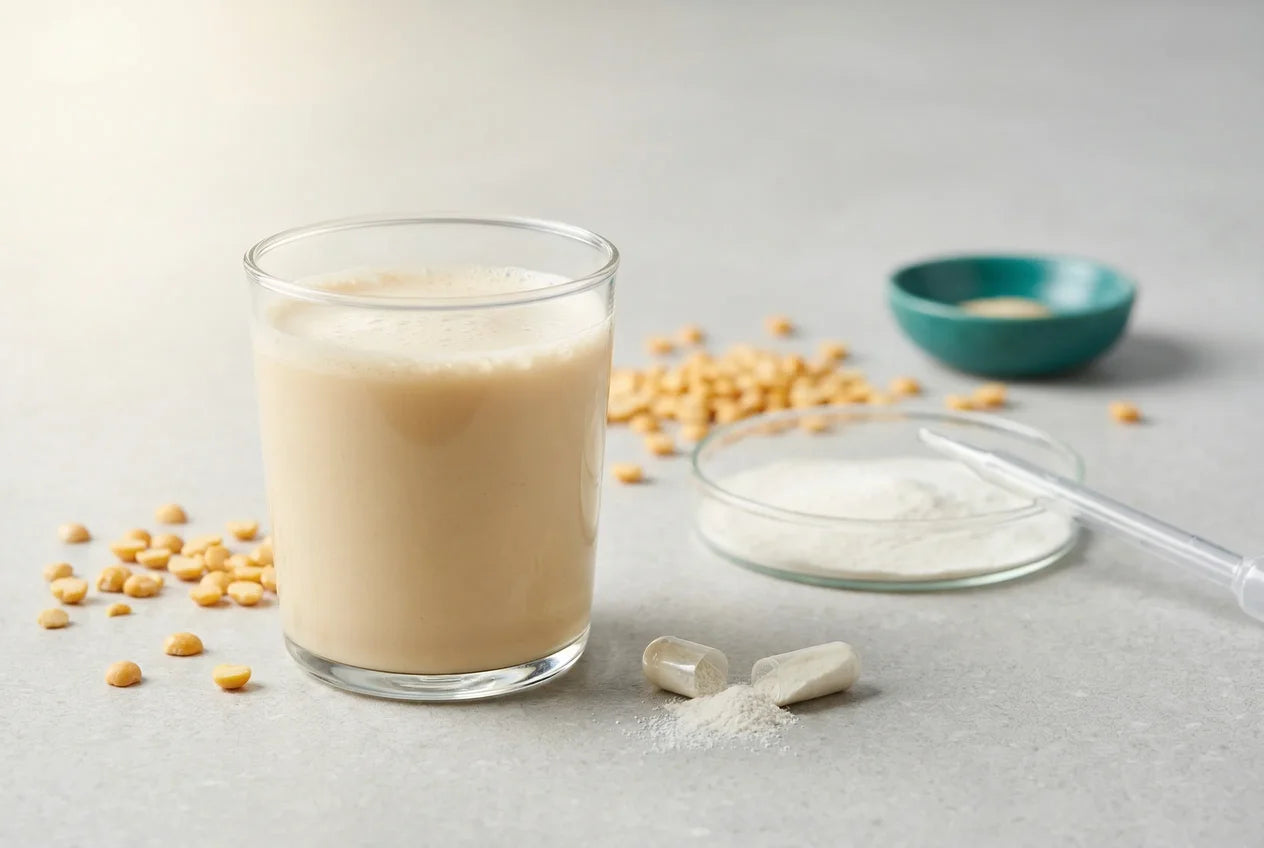
24 grams of protein. That's what the label on your protein powder says. But how much of that actually ends up in your bloodstream? Most people never ask themselves this question – and that's exactly where the first mistake lies.
Protein digestion isn't linear. It's a complex system where your stomach does the groundwork with acid, your small intestine cleans up with a range of enzymes, and antinutritive factors from plants can slow the entire process down. That's true for animal proteins too, but it's more pronounced with plant-based sources.
Exogenous digestive enzymes were developed to tackle exactly this problem. But do they actually work? Or are they just another supplement trend without solid evidence behind it?
- Plant proteins are slowed by antinutritive factors (phytates, tannins, trypsin inhibitors) – bioavailability typically sits 5–15 % below whey.
- DigeZyme is an enzyme complex of amylase, protease, lactase, lipase, and cellulase, clinically tested in multiple RCTs for tolerability and improved breakdown.
- A 2024 RCT (Paulussen et al.) shows a microbial protease blend significantly raises total plasma amino acids in the first two hours after pea protein, versus placebo.
- EFSA status: enzyme complexes have no approved health claim. Permitted phrasing: "contains enzymes that play a role in digestion".
- Practice: enzymes built into the powder work on the go, no timing trick required. They speed up absorption – bloating itself comes from accompanying oligosaccharides, not the protein, so pure isolates and smaller portions are the better lever there.
The Digestion Process: Overview and Function
Your body breaks down protein in several stages. In the stomach, hydrochloric acid denatures the protein and pepsin tears apart the first bonds. In the small intestine, the pancreatic enzymes trypsin and chymotrypsin take over the fine work, cutting peptide chains piece by piece until only individual amino acids remain, which then move into your bloodstream.1
How well this works depends on several factors: protein source, protein structure, and your individual enzyme capacity. And then there are the antinutritive factors.
The Factors That Slow Down Plant Proteins Are Diverse
Legumes come with their own natural protective compounds. Trypsin inhibitors, phytic acid, tannins – these so-called antinutritive factors aren't a flaw in the product, they're the plant's own defence mechanisms.
The problem: they block or slow enzymatic breakdown. In 2012, Gilani and colleagues analysed dozens of studies on the topic and reached a clear conclusion: trypsin inhibitors from soy and other legumes can reduce protein digestibility by up to 50 percent. Phytic acid alone can lower digestibility by around 10 percent.2
That sounds bad. But there's a strong counterpoint.
Guillin et al. tested pea protein isolate against casein and measured real ileal amino acid digestibility. The result was surprising if you were expecting Gilani's numbers: pea protein reached 93.6 %, casein 96.8 %. The difference wasn't statistically significant (P = 0.22). For comparison, the DIAAS score for pea protein came out at 1.00 – meaning it covers your entire amino acid requirement.3
Modern processing makes the difference: heating, fermenting, isolating – these steps massively reduce residual antinutritive content.
So the answer is: yes, plant proteins are more digestible than earlier data suggested. But the gap is real. It's just smaller than long assumed. Which raises the practical question: can that gap be closed further still? We looked at how biological value amplifies these discrepancies in our deep dive on biological value.
Exogenous enzymes act precisely here: protease cleaves peptide bonds, cellulase breaks down plant cell walls, lactase and lipase cover additional substrates – all before antinutritive factors can make life harder for the body's own pancreatic enzymes. What that means in practice for amino acid availability is what the three clinical studies below put into context.
The Core Approach: What Enzymes Can Do
The logic is deceptively simple: if plant proteins break down too slowly and your body needs more time to get amino acids into your blood, could external enzymes reduce that bottleneck?
Exogenous enzyme complexes don't replace your own digestion. They speed it up exactly where plant proteins and residual antinutritive factors slow it down.
Three clinical studies have looked at this approach. The designs differ, but the results line up.
Paulussen et al. set out to test whether a microbial protease blend actually speeds up absorption. They gave 24 healthy adults 25 g of pea protein isolate – once with an enzyme blend, once with placebo, double-blind and in a crossover design. The outcome measure was plasma amino acid concentration over the first few hours. With enzymes: significantly higher values in the first two hours. Without: a slower rise.4
What Paulussen and team found wasn't marginal: the enzyme blend produced higher total plasma amino acids in the first two hours (0-2h iAUC, all p<0.05) versus placebo. That could matter for muscle protein synthesis, particularly in the critical 2–3 hours after training when the synthesis rate is elevated. The availability of leucine in that window matters.
Minevich et al. ran a more direct comparison: whey protein versus a pea-rice blend (70:30), each with and without enzyme support. Without enzymes, whey was significantly ahead on peak amino acid values (EAA Cmax: 2,261 vs. 1,797, P = 0.01). With the enzyme blend, that significant difference disappeared entirely (1,881 vs. 2,261, P = 0.07).5
The pattern running through all three: enzymes don't change the total amount of digestible protein. They shorten how long digestion takes.
Pea Protein Isolate
Higher amino acid availability in the first 2h with enzymes
Whey vs. Plant + Enzyme
There's also evidence for symptomatic effects, if digestion itself is your personal problem.
Majeed et al. tested DigeZyme, a multi-enzyme complex with five different enzymes, over 60 days in patients with functional dyspepsia. The treatment group showed significant improvements in symptom scores – bloating, upper abdominal pain, gas, and heartburn – compared with placebo.6
Important context: the Majeed study comes from DigeZyme's own manufacturer. That doesn't invalidate the data, but it is a conflict of interest, and independent replication is still pending. There's also a transferability gap: dyspepsia patients aren't healthy athletes, and their symptoms aren't the oligosaccharide problem behind bloating after a plant-based shake. So this study doesn't support "DigeZyme against post-shake bloating" as a claim.
Five Enzymes, Five Purposes
A multi-enzyme complex isn't an arbitrary mix. Each enzyme has a specific function, and together they cover a range of substrates.
Breaks down proteins into amino acids. The key enzyme for all protein-containing meals.
Breaks down starch. Relevant since plant proteins often contain starch.
Breaks down fats in digestion. Becomes active whenever a shake contains oil or plant-based milk.
Breaks down plant cell walls. Releases nutrients trapped inside.
Breaks down lactose. Becomes relevant if you make your shake with milk.
Dosage and Timing: What Matters With Enzymes
If you do go for an enzyme complex, a few concrete details make the difference.
A single enzyme only addresses a small part of the digestion problem. Plant-based protein sources contain not just protein, but also starch, fats, and fibre, all of which affect digestion together. Only a multi-enzyme complex covers multiple substrates and addresses the whole system.
External enzymes only work if they reach your intestines at the same time as the substrate. If you took an isolated enzyme after already drinking your shake, it would be too late. The enzyme needs to already be in the powder, or taken immediately with the shake, to be active in the critical first two hours – the decisive window for your plasma amino acid availability.
Enzymes aren't a cure-all that turns a low-quality protein into a good one. What they do: they speed up absorption from an already high-quality protein isolate. That's useful, but it isn't a change to the fundamentals.
Enzymes aren't a universal must-have, but three groups benefit disproportionately: people with sluggish, slow digestion after plant-based protein, older adults with declining pancreatic enzyme output, and anyone drinking multi-source plant proteins with a high fibre content. Enzymes don't touch bloating itself – that comes from accompanying oligosaccharides, and pure isolates plus smaller portions are the better counter there. With pure whey, the added benefit is marginal.
Are Enzymes Necessary for Everyone?
Your body already produces large amounts of digestive enzymes on its own. In healthy people without pancreatic insufficiency or chronic digestive disorders, your own enzyme production is more than enough in most cases.
The evidence for enzyme supplementation in healthy adults is therefore less compelling than in patients with digestive complaints. The Paulussen study shows measurable effects on absorption kinetics, but whether that translates into better long-term training results or health outcomes hasn't been sufficiently studied yet.
Enzymes aren't a must for everyone. But if you regularly drink plant-based protein and want to speed up absorption or ease sluggish digestion, there are scientifically plausible reasons why a multi-enzyme complex could help. Bloating itself, however, comes down to the accompanying sugars raffinose and stachyose, which the body can't break down without alpha-galactosidase and which ferment in the colon instead – pure isolates and practical habits do more for that than any enzyme (more in our piece on the mechanism behind bloating after a shake). The type of fibre and its fermentation speed in the colon also play a role in tolerability.
Digestive enzymes only do their job if they reach your gastrointestinal tract at the same time as the substrate (protein, starch, fat). In practice, that means right before or with a meal, not after. With a protein shake that already has DigeZyme built in, this happens automatically, since the enzymes are consumed together with the powder.
With pancreatic insufficiency (a pathological enzyme deficiency), substrates reach the colon undigested, leading to abdominal pain, fatty stools, and reduced nutrient uptake – that's a medical condition. In healthy adults, your own production is usually enough. Factors like age, very large protein meals, or residual antinutritive factors in plant sources can occasionally exceed your enzyme capacity, which slows down substrate breakdown. Bloating is a separate issue: it comes from accompanying oligosaccharides, not from incompletely broken-down protein.
Conclusion: Digestive Enzymes as a Solution for Plant Protein
Pea protein isolates are more digestible than most people think: 93.6 % ileal digestibility, DIAAS score 1.00 (full coverage of your amino acid needs). That's fully digestible. Absorption speed, however, can be an issue, especially once residual antinutritive factors come into play.
Exogenous digestive enzymes address exactly this bottleneck. Research shows they can measurably speed up plasma amino acid availability in the critical first few hours.4 And they can narrow the quality gap between animal and plant protein.5
Whether you need them depends on your situation. No digestive issues and no complaints with plant-based protein? Your body handles it on its own. You like plant-based protein, but your stomach doesn't? Then there's a scientifically grounded alternative. And if you're also sensitive to sweeteners, naturally sweetened formulas give you another lever to pull.
The Bottom Line
Plant proteins are considerably more digestible than their reputation suggests: 93.6 % ileal digestibility, DIAAS 1.00. The real problem isn't overall digestibility, it's speed. Studies suggest that exogenous digestive enzymes, specifically multi-enzyme complexes, can speed up amino acid availability and narrow the speed gap to animal protein. Not necessary for everyone, but a scientifically grounded option if you struggle with digestion.
References
- Piper, D.W. & Fenton, B.H. (1965). pH stability and activity curves of pepsin with special reference to their clinical importance. Gut, 6(5), 506-508. doi:10.1136/gut.6.5.506
- Gilani, G.S., Xiao, C.W. & Cockell, K.A. (2012). Impact of antinutritional factors in food proteins on the digestibility of protein and the bioavailability of amino acids and on protein quality. British Journal of Nutrition, 108(S2), S315-S332. doi:10.1017/S0007114512002371
- Guillin, F.M. et al. (2022). Real ileal amino acid digestibility of pea protein compared to casein in healthy humans: a randomized trial. The American Journal of Clinical Nutrition, 115(2), 353-363. doi:10.1093/ajcn/nqab354
- Paulussen, K.J.M. et al. (2024). Acute microbial protease supplementation increases net postprandial plasma amino acid concentrations after pea protein ingestion in healthy adults: a randomized, double-blind, placebo-controlled trial. The Journal of Nutrition, 154(5), 1549-1560. doi:10.1016/j.tjnut.2024.03.009
- Minevich, J. et al. (2015). Digestive enzymes reduce quality differences between plant and animal proteins: a double-blind crossover study. Journal of the International Society of Sports Nutrition, 12(Suppl 1), P26. [Conference Abstract] doi:10.1186/1550-2783-12-S1-P26
- Majeed, M. et al. (2018). Evaluation of the safety and efficacy of a multienzyme complex in patients with functional dyspepsia: a randomized, double-blind, placebo-controlled study. Journal of Medicinal Food, 21(11), 1120-1128. doi:10.1089/jmf.2017.4172


Share: