
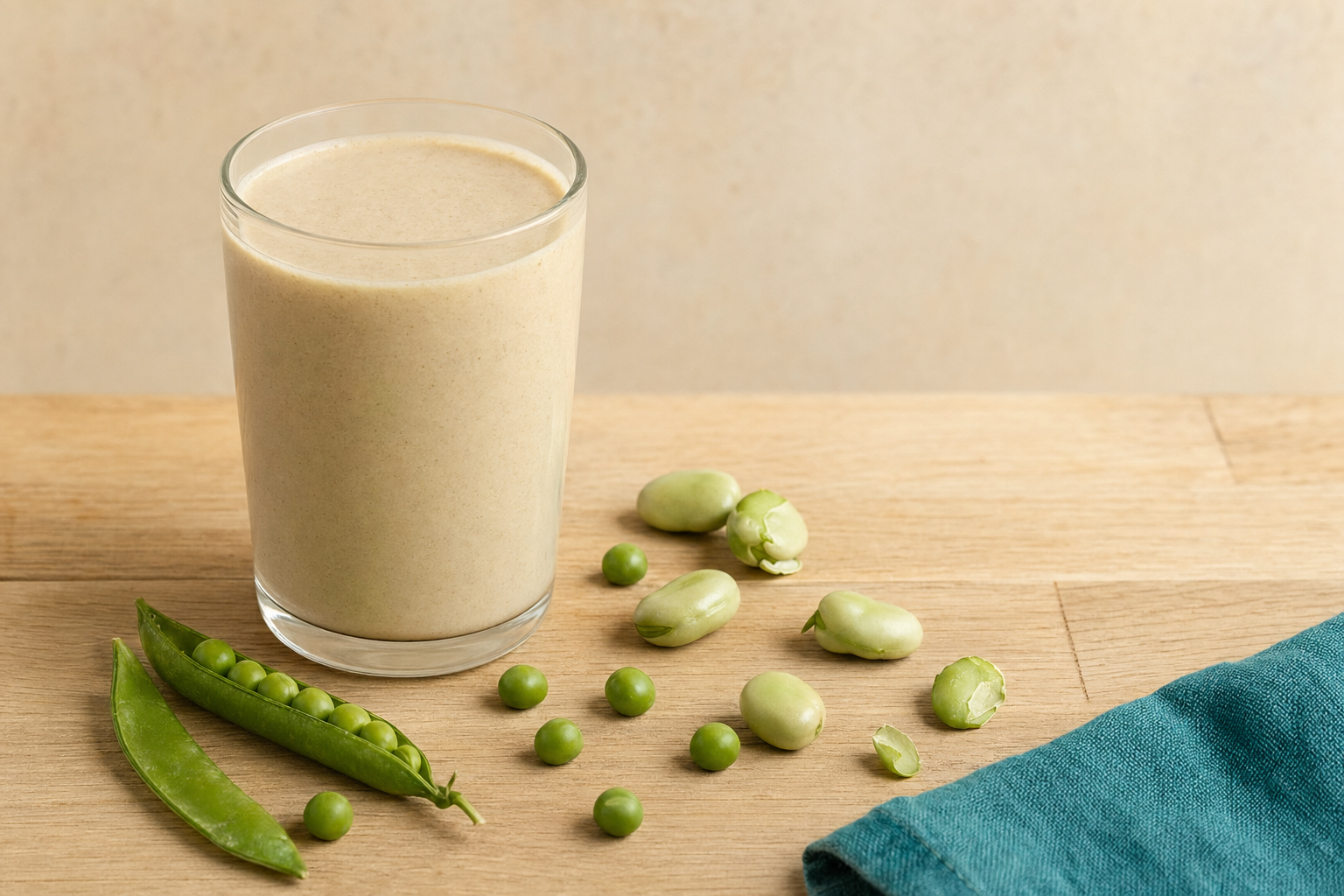
Anyone who has switched to vegan protein powder knows the small list of side effects: a dull pressure in the stomach after the shake, more bloating than usual, sometimes the feeling that the 24 g of protein got lost somewhere between the glass and the muscle.
On many labels, a second term now sits next to pea and fava bean protein: digestive enzymes. Sometimes branded as DigeZyme, sometimes just listed as a mix of protease, amylase, and lipase. The idea behind it is straightforward. Whatever your digestion cannot finish on its own, an added enzyme picks up.
Does that actually do anything, or is it marketing dressed in Latin? This article walks through what really happens when you digest plant protein, what enzymes in the powder can and cannot do, what the current research supports, and what to look for when you want to combine the two.
Key Takeaways
- Plant protein scores lower than milk protein on the DIAAS quality score (milk protein concentrate DIAAS 1.18, Rutherfurd 2015, growing rats; pea sits lower, how much depends on reference pattern and method). The score is capped by the limiting amino acid (methionine in pea) – it is a quality measure, not a tolerance measure. Real ileal digestibility of pea isolate is high.4
- That post-shake pressure feeling almost never comes from the protein. It comes from accompanying multiple sugars (raffinose, stachyose) that humans cannot split, lacking α-galactosidase, so they ferment in the colon instead.
- DigeZyme® is a 5-enzyme complex (amylase, protease, cellulase, lactase, lipase). It carries no EFSA health claim, but it is permitted as a food ingredient and is well characterised.
- A crossover human trial shows that a targeted exopeptidase complex can accelerate the enzymatic breakdown of hard-to-digest peptides (Mourabit 2024, in a coeliac context) – a proof of principle for enzyme action, not evidence for the absorption of plant protein.5
- When you buy, three things matter: declared enzyme dose, a sensible combination (protease is mandatory), and a transparent leucine value per serving.
Contents
What actually happens when you digest plant protein?
Plant protein travels the same route as animal protein: stomach, small intestine, colon. It is absorbed well, just a little slower, and with a tighter limiting amino acid. But the feeling in your gut after a shake does not come from the protein. It comes from specific multiple sugars that ride along with legumes: raffinose and stachyose. Humans lack the enzyme α-galactosidase to split them, so they pass into the colon undigested, where bacteria ferment them and gas is the by-product.
The DIAAS system (Digestible Indispensable Amino Acid Score) measures protein quality, weighted by the limiting amino acid. In a comparison study in growing rats, milk protein concentrate reached a DIAAS of 1.18; plant sources such as pea sit lower, how much depends heavily on reference pattern and method. Crucially, the lower score comes from the tight limiting amino acid (methionine in pea), not from poor overall digestibility; the real ileal digestibility of pea isolate is considerably higher. DIAAS is therefore a quality measure, not a tolerance measure.4
That gap does not mean plant protein is "inferior." Mainly, it means the limiting amino acid (methionine) is in shorter supply, and part of the amino acids reach the muscle a little later. That is a question of quality and absorption speed, not the cause of bloating. Animal protein scores higher on DIAAS simply because its amino acid profile is more complete.
In a powder, those barriers are reduced (isolation and hydrolysis have already broken some cell walls open), but they are not gone. Anti-nutritional factors like trypsin inhibitors and phytates blunt some of the body's own proteases. The result: even a high-quality plant powder cannot quite match whey on absorption speed and amino acid profile.
Gorissen et al. analysed the amino acid profile of ten plant protein sources (out of 35 commercial protein samples) and compared them with animal proteins and human skeletal muscle. On average, plant isolates contained only 1.0 ± 0.3 % methionine versus 2.5 ± 0.1 % in animal sources, and 3.6 ± 0.6 % lysine versus 7.0 ± 0.6 %. Leucine varied widely: 5.1 % (hemp) to 13.5 % (corn).1
Plant protein, then, is not "worse," but structurally different. Combining pea and fava bean protein gives you a more robust amino acid profile than pea protein on its own. A small residual fraction of protein that is not absorbed in time does carry on into the colon, but it is a side note for bloating, which comes from the accompanying sugars. What matters more is absorption speed: how fast and efficiently the amino acids reach your bloodstream.
And that is exactly where digestive enzymes come in.
Why plant protein in particular benefits from enzymes.
If you want to hit 1.6 g of protein per kilogram of body weight on a plant-based diet, you often need to eat 25 to 30 percent more raw protein than someone on a mixed diet, simply because part of it never reaches your bloodstream. Digestive enzymes target exactly that gap: protease cleaves protein chains into shorter peptides and free amino acids, starting in the stomach and the upper small intestine. That fits a recent observation from Trommelen et al.: larger protein doses extend the anabolic window to over twelve hours3 – an effect that depends on the amino acids actually being absorbed. With plant protein's tighter amino acid profile and somewhat slower absorption,4 efficient hydrolysis is therefore especially relevant.
In their review in the Journal of Nutrition, van Vliet et al. list four strategies for offsetting the lower anabolic response to plant protein: fortification with limiting amino acids (methionine, lysine, leucine), breeding improved cultivars, higher absolute doses, and combining multiple sources. Digestive enzyme supplementation adds a pragmatic fifth lever to that list.2
The point is not that human digestion fails without help. It does not fail. But on plant protein, it works at a worse ratio: more substrate, harder to access, in the same time window. An added protease shifts that balance.
One thing many people miss: enzymes in your shake do not only help the protein. They help the protein in context. If you mix your powder with oat milk or cow's milk, you are combining protein, starch, and fat. Amylase, protease, and lipase cover all three substrates. Lactase becomes relevant when cow's milk is involved, and you happen to be sensitive to lactose.
The other side of that coin: enzymes are not magic. They do not replace a sensible amino acid profile, and they do not replace an adequate daily total. They also do not have a meaningful downside, though. The doses are small, the metabolic pathway is physiological, and controlled safety data exist.
Mourabit et al. ran a crossover study in healthy participants to test whether an exopeptidase complex accelerates the breakdown of an isotopically labelled, hard-to-digest gluten peptide (the 33-mer); the backdrop is coeliac enzyme therapy. With the enzymes added, peak plasma concentration of the labelled amino acids derived from that gluten peptide rose by a factor of 2.8 in the presence of wheat gluten. The number therefore refers to gluten-derived amino acids, not to plant or pea protein.5
The study is not proof for DigeZyme in a protein shake, nor for the absorption of plant protein. It used a different enzyme mix and studied gluten peptides in a coeliac context. But it shows the principle: a purpose-built exopeptidase complex can measurably accelerate the enzymatic breakdown of hard-to-digest peptides in vivo. Whether that translates into a practically relevant efficiency gain for plant protein is not shown here, only made plausible.
DigeZyme evidence check: what the studies actually show.
DigeZyme® is a standardised multi-enzyme complex made up of five enzymes: alpha-amylase (starch), neutral protease (protein), cellulase (plant cell walls), lipase (fats), and lactase (milk sugar). It is produced by fermentation and marketed by Sabinsa as an ingredient for functional foods and supplements. One thing matters up front: the brand name alone says nothing about efficacy. The question is what the five enzymes actually do in your shake.
Start with the regulatory reality: DigeZyme carries no approved EFSA health claim. Marketing statements like "improves digestion" or "reduces bloating" are not permitted in the EU. What is allowed is the sober description: "contains digestive enzymes that play a role in digestion." That is the ceiling.
This also matches the biochemistry: the complex contains no α-galactosidase, exactly the enzyme that would split the bloat-causing multiple sugars raffinose and stachyose. What actually helps against bloating, then, is not the enzymes, but pure isolates (which largely wash out those sugars) plus a handful of practical adjustments: smaller servings, enough fluid, drinking slowly, easing in gradually. The enzymes in the shake work at a different point: absorption.
What manufacturers are allowed to do is declare enzyme activity precisely (for example in DU for Diastase Units or HUT for Haemoglobin Units of Tyrosine). On most powders, those numbers are simply missing, which is a clue that the enzyme dose is largely symbolic in some products.
The body of research on DigeZyme in a protein context is modest. There are individual manufacturer-sponsored studies showing things like increased nitrogen retention after protein meals or subjective improvement in gastrointestinal symptoms. They carry the usual sponsorship bias, but they are not methodologically broken. They are also not a substitute for independent replication.
What broader enzyme research does support:
| Enzyme | Substrate | Relevance in a protein shake |
|---|---|---|
| Protease | Protein chains | High — speeds up hydrolysis, blunts trypsin-inhibitor effects |
| Cellulase | Plant cell walls | Medium — useful when protein is not fully isolated |
| Amylase | Starch | Low in a plain shake, higher with oats or banana |
| Lipase | Fats | Low in plant powder on its own, higher with whole milk |
| Lactase | Lactose | Only relevant with cow's milk and lactose intolerance |
Our own assessment based on substrate specificity and a typical shake composition.
The actual workhorse in the plant protein context is the protease. The other four enzymes make the blend more broadly useful (breakfast shake, oats, milk), but they are not the central reason for pairing digestive enzymes with plant protein.
An honest read: human studies on exopeptidase complexes show that a well-matched enzyme combination can accelerate the enzymatic breakdown of hard-to-digest peptides in vivo. The most recent, methodologically clean example (Mourabit 2024) comes from coeliac enzyme therapy, though, and concerns gluten peptides, not plant protein.5 Whether the DigeZyme dose in a typical protein powder (often in the 50 to 150 mg range per serving) is enough to make that effect clinically noticeable is not directly proven. Plausible, yes. Dose-dependent, yes. Guaranteed, no.
How to spot a sensible protein-and-enzyme combination.
The decision rule is shorter than the marketing copy on the bag suggests. Three points are enough to separate symbolism from real formulation.
First: the amino acid profile is on the label. Leucine, at minimum, should be listed per serving, ideally within the reference range of about 2.5–3 g that research discusses (age-dependent, not a universal cut-off), where muscle protein synthesis responds strongly in studies. A complete published amino acid profile is an extra trust signal. Without a leucine number, the assessment turns into guesswork.
Second: the enzyme complex is standardised and named. Instead of a vague "enzyme blend," the ingredient list shows a clearly defined complex. DigeZyme®, with its five fixed enzymes, is the typical representative in the DACH market. A milligram dose or activity unit (DU, HUT, FCC) helps as well. "Digestive enzymes" with no complex name and no quantity is smoke, not proof.
Third: protease is non-negotiable. For a pure protein powder, you do not need all five enzymes. A complex without protease delivers little, and a protease-only complex gives you the most efficiency per gram. Multi-enzyme complexes like DigeZyme make sense when the powder also goes into a breakfast shake or with milk, which is the more common reality.
What else helps has nothing to do with enzymes, but it is practical: mix your powder with water or plant milk rather than cow's milk if your stomach reacts sensitively. Do not drink the shake ice-cold, since enzymes work more efficiently at body temperature and cold liquid slows gastric emptying. And if you have had daily symptoms after every shake for weeks, it is worth talking to a doctor. Irritable bowel, lactose intolerance, and fructose intolerance can have causes of their own that no different powder will fix.
Once powder, amino acid profile, and enzyme complex are all transparent, the shortlist is small. Only a handful of manufacturers in the DACH market check all three boxes. Our SYNTYZE Plant Protein combines pea and fava bean protein with the DigeZyme® enzyme complex and publishes the full amino acid profile per serving. If you want to dig into the biochemistry, the details are in our pieces on digestive enzymes in protein powder and the mechanism behind post-shake bloating. The background on the pea-and-fava-bean combination rounds out the picture.
FAQ
Digestive enzymes are protein molecules that break other nutrients into smaller fragments. In protein powder, the focus is mostly on proteases, which split protein chains into peptides and free amino acids. That is the same job your stomach and small intestine already do, just earlier in the process and somewhat more robust against inhibitors like trypsin inhibitors.
Multi-enzyme complexes like DigeZyme® also include amylase (starch), cellulase (plant cell walls), lipase (fats), and lactase (milk sugar). Those are particularly useful when the shake is mixed with oats, banana, plant milk, or cow's milk.
Three groups are most likely to see practical benefit: people with a sensitive gut, athletes with high protein demands (from 1.6 g/kg, where better efficiency per serving becomes practically useful), and people who rely mostly on plant protein sources and already take in a lot of anti-nutritional factors.
People who do fine on classic whey and cover their protein from food are unlikely to notice much. And even with a plant powder, if you do not hit your daily total, the best enzyme will not do much.
For a normal protein shake with plant milk, a well-dosed multi-enzyme complex is enough. DigeZyme® with 5 enzymes covers the typical substrates. A separate enzyme capsule is usually unnecessary as long as the shake is not replacing your main meal.
Extra enzymes only make sense in specific cases: diagnosed pancreatic insufficiency (which belongs in medical hands), very large, fat-rich meals taken alongside the shake, or documented lactose or fructose intolerance with a clear substrate match. In every other case, sort out the daily total first, then the amino acid profile, then look at additional supplements.
The Bottom Line
Vegan protein and digestive enzymes are not a marketing invention, but they are not a miracle mix either. The combination earns its place where plant protein's amino acid profile is the limiting factor, not raw digestibility, and it becomes useful when the enzyme dose is sufficient and the amino acid profile stays transparent. Get both right, and you have the two levers that make a plant-based shake noticeably better in everyday use.

Share: