
Tubs labelled "vegan collagen" are piling up on the supplement shelf, and the pitch sounds reassuringly simple: plant-based, cruelty-free and still something for firmer skin. That exact combination is selling brilliantly right now, especially to people who want collagen but would rather not take an animal product.
There is just one catch the labels tend to gloss over. Collagen is an animal protein. It occurs in no plant, and no pea, rice or soy protein on earth contains a single molecule of it. "Vegan collagen", then, is not collagen at all, but something else with a clever name.
What is really in those tubs, what the research on collagen and skin actually supports, and how your body makes its own collagen anyway: we will sort that out with studies rather than marketing. By the end you will know whether "vegan collagen" earns its price, or whether your protein powder is the more honest answer.
- Real collagen is always animal-derived. "Vegan collagen" as a protein does not exist; the products are blends of amino acids, vitamin C and zinc meant to prompt your body's own collagen formation.
- The skin evidence for collagen peptides comes from studies using animal-derived material: a meta-analysis of 19 RCTs with 1,125 participants found better skin hydration and elasticity after 90 days (de Miranda 2021).1
- Your body builds collagen itself from amino acids such as glycine and proline, with vitamin C as a necessary cofactor of the enzymes involved (Ricol 2026).3
- A protein-rich diet supplies the amino acid building blocks your body shapes into collagen. That alone, however, does not justify a direct skin claim.
Contents
- Is there such a thing as vegan collagen? The honest answer
- What "vegan collagen boosters" really contain
- How your body builds collagen on its own
- Collagen peptides vs. plant protein powder: what the studies show
- What you can genuinely do for your collagen formation
- FAQ: Vegan collagen, skin and protein powder
Is there such a thing as vegan collagen? The honest answer
No, not in the literal sense. Collagen is a structural protein found only in animal tissue, in skin, bone, tendon and connective tissue. Plants make no collagen. The entire body of skin research on collagen peptides therefore rests on animal-derived material; the studies pooled in the meta-analysis used animal collagen without exception (de Miranda 2021, 19 RCTs).1
Here is the assumption many people make: where it says vegan, there ought to be plant-based collagen inside. That feels logical, since vegan protein and vegan iron clearly exist. With collagen, though, the analogy breaks down, because there is no plant-based equivalent. What gets sold as "vegan collagen" is a blend of raw materials meant to help your body build its own collagen. That is a meaningful distinction, not a pedantic quibble.
To see what the popular collagen promises actually rest on, it helps to look at a typical study. It stands in for almost everything the skin evidence has to offer.
Kim and colleagues (Nutrients) gave 64 people 1,000 mg of low-molecular-weight collagen peptide or a placebo every day for 12 weeks. The treatment group showed measurably better skin hydration, fewer wrinkles and greater elasticity. The point that matters for our question: the collagen used came from fish, so it was animal-derived.2
Results like these are why collagen is so popular. But they show what animal peptides do, not what a plant-based powder does. Anyone buying "vegan collagen" is not getting the same molecule in plant form; they are getting a different concept altogether.
Collagen is an animal structural protein and does not occur in plants. Products labelled "vegan collagen" contain no collagen, but amino acids and cofactors such as vitamin C. The positive skin evidence for collagen peptides is based on animal-derived material, for example from fish (Kim 2018, RCT, n = 64).2
What "vegan collagen boosters" really contain
Three components turn up almost every time: individual amino acids (above all glycine and proline), vitamin C and zinc, often rounded out with biotin or plant extracts. The thinking behind it is not wrong: vitamin C is a necessary cofactor of the enzymes that stabilise collagen (Ricol 2026, review).3 None of these ingredients, though, is collagen.
The building-block idea has a real basis. When your body produces collagen, it needs amino acids as material and vitamin C as the tool. That is exactly where the boosters come in: they supply both in concentrated form. The vitamin C component is even the only part with an approved health claim. Under EU health claims legislation, you may state that vitamin C contributes to normal collagen formation for the normal function of the skin.
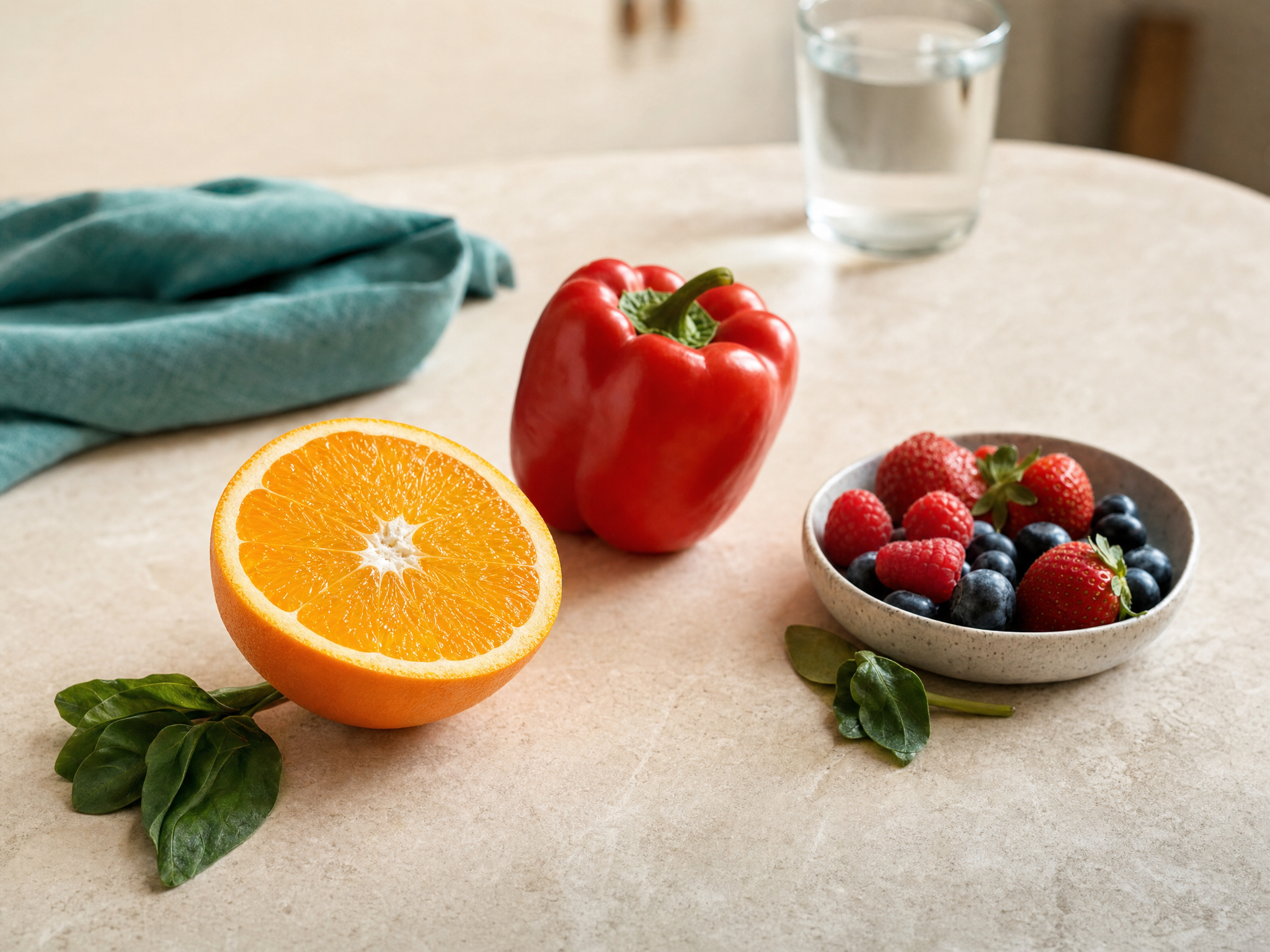
Worth keeping in perspective: the approved claim applies to vitamin C as a nutrient, not to any particular "collagen product". You also get vitamin C from a bell pepper or a kiwi, no booster tub required.
What these products lack is the part the advertising implies: evidence that the finished blend improves skin the way the animal peptides in the studies do. Amino acids plus vitamin C are sensible basic nutrition. They do not automatically become a skin active ingredient just because they share a tub.
"Vegan collagen boosters" typically supply glycine, proline, vitamin C and zinc. Vitamin C is necessary for collagen synthesis as a cofactor of the prolyl and lysyl hydroxylases (Ricol 2026, review). For the finished product blend itself, however, there is no skin evidence comparable to that for animal collagen peptides.3
How your body builds collagen on its own
Your body makes collagen continuously, from amino acids and with vitamin C as a cofactor. Three amino acids dominate the process: glycine, proline and hydroxyproline together make up roughly 57% of the amino acids in collagen (Li & Wu 2017, review).4 They are the raw material from which the collagen triple helix is formed.
How much the availability of these building blocks plus vitamin C matters shows up in a small but elegant study. It measured the effect not on the skin, but directly in the blood, using a marker of collagen synthesis.
Shaw and colleagues (Am J Clin Nutr) gave 8 healthy men 5 or 15 g of vitamin-C-enriched gelatin, or a placebo, an hour before a short bout of exercise. The 15-gram dose doubled blood levels of type I pro-collagen, a marker of active collagen formation. Levels of glycine, proline and hydroxyproline rose as well. With 8 participants the sample is small, but the mechanism is shown cleanly.5
Notice the pattern? It is not finished collagen molecules that count, but available building blocks plus the right cofactor. Whether those building blocks come from animal gelatin, from a booster or from your ordinary protein-rich diet is secondary for the biochemistry. What matters is that enough of them are on hand when the body builds. That is precisely what makes the "vegan or not" question less dramatic for collagen synthesis than the marketing makes out.
Glycine, proline and hydroxyproline account for roughly 57% of the amino acids in collagen (Li & Wu 2017). In one RCT, vitamin-C-enriched gelatin taken an hour before exercise doubled blood levels of type I pro-collagen, a marker of increased collagen synthesis from available building blocks plus vitamin C (Shaw 2017, n = 8).5
Collagen peptides vs. plant protein powder: what the studies show
This is where two things that often get muddled collide. Animal collagen peptides have a genuine body of skin research behind them, including a meta-analysis (de Miranda 2021, 19 RCTs).1 A plant protein powder does not, but it supplies amino acids and is basic nutrition rather than a niche active ingredient. So the two do not do the same job.
The fair counterpoint matters here: the collagen research is real, and the effects on skin hydration and elasticity have been reproduced in several RCTs, for instance over 12 weeks with low-molecular-weight peptides (Seong 2023, n = 100).6 Brushing that evidence aside would be too easy. Just as honest, though, is the second half: many of these studies combine collagen with other compounds, which makes it harder to pin the effect on the collagen alone.
Czajka and colleagues (Nutr Res) tested collagen peptides combined with vitamins and antioxidants against a placebo in 120 people over 90 days. Skin elasticity and hydration improved noticeably. Because collagen plus cofactors were given together here, the share attributable to the collagen alone cannot be cleanly isolated. Fish collagen was used, and the study came from the maker of the product tested.7
And the protein powder? High-quality protein supplies the amino acids from which the body builds, among other things, collagen. But it is not a targeted collagen product. A recent study on glycine, one of the three main collagen building blocks, is telling.
Aussieker and colleagues (Int J Sport Nutr Exerc Metab) showed in 14 men that whey protein after training actually lets blood glycine levels fall. Just 5 g of added collagen prevented that drop. It illustrates the point: standard protein powder is not rich in glycine, the most abundant collagen building block by mass. The collagen used was animal-derived.8
The table below places the three options honestly, without overselling any of them.
| Criterion | Animal collagen peptides | "Vegan collagen" (booster) | Plant protein powder |
|---|---|---|---|
| Contains collagen? | Yes (animal) | No | No |
| What's inside? | Hydrolysed peptides from fish/beef | Amino acids, vitamin C, zinc | Complete amino acid spectrum |
| Skin evidence | Yes, incl. meta-analysis1 | None for the finished product | None direct |
| Supplies collagen building blocks | Directly (glycine, proline) | Partly, depending on the formula | Yes, as part of the protein |
| Vegan | No | Yes | Yes |
An honest comparison of the three options. The skin evidence sits with the animal peptides; boosters and protein powder supply building blocks, not finished collagen.
So the bigger picture is sober. If proven skin benefits matter to you, and you have no issue with animal products, collagen peptides are the option with the best data behind them. If you stay plant-based, it is not about a collagen miracle but about solid fundamentals: enough protein and enough vitamin C, so your body can build. Which protein sources deliver the best amino acid profile is something we pulled apart in detail in the article on biological value.
What you can genuinely do for your collagen formation
Rather than pouring money into a "collagen" product without any collagen, it pays to look at the two levers with a real biochemical basis: enough protein for the building blocks, and enough vitamin C as a cofactor of the collagen-synthesis enzymes (Ricol 2026, review).3
With protein, the rule is simple: total amount and a complete amino acid profile count for more than a single powder with a buzzword on the tub. Glycine is an interesting special case here, because many standard proteins are fairly low in it (Aussieker 2024).8 A varied, protein-rich diet with pulses, wholegrains and, where useful, a plant protein powder covers that well. Which amino acids tend to run low on a fully plant-based diet is laid out in detail in the article on vegan amino acids.
Vitamin C is the easier part. A serving of bell pepper, broccoli, berries or citrus a day comfortably covers your needs. One note on expectations: "natural" sources are not automatically more reliable than a supplement. Bone broth, for instance, often touted as a collagen booster, supplies the relevant amino acids in highly variable and usually low amounts (Alcock 2019).9 What counts is the actual dose, not the image of the source.
For your body's own collagen formation, what counts is available amino acids and vitamin C as a cofactor. A protein-rich diet covers the building blocks, and a serving of vitamin-C-rich vegetables or fruit covers the cofactor. "Natural" sources such as bone broth supply collagen precursors in highly variable amounts (Alcock 2019).9
Those building blocks are exactly what our approach targets. SYNTYZE Plant Protein delivers 24 g of protein per serving with a fully published amino acid profile. It is not a collagen product and makes no skin promise. What it does is cover the protein side of the equation, transparently and verifiably. How the individual building blocks fit together is shown in the article on pea and fava bean protein.
The Bottom Line
Vegan collagen is a marketing term, not an ingredient: real collagen is always animal-derived, and the tubs hold amino acids and vitamin C. If you want the proven skin benefit and have no issue with animal products, reach for collagen peptides. If you stay plant-based, skip the pricey "collagen" powder and make sure you get enough protein and vitamin C instead. Sobering for the shelf, freeing for your wallet.
FAQ: Vegan collagen, skin and protein powder
No. Collagen is an animal structural protein and occurs in no plant. Products labelled "vegan collagen" contain no collagen, but amino acids such as glycine and proline, plus vitamin C and often zinc. These are meant to support your body's own collagen formation. The positive skin evidence for collagen peptides, by contrast, is based on animal-derived material from fish or beef (de Miranda 2021, meta-analysis).
Indirectly, yes. Your body builds collagen from amino acids, and a protein-rich diet supplies those building blocks. But plant protein powder is not a collagen product and has no skin evidence of its own. More important than any single powder is total protein intake and a complete amino acid profile, combined with enough vitamin C as a cofactor of collagen synthesis (Ricol 2026). Glycine is a special case here, because many standard proteins are relatively low in it.
Both act in different places. Animal collagen peptides have shown better skin hydration and elasticity in several RCTs and a meta-analysis (de Miranda 2021). Vitamin C is involved in collagen synthesis. The approved EU health claim reads: "Vitamin C contributes to normal collagen formation for the normal function of skin." A vitamin C deficiency slows collagen synthesis, but an excess brings no added benefit. People on a plant-based diet are therefore well served by enough protein plus a good vitamin C supply.
24 g of protein per serving from pea and fava bean, with a fully published amino acid profile. Plant-based, no sweeteners.



Share: