
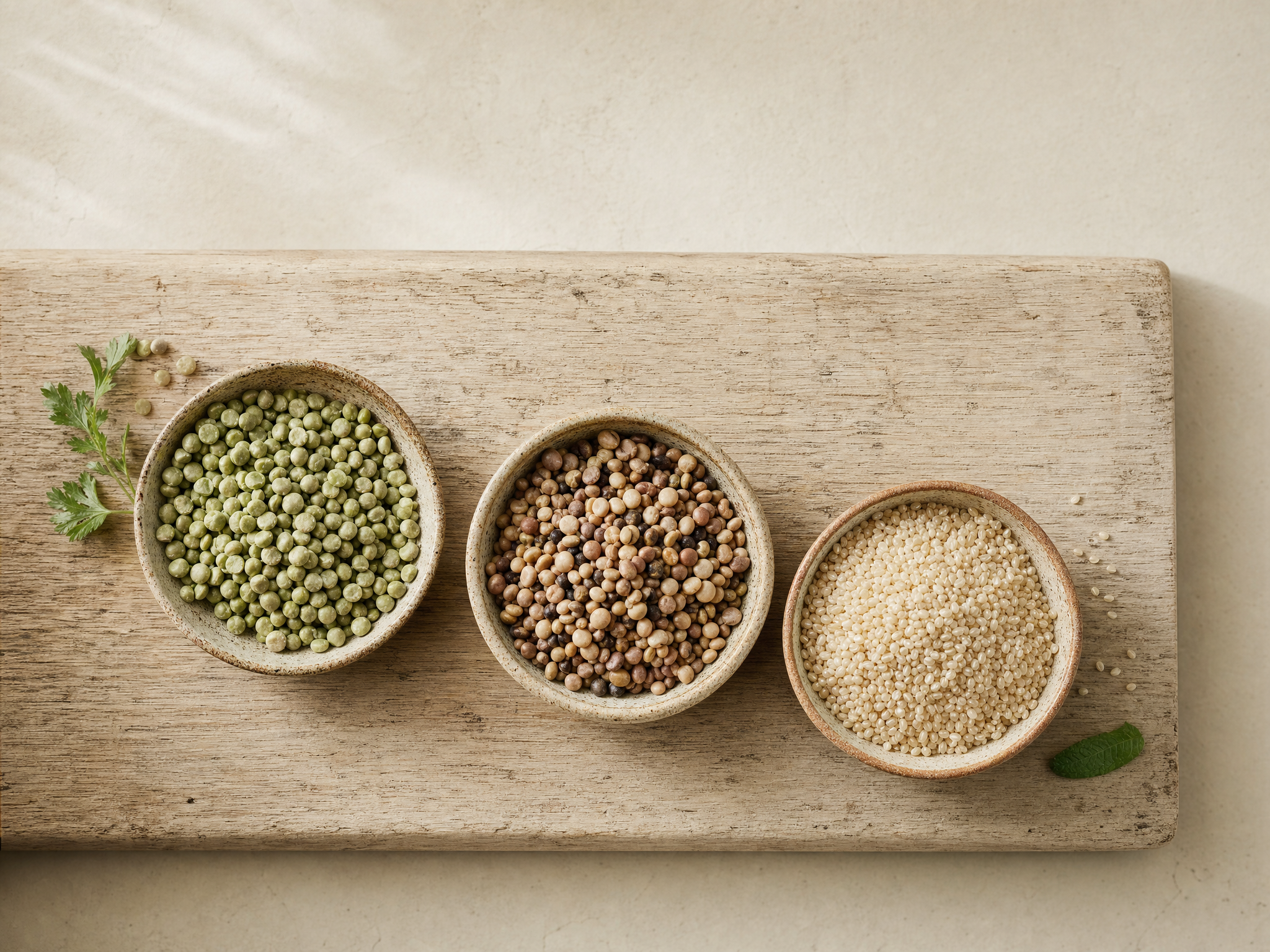
“A plant-based diet inevitably leads to amino acid deficiency” is a claim repeated so often that it now sounds almost like a biochemical fact. The argument rests on a real observation: plant protein sources deliver fewer essential amino acids per gram than animal sources, and two of those, methionine and lysine, are genuinely sparse in many legumes and grains.
What the popular reading misses are the two variables that decide everything: total daily intake and per-meal dose. Once both are right, the amino acid disadvantage all but disappears in most studies. A 2024 crossover trial in young adults using the phenylalanine tracer method showed exactly this: plant protein with added leucine matched whey for muscle protein synthesis, with no significant difference.5
This article shows which amino acids genuinely run low on a plant-based diet, why leucine intake per meal is the real lever, and how to cover your profile without meat, without falling for the myth of “incomplete plant protein”.
- Limiting amino acids in plant sources are primarily methionine (in legumes) and lysine (in grains), while leucine sits below average in many sources.1
- Plant protein isolates contain 21 to 37 percent essential amino acids, animal isolates 32 to 43 percent. The gap matters when daily intake is low.1
- From around 2.5 g of leucine per meal, muscle protein synthesis responds strongly in studies (a discussed reference value, age-dependent). A 25 g serving of pea protein delivers around 1.9 g, whey roughly 2.7 g.1
- Combining sources or fortifying with L-leucine lifts plant protein to the same effect level as animal sources, demonstrated in a 2024 RCT using the phenylalanine tracer method.5
Contents
Why there is an amino acid question for vegans at all
Plant protein sources have three structural quirks that together feed the amino acid argument: lower ileal digestibility of amino acids, a lower share of essential amino acids in total protein, and systematically tighter levels of methionine, lysine, or leucine depending on the source.2
In a critical review by Berrazaga et al. (2019), plant proteins tend to have lower ileal digestibility than animal proteins. The gap shrinks further with isolated proteins compared with whole foods such as beans or lentils.2
At first glance this sounds like a clear deficit, but it ignores the context in which the numbers were generated. Studies measuring amino acid losses from plant sources usually used isocaloric comparisons at low or moderate protein intake. As soon as daily intake rises and the meal clears the threshold for muscle protein synthesis, the difference shrinks.
Berrazaga et al. analysed plant versus animal proteins and identified four levers that close the gap: fortification with limiting amino acids (especially leucine), breeding higher-protein cultivars, plant-plant combinations such as legume plus grain, and plant-animal combinations. The authors emphasise that none of these levers supports the concept of an “incomplete protein”.2
The amino acid question is therefore less about “complete or incomplete” and more about “sufficiently dosed or not”. That is exactly why the rest of this article is not about myths but about the two levers that genuinely matter: which amino acids actually run low, and how you hit the critical per-meal threshold.
Which essential amino acids run low on a plant-based diet
Three essential amino acids regularly land on the watch list for plant-based diets: methionine (low in legumes), lysine (low in grains), and leucine (below the MPS threshold per typical serving in many plant sources).1 That said, the picture depends heavily on which source and which daily intake are in play.
Gorissen et al. (2018) measured the amino acid profiles of 15 protein isolates (10 plant, 5 animal) by UPLC-MS/MS. Plant isolates contained 21 to 37 percent essential amino acids, animal isolates 32 to 43 percent. Methionine averaged 1.0 percent in plant sources versus 2.5 percent in animal sources, lysine 3.6 percent versus 7.0 percent.1
The most useful practical point from this analysis: hemp protein had the lowest leucine share at 5.1 percent, corn protein the highest at 13.5 percent, with human skeletal muscle tissue sitting at 7.6 percent. Pea protein lands in the middle, soy protein close to whey.1 Source choice therefore makes a bigger difference than the “plant or not” question.
Gorissen et al. analysed 15 protein isolates (10 plant, 5 animal) plus human skeletal muscle protein as a reference (hemp, rice, pea, soy, lupin, oat, corn, microalgae, casein, whey, egg) for amino acid content and leucine share. Result: plant isolates structurally hold less EAA per gram of protein, the methionine share is lowest in bean-based sources, lysine in grain-based sources. The authors conclude that a larger serving size or additional leucine fortification compensates for the gap in muscle protein synthesis.1
Translated to the plate: anyone living off pea protein alone should keep an eye on the methionine gap. Anyone leaning on rice protein as the main source has a lysine question. Both gaps close as soon as a second source joins or daily intake climbs.
How to optimise your amino acid profile without meat
A complete amino acid profile as a vegan comes down to three pragmatic levers: combine sources rather than rely on a single one, keep daily protein above 1.4 g per kilogram of body weight, and spread it across at least three protein-rich meals.3 The fourth, optional lever is targeted L-leucine fortification on lower-dose plant protein meals.
Rule of thumb for vegan amino acid coverage: 1.6 g of protein per kg of body weight per day, spread across three to four meals of 25 to 40 g each, with at least two different sources per day.
Pea protein only at breakfast? Add rice, oat, or corn protein at lunch. Legumes (low in methionine) plus grains (low in lysine) is the classic complementary pairing that has been standard in many food cultures for centuries and is now confirmed by modern nutrition science via the DIAAS rating.3
Herreman et al. (2020) calculated DIAAS values for 17 protein sources and their combinations. Pea protein on its own scored under 75 (class “no quality claim”), the pea-plus-rice combination reached a DIAAS of up to 84 (class “high quality protein”) because the methionine and lysine profiles offset each other.3
If you would rather not pair two sources at every meal, there is a second route: a plant protein powder with added L-leucine. An RCT by Lim et al. (2024) compared plant protein, plant protein plus leucine, and whey using the phenylalanine tracer method. Plant plus leucine was not statistically lower than whey.5
Why leucine intake per meal is the real lever
Leucine is not just one essential amino acid among others. It is a key molecular trigger for muscle protein synthesis via the mTORC1 pathway, which initiates translation of new muscle proteins. Research discusses a reference value of about 2.5 g of leucine per meal (age-dependent, not a universal cutoff) above which the anabolic response ramps up strongly. At lower amounts it tends to be weaker. The decisive factor here is the leucine content of the meal, not the rest of the amino acid profile.5
For direct comparison: a 25 g serving of pea protein delivers around 1.9 g of leucine, soy protein roughly 2.1 g, whey around 2.7 g. A 30 to 40 g serving of pea protein reaches the discussed reference value of about 2.5 g without further help, and so does a 25 g serving with leucine fortification.1
Lim et al. (NCT05139160) measured muscle protein synthesis in young adults after a single dose of plant protein, plant protein plus L-leucine, or whey, each via the phenylalanine tracer method. Plant alone was significantly lower than plant plus leucine (p = 0.002) and whey (p = 0.046). Plant plus leucine versus whey: no significant difference (p = 0.052). Practical takeaway: the leucine content per meal is the decisive lever, not the protein source.5
More on the mechanics behind the threshold and why leucine acts as the “switch” for muscle protein synthesis is in our article on leucine and muscle protein synthesis. For practice the message holds: a plant meal below the reference value of about 2.5 g of leucine is not “bad”, it just leaves anabolic potential on the table.
Amino acid profiles of plant protein powders compared
Anyone covering amino acids on a plant-based diet quickly lands on protein powders, because they are more concentrated than whole-food sources and simplify per-meal dosing. The question is not “which is the best” but “which fits which gap”. The table below shows leucine and limiting amino acids for the most common plant powders.
| Source (25 g protein) | Leucine | Limiting | DIAAS |
|---|---|---|---|
| Pea protein | ~ 1.9 g | Methionine | < 75 |
| Soy protein | ~ 2.1 g | - (complete) | ~ 90 |
| Rice protein | ~ 2.1 g | Lysine | 47 |
| Hemp protein | ~ 1.3 g | Lysine, leucine | 54 |
| Pea + fava bean + L-leucine (SYNTYZE) | 3.0 g | Methionine (partially compensated by L-leucine) | n/a (in-house value) |
Leucine values from Gorissen et al. (2018), DIAAS values from Herreman et al. (2020).13 SYNTYZE leucine value from in-house amino acid profile; an external DIAAS for the pea-fava bean combination is not available. Pea and fava bean are both legumes with a similar methionine gap and do not form a complete amino acid complementarity in the classical sense.
Mathai, Liu, and Stein (2017) showed in a pig model that the older PDCAAS system systematically overestimates the quality of plant proteins, because it measures faecal rather than ileal digestibility. DIAAS has been the more precise yardstick ever since and has been recommended by the FAO since 2013.4
More on the pea-fava bean combination and why it does not deliver true amino acid complementarity but mainly improves texture is in our article on pea protein and fava bean protein. For the amino acid question what counts is this: both are legumes with a similar profile, and the decisive lever stays leucine.
If you want to dig into the “plant versus animal” question more deeply, our article on plant protein compared with whey is worth a read. There we work through the 12-week trial evidence, which shows that at comparable daily intake there is no measurable difference in muscle growth.
FAQ: Soy, pea protein, and BCAAs
No, soy is a strong option but not mandatory. Soy protein is the only major plant source with a complete amino acid profile and no clear limiting amino acid, with a DIAAS around 90.3 Vegans without soy cover their needs just as well via combinations of legumes plus grains, pea plus rice protein, or via plant protein powders with added leucine. The one amino acid you should explicitly track is leucine per meal, not the source overall.
Pea protein on its own has two gaps: methionine sits below need, and leucine per 25 g serving sits below the discussed reference value of about 2.5 g. Both close in two ways. First, raise serving size to 35 to 40 g, and you reach around 2.5 g of leucine while widening the methionine margin. Second, add a second source, ideally grain- or corn-based, to reach methionine-lysine complementarity.3 Pea protein with added L-leucine (as in many modern plant protein powders) solves both points in a single serving.
If your daily protein intake sits above 1.4 g per kg of body weight, isolated BCAA supplements are redundant. The three BCAAs (leucine, isoleucine, valine) are already in every protein source, and isolated BCAA dosing without the other essential amino acids can only briefly and partially stimulate muscle protein synthesis, because the remaining building blocks are missing. A more useful move is targeted L-leucine as an add-on to lower-dose plant meals, or a complete plant protein powder with added leucine.
The Bottom Line
The amino acid question is not decided between plant and animal but between sufficiently dosed and underdosed. Anyone hitting 1.6 g of protein per kg of body weight, combining at least two plant sources per day, and landing in the discussed leucine reference range of about 2.5 g per meal covers their amino acid profile without deficiency and without animal products.

Share: