

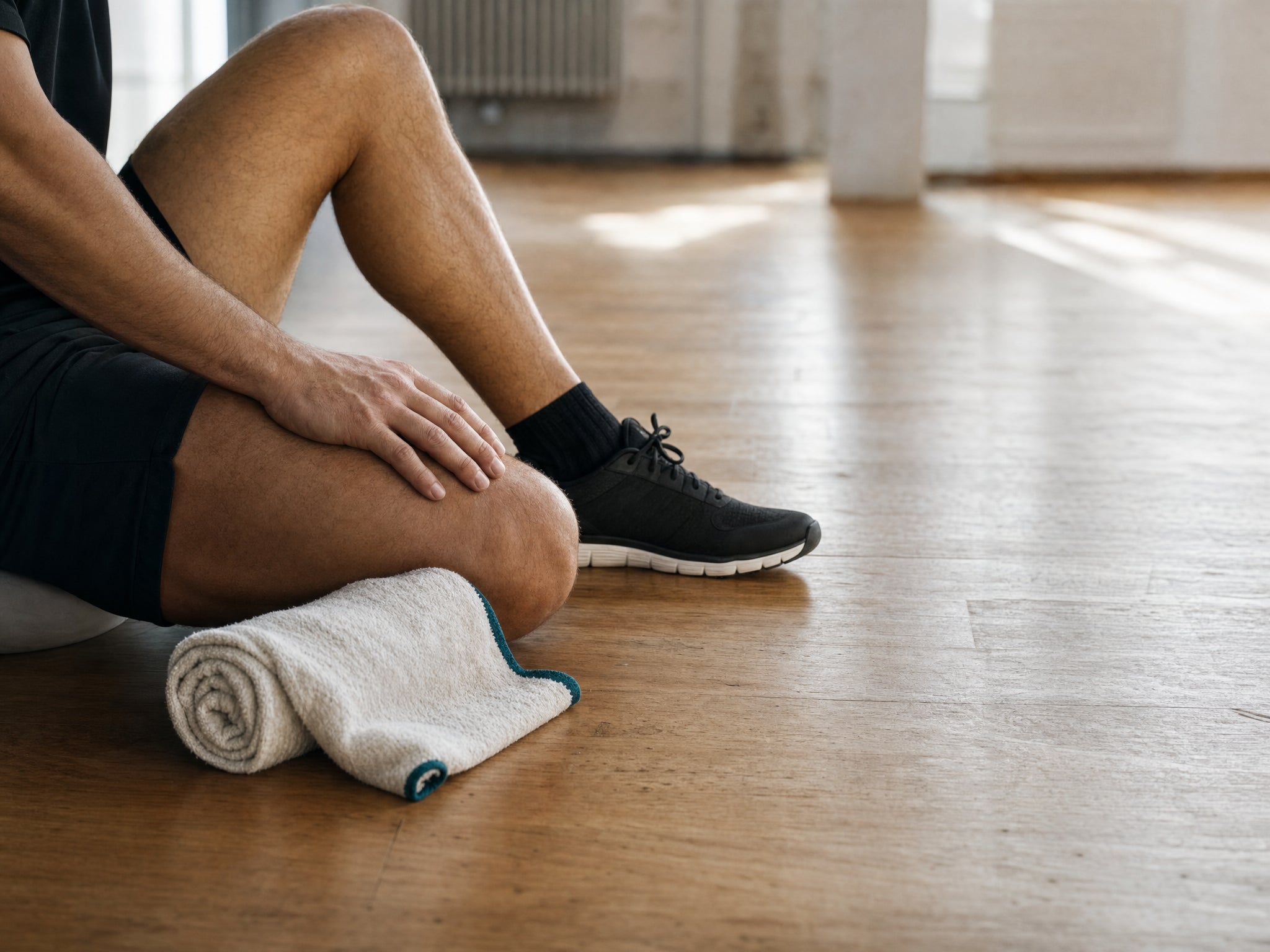
The alarm goes off, you swing your legs out of bed, and your thighs complain with every step towards the coffee machine: yesterday's leg day is still sitting deep in the muscle. Today, the next session is technically due.
Two voices argue in your head. One says push through, no minor ache gets to derail the plan. The other wants to take it easy before something actually tears. Both run on gut feeling, neither on the research.
Yet the question is well studied. What muscle soreness actually is, whether you are allowed to train, what genuinely helps and what is merely a myth: the studies give surprisingly clear answers.
- Muscle soreness (technical term DOMS) comes from tiny tears in the muscle structure after unfamiliar or braking loads, not from lactate. The pain peaks 48 to 72 hours later (Hotfiel 2018).1
- You are allowed to train with sore muscles. Reviews advise lowering intensity and volume for one to two days, or training the less affected muscle groups (Cheung 2003).2
- What measurably helps against soreness: cold therapy, contrast baths, and massage. Stretching shows no meaningful effect (Wiecha 2025, Herbert 2011).3,6
- Soreness is not a marker for muscle growth. It signals an unfamiliar load and disappears once the body adapts (Cheung 2003).2
- Dark urine, extreme swelling, and unusually severe pain are not part of normal soreness and belong in front of a doctor.
Contents
- What muscle soreness really is, and why lactate has nothing to do with it
- Should you train with sore muscles?
- What genuinely helps against soreness, and what does nothing
- Do you need soreness to build muscle?
- Nutrition and recovery: the underrated levers
- When soreness is a warning sign
- FAQ: duration, heat or cold, stretching
What muscle soreness really is, and why lactate has nothing to do with it
Muscle soreness is not a sign of acid build-up but a real, if small, injury. Behind the technical term DOMS (delayed-onset muscle soreness) sit microscopic tears in the muscle fibres, triggered above all by unfamiliar and braking movements. The pain arrives late and peaks 48 to 72 hours afterwards.1
The most stubborn misconception first: lactate is not the culprit. The idea that lactic acid lingers in the muscle and burns away there has held on in changing rooms for decades. Lactate, however, is cleared within a few hours of training, long before the soreness even sets in.
Hotfiel and colleagues (Sportverletzung Sportschaden) classify DOMS as an ultrastructural muscle injury. The triggers are eccentric, meaning braking, or unfamiliar loads. Protein breakdown and a local inflammatory response follow, which is why the pain sets in late and reaches its peak 48 to 72 hours afterwards.1
Braking movements in particular set off DOMS: lowering the barbell, running downhill, the eccentric phase of every repetition. The muscle is lengthened under tension, and that is exactly where the small structural damage forms that the body then repairs.
Delayed-onset muscle soreness arises from microstructural damage to the muscle cells after eccentric or unfamiliar loading, followed by protein breakdown and local inflammation. The symptoms appear with a delay and peak 48 to 72 hours after training (Hotfiel 2018, review).1
Should you train with sore muscles?
Yes, you can train with sore muscles, but you should adjust the load. Cheung's large review recommends lowering intensity and volume for one to two days, or training the less affected muscle groups, so the heavily worked ones can recover in peace.2
Light movement actually helps. It boosts circulation and eases the pain for a while, as anyone who suddenly feels better after warming up will know. The effect, though, is purely pain-relieving and no healing accelerator: as soon as you cool down again, the soreness is back.2
Movement is the most effective way to relieve pain during a bout of soreness, although the effect is only temporary. Anyone who has to train daily should reduce intensity and duration for one to two days after intense, DOMS-inducing loading (Cheung 2003, review).2
The most honest answer, though, is this: it depends on how bad the soreness is and how well you recover. And that recovery runs more individually than most training plans admit.
Hayes and colleagues (Sports Medicine - Open) reviewed the research on recovery after resistance training in older adults. The finding: the recovery course varies widely by age and sex, and the data are inconsistent. A rigid rule for how long you have to rest cannot be drawn from it.8
One point many training plans overlook: in women, the severity of soreness fluctuates across the menstrual cycle. A meta-analysis of 19 studies found the strongest DOMS response in the early follicular phase, shortly after the period begins, when sex hormones are low.7
What does that mean in practice? Not that women have to rest in certain phases. Rather, that a weaker day with more soreness is not a failure but physiology. Easing the training load a little in such phases makes more sense than training against your own body.
What genuinely helps against soreness, and what does nothing
The most reliable remedy against soreness is cold. A comprehensive review of 29 systematic reviews covering 863 individual studies found the strongest evidence for cold therapy, contrast baths, massage, and light therapy. For stretching, by contrast, the evidence is weak.3
Wiecha and colleagues (Sports Medicine) summarised 29 systematic reviews covering 863 randomised studies on 24 treatment methods in an umbrella review. Solid evidence exists for cold, cryostimulation, contrast baths, massage, light therapy, and kinesiotaping. For stretching, active cool-downs, and electrostimulation, the evidence is weak by contrast.3
A network meta-analysis backs up the picture and sharpens it. It compared various water and cold applications directly with one another and found the clearest effect of cold on the soreness itself.
Chen and colleagues (BMC Musculoskeletal Disorders) analysed 57 studies with 1,220 participants. The result: cryotherapy was the most effective against soreness and for neuromuscular recovery. Contrast baths, the alternation between warm and cold, worked best on the muscle-damage marker creatine kinase.4
A third meta-analysis of 121 studies reaches the same conclusion: contrast baths, cold, massage, and light active training all came out ahead of doing nothing at all.5 Three independent analyses, one consistent picture. Almost too clear-cut to stay interesting.
Now the counter-test, because one classic falls through: stretching. For generations, stretching counted as a remedy against soreness. The data do not bear that out.
Herbert and colleagues (Cochrane Database of Systematic Reviews) pooled twelve studies on stretching before or after training. Whether before, after, or both: stretching lowered soreness on average by less than one point on a 100-point scale. Statistically measurable, practically meaningless.6
Muscle stretching, whether before, after, or both before and after training, produces no clinically meaningful reduction in soreness in healthy adults. Across twelve randomised studies, the effect was below one point on a 100-point pain scale (Herbert 2011, Cochrane meta-analysis).6
| Method | Evidence | What it does |
|---|---|---|
| Cold / ice bath | Solid | Eases soreness most reliably, effect moderate |
| Contrast baths (warm/cold) | Solid | Best effect on the damage marker creatine kinase |
| Massage | Moderate | Reduces pain, above all in the first few days |
| Light movement | Moderate | Eases pain temporarily, does not speed up healing |
| Stretching | Weak | No clinically meaningful effect on soreness |
| Ultrasound | None | No demonstrable effect |
Evidence based on Wiecha 2025, Chen 2024, Nahon 2021, and Herbert 2011.3,4,5,6
An honest framing belongs here too: the evidence for the winners is mostly of low to moderate quality, and the effects are noticeable but not huge. None of these methods makes soreness vanish overnight. They make it more bearable while your body repairs itself.
Do you need soreness to build muscle?
No. Soreness is not a reliable marker for growth but for novelty. It appears above all when you learn an exercise for the first time or have not done it in a long while, and it fades with every repetition of the same load, even though the training stimulus remains.2
This habituation effect has a name: the repeated-bout effect. After the first unfamiliar session, the muscle adapts and responds the next time with far less damage, and so with less soreness too. You get stronger, but the soreness goes away. If soreness were the yardstick, you would have to conclude that you are no longer making progress, which is plainly wrong.
Soreness occurs most often at the start of a season and with unfamiliar activities, regardless of the time of year. With repeated loading, the muscle adapts and responds with less damage. The severity of soreness therefore reflects the novelty of the stimulus rather than the size of the growth signal (Cheung 2003).2
What truly makes the muscle grow is the mechanical stimulus over time, not the pain afterwards. How to step up that stimulus deliberately is something we explained in detail in our article on progressive overload. In short: take your cue from load, repetitions, and technique, not from how much it hurts the next day.
Nutrition and recovery: the underrated levers
Recovery after training runs on two levers that rarely get the spotlight: enough protein spread across the day, and enough sleep. Both create the conditions under which the body repairs the small damage that causes the soreness.
On the subject of protein, the question of amino-acid supplements comes up regularly. There are signs that a better amino-acid supply can dampen soreness, although the source is what matters.
Salem and colleagues (Sports Medicine - Open) analysed 18 studies on branched-chain amino acids (BCAAs) after exercise-induced muscle damage. BCAAs measurably reduced soreness at several measurement points. The finding shows that an adequate amino-acid supply supports recovery.9
The catch with isolated BCAAs: they deliver only three of the nine essential amino acids. A complete protein covers all of them and contains the same branched-chain amino acids anyway, without you needing a separate supplement. Why standalone BCAA powders are unnecessary for most people is something we broke down in our article on BCAA effects.
A meta-analysis of 18 studies showed that an increased intake of branched-chain amino acids reduced soreness after exercise-induced muscle damage at several time points. The underlying amino acids are also found in a complete protein (Salem 2024, meta-analysis).9
In practice this means: spread enough protein across the day rather than relying on a single supplement. Protein contributes to the maintenance and growth of muscle mass, and a leucine-optimised plant-based protein powder makes it easier to hit the daily amount without much fuss. The second lever costs nothing and still gets neglected constantly: sleep. Why it is the single strongest recovery factor of all is something you can read in our article on sleep as a supplement.
When soreness is a warning sign
Normal soreness is dull, affects the trained muscles, and subsides within a few days. There is, however, a line beyond which the symptoms are no longer harmless and need to be checked by a doctor.
See a doctor if you notice: dark-coloured urine (cola- or tea-coloured), extreme swelling of the muscle, and pain out of all proportion to the training, or pain that lasts for days beyond the usual. These can be signs of rhabdomyolysis, a serious breakdown of muscle tissue that should not be confused with ordinary soreness.
Such cases are rare, but they cluster after extremely unfamiliar, very intense loading. When in doubt: better to get it checked one time too many than to ignore a warning sign.
The Bottom Line
Soreness is a small, easily repaired injury, not a no-entry sign for training and not proof of progress. You can train as long as you ease the load on the affected muscles for one to two days. Against the pain, cold, massage, and light movement help, stretching does not. The rest is handled by enough protein and sleep. Listen to your body, but do not mistake adaptation for weakness.
FAQ: duration, heat or cold, stretching
Soreness sets in with a delay and peaks 48 to 72 hours after training (Hotfiel 2018). After that it usually subsides fully within five to seven days. Exactly how long depends on the load, your training condition, and individual factors such as age and sex, so recovery does not run the same for everyone. The more unfamiliar the movement was, the longer and stronger the soreness tends to be.
The evidence is strongest for cold. A network meta-analysis of 57 studies found cryotherapy the most effective against soreness itself, while contrast baths, the alternation between warm and cold, work best on the muscle-damage marker creatine kinase (Chen 2024). Heat alone comes out weaker. In practice this means: a cool bath or a cold application after hard loading, or showering alternately warm and cold. Neither is an instant fix, the effect is noticeable but moderate.
For relieving soreness, stretching does nothing measurable. A Cochrane meta-analysis of twelve studies showed that stretching, whether before or after training, lowers soreness by less than one point on a 100-point scale (Herbert 2011). That is clinically meaningless. You can still stretch if it feels good or serves your mobility, it just is not much use as a targeted remedy against soreness. Anyone wanting to ease the pain is better served by light movement or cold.
24 g protein and 3 g leucine per serving, plant-based and without sweeteners. Protein contributes to the maintenance of muscle mass.
Share: