

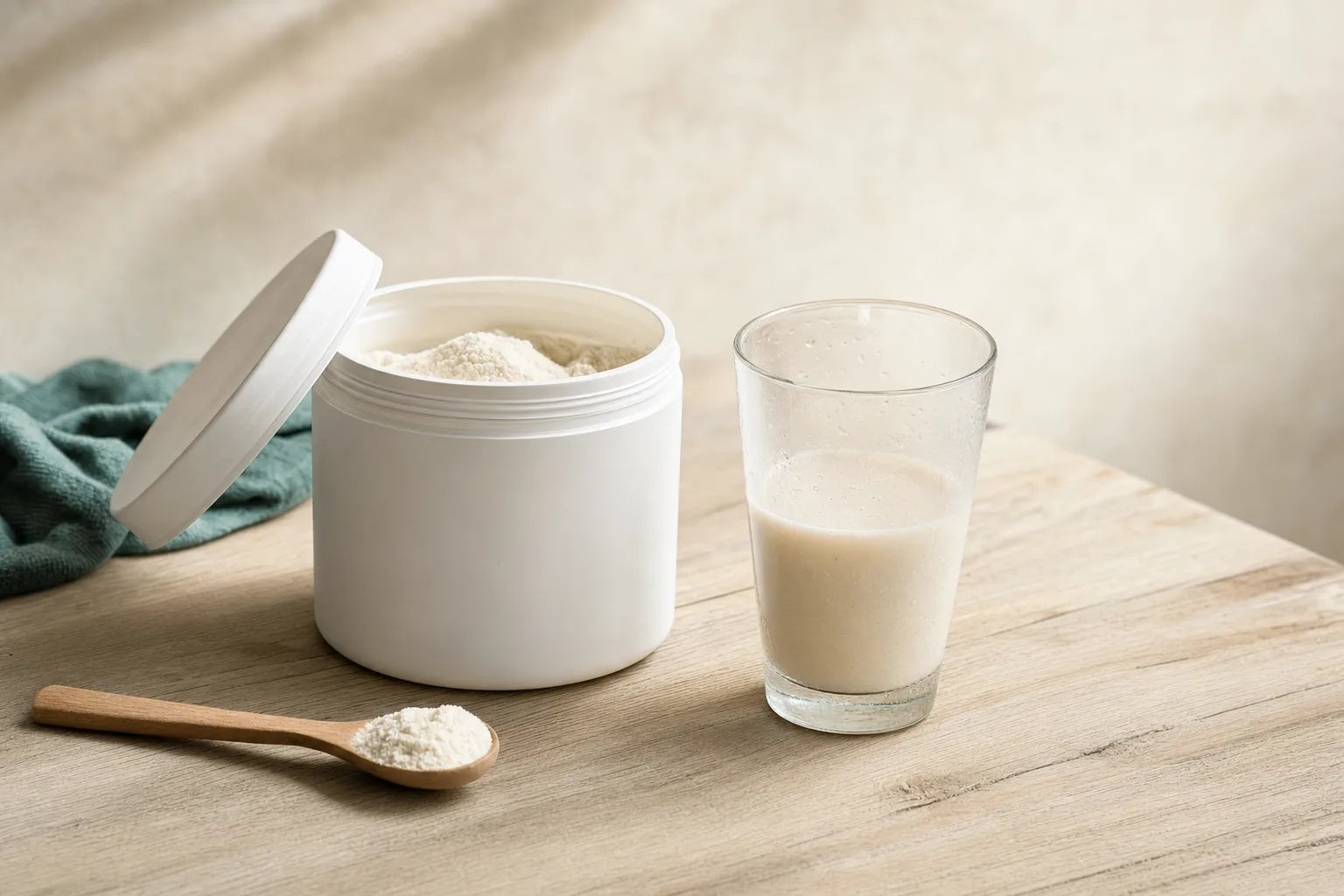
"BCAAs are essential for your muscle gains" is one of the oldest sales pitches in the supplement aisle. Three amino acids in colourful tubs, wrapped around a real biochemical detail: leucine, isoleucine, and valine genuinely hold a special role in muscle metabolism. The catch is that this special role rarely justifies a separate BCAA powder sitting next to your protein.
Robert Wolfe, one of the most cited muscle protein researchers of the past three decades, published a 2017 review that takes the industry's pitch apart. Because BCAAs cover only three of the nine essential amino acids, muscle protein synthesis from BCAA supplements on their own can at best draw on the building blocks the body releases from its own protein breakdown. The only available intravenous human studies actually showed a drop in muscle protein synthesis, not a rise.1
So what does that mean in practice? Do you need BCAAs alongside your protein powder, or is the tub just wasted money? This article walks through what five reviews and a meta-analysis of 49 RCTs say about BCAA effects, leucine as the anabolic trigger, and the single edge case where a BCAA dose still makes sense, and where your money is better spent on complete protein instead.
- BCAAs are three of the nine essential amino acids: leucine, isoleucine, and valine. Only leucine flips the mTORC1 switch on muscle protein synthesis; the other two play supporting roles.2
- Wolfe (2017): BCAA supplements on their own cannot substantially stimulate MPS in humans, because six essential building blocks are missing. On both theoretical and empirical grounds, BCAA supplementation is "unwarranted".1
- Kaspy et al. (2023): BCAAs lift MPS measurably after a dose, but the effect is markedly smaller than after complete protein.3
- Morton et al. (2018, meta-analysis of 49 RCTs): protein from complete sources significantly increases strength and lean mass up to a daily ceiling of 1.62 g per kg body weight. Beyond that point, additional protein from complete sources adds nothing measurable.4
- What matters in practice: leucine per meal from complete protein drives the anabolic trigger, and research discusses a reference value of about 2.5–3 g for this (age-dependent, not a universal cutoff). A protein powder with enough leucine per serving replaces a BCAA tub, except in the rare fasted-training edge case.
Contents
BCAA effects on muscle building: what the research says
The logic behind BCAA tubs sounds tidy at first glance: leucine activates muscle protein synthesis via mTORC1, isoleucine and valine are the two related branched-chain amino acids, so a blend of all three should maximise the anabolic signal. This is exactly where Wolfe's critique lands. Activating muscle protein synthesis without substrate is, in physiological terms, like firing up an engine with no fuel in the tank.
For the body to build new muscle proteins, all nine essential amino acids have to be available in the plasma. BCAAs deliver only three of them. The remaining six have to come from the body's own protein breakdown, which leaves the anabolic balance neutral at best.
Wolfe (J Int Soc Sports Nutr) reviewed the theoretical and empirical evidence for BCAA supplements as an anabolic tool in humans. In theory, peak MPS stimulation from BCAAs alone is capped by protein breakdown at roughly 30 percent, and lower in practice because of amino acid oxidation. The only available intravenous human studies showed muscle protein synthesis falling, because isolated BCAAs without the remaining essential amino acids do not supply a complete pool of building blocks. The conclusion: an anabolic effect of BCAA supplementation in humans is "unwarranted".1
What Wolfe is careful to flag: BCAAs are not inert. They do activate signalling pathways, they can blunt protein breakdown, and intramuscular leucine rises measurably after a BCAA dose. The problem is that flipping the signal without enough building blocks does not translate into measurable hypertrophy over weeks or months.
A 2023 update review from the McGill group led by Kaspy confirms this picture with newer data: BCAAs activate mTORC1, lower whole-body and muscle protein breakdown, and increase MPS measurably after a meal. The effect is still markedly smaller than after an equivalent dose of complete protein.3
That leaves two findings sitting side by side without contradicting each other: BCAAs have real mechanistic effects, and those effects are too small for clinically relevant hypertrophy because the missing building blocks stop the anabolic signal from turning into actual muscle.
BCAA versus leucine alone: which of the three actually triggers growth
If only one of the three BCAAs really matters, it is leucine. It is the only direct mTORC1 activator among the amino acids, the biochemical switch that starts translation of new muscle proteins. Isoleucine plays a smaller role in insulin signalling, and valine mainly contributes amino nitrogen with no independent anabolic function of its own.
That raises an obvious follow-up: if leucine is the trigger, would isolated leucine on top of complete protein be the optimal combination? Plotkin and colleagues, working with Brad Schoenfeld and Alan Aragon, tackled that exact question in a 2021 narrative review. The answer: beyond a handful of acute studies showing a short-term MPS bump, long-term training studies show no advantage for isolated leucine or BCAAs over complete protein.
Plotkin et al. (Int J Sport Nutr Exerc Metab) reviewed the evidence on isolated leucine and BCAAs versus complete protein for hypertrophy and strength. Acutely, leucine raises MPS measurably. In long-term resistance training trials, leucine or BCAA top-ups show no superior adaptations compared with adequately dosed complete protein. The authors conclude that the added value of isolated amino acid supplements disappears as soon as daily protein intake is sufficient.2
The point most people miss: a 30 g serving of whey already provides about 2.7 g of leucine, and a 30 g serving of plant-based protein powder with leucine fortification lands in the same range. So if you take in 25 to 40 g of protein per meal, you land within the discussed leucine reference range (about 2.5–3 g) without a separate leucine powder, let alone a BCAA tub.
More on the mechanics of leucine as the anabolic switch is in our article on leucine and muscle protein synthesis. It goes into the leucine reference value discussed in research (~2.5 g) per meal and the mTORC1 cascade in more detail.
BCAA versus complete protein: what the meta-analyses show
If acute MPS studies are already ambiguous and long-term training studies show no edge for isolated amino acids, what does the most robust evidence class say? The clearest answer comes from Morton and colleagues, a meta-analysis with meta-regression covering 49 randomised controlled trials and 1,863 participants in total.
Morton et al. (Br J Sports Med) pooled 49 RCTs on protein intake and resistance training in healthy adults. Protein supplementation increased fat-free mass by an average of 0.3 kg and 1RM strength by 2.5 kg versus placebo. The crucial detail: the effect plateaued at a daily protein intake of 1.62 g per kg body weight. Above that point, extra protein from complete sources produced no further gains. Isolated amino acids such as BCAA powders were not tested in the meta-analysis.4
The practical takeaway from this meta-analysis is the most direct answer to the opening question. If you hit 1.6 g of protein per kg of body weight from complete sources, you have already maxed out the anabolic signal. A BCAA tub on top adds nothing measurable, because the daily ceiling at which additional substrate stops driving growth has already been crossed.
Rule of thumb from the evidence: 1.6 g of protein per kg of body weight per day from complete sources, split across three to four meals of 25 to 40 g each. Every one of those meals should ideally land within the discussed leucine reference range (about 2.5–3 g, age-dependent) to drive MPS strongly. More protein, or isolated BCAA doses, show no added benefit in the meta-evidence.
There is a second finding worth noting, picked up by Holecek (2018) in his review of BCAA metabolism, that matters for risk assessment. Elevated plasma BCAA levels are associated with insulin resistance, obesity, and type 2 diabetes in observational studies. The causal direction is unresolved, meaning it is not yet clear whether high BCAA levels help drive the metabolic dysfunction or simply mark it.5
For a healthy athlete with normal insulin sensitivity, this is not an acute issue. For someone with metabolic risk factors it is an extra reason to treat BCAAs as a niche tool rather than a daily habit, and to lean on complete protein, which delivers BCAAs in their natural ratio.
When BCAA supplements might actually be worth it
A flat "BCAAs are useless" would be wrong, and it is not what the reviews say either. There are two scenarios where a BCAA dose could plausibly do something, and both are narrow edge cases rather than standard practice.
First, fasted training paired with a very low daily protein intake. If an athlete trains in the morning on an empty stomach and total daily intake sits below 1.2 g per kg body weight, a small pre-workout BCAA dose can blunt protein breakdown and provide a minimal MPS signal. This is a rare setup in everyday training, because the average protein intake of active adults usually sits above that threshold.
Second, specific clinical settings such as liver insufficiency, where BCAAs are used therapeutically, or extreme endurance bouts with glycogen depletion, where BCAA oxidation can contribute a small amount of fuel. That sits outside the hypertrophy and strength conversation entirely.
Both edge cases also resolve themselves through complete protein. A serving of whey or plant-based protein powder pre-workout delivers the same BCAAs in their natural ratio, plus the other six essential amino acids. At a matched leucine dose, complete protein is consistently at least as effective as BCAAs alone.3
The often-missed point: an edge case does not justify a separate product on the shelf when the same problem can be solved by a product that is already there.
What to do instead
Instead of buying BCAAs, turn the two dials the meta-analysis identified as the biggest levers: total daily protein and leucine per meal. Both are controllable through complete protein alone, without a second product taking up shelf space.
The table below compares the leucine content of typical meal sources against the reference value discussed in research (~2.5 g). It shows that a single meal of 25 to 40 g of protein from a well-balanced source lands within the reference range without any supplement.
| Source (standard serving) | Protein | Leucine | Classification (reference ~2.5 g) |
|---|---|---|---|
| Whey protein isolate (30 g) | 24 g | ~ 2.7 g | within the reference range |
| Pea protein (25 g) | 21 g | ~ 1.9 g | below the reference without fortification |
| Chicken breast (120 g) | ~ 28 g | ~ 2.2 g | just below the reference |
| Low-fat quark (250 g) | ~ 30 g | ~ 3.0 g | within the reference range |
| BCAA powder (5 g, 2:1:1) | 0 g (no complete protein) | ~ 2.5 g | leucine within reference, EAAs missing |
| SYNTYZE Plant Protein (40 g) | 24 g | 3.0 g | within the reference range |
Leucine values for whey, pea protein, and whole foods are based on Gorissen et al. (2018) and Plotkin et al. (2021). BCAA powder values assume a 2:1:1 leucine to isoleucine to valine ratio. SYNTYZE values come from the published amino acid profile.
Following a vegan diet with pea protein as your main source? Close the methionine gap and the lower leucine density by pairing pea with a grain source, or choose a plant-based protein powder fortified with L-leucine. Either route fixes the amino acid profile without a separate BCAA tub.
More on the amino acid side of plant-based eating is in our article on vegan amino acids and how to cover them. For a head-to-head comparison of plant-based and whey protein, see our piece on plant-based protein compared with whey.
FAQ: vegan, weight loss, and intra-workout
No, not as a default. A plant-based diet covers BCAAs well enough as soon as daily protein intake sits above 1.4 g per kg body weight and meals are planned around the discussed leucine reference value (about 2.5–3 g). Pea, soy, and oat-rice combinations all deliver the three BCAAs in their natural ratio. If pea protein is your main source and you stay under the reference, a serving of a powder fortified with L-leucine is a better fix than a BCAA supplement, because the powder also delivers the other six essential amino acids in the same scoop.2
Not beyond what calorie intake and protein intake already do. In a calorie deficit, the central lever for protecting lean mass is a higher protein intake of roughly 1.8 to 2.2 g per kg body weight from complete sources, paired with resistance training. BCAAs are not a fat burner and not a metabolism booster. If you are in a deficit and hitting your protein target, you have already pulled the main lever. A review by Holecek also notes that elevated plasma BCAA levels are associated with insulin resistance, which is another reason not to take them long-term without a clear reason.5
In a typical 45 to 90 minute resistance training session with a sensible pre-workout meal, intra-workout BCAAs are essentially redundant. If you had a meal or a shake with 20 to 30 g of protein beforehand, plasma amino acids stay elevated through the session, because the digestion and absorption window runs for several hours. The exception is fasted training after 8 to 12 hours without food on very long or very intense sessions. Even then, a pre-workout whey or plant-based protein shake is the better lever than BCAAs alone, because it delivers all nine essential amino acids.1
The Bottom Line
BCAAs are not a myth, but they are not a miracle either. They activate mTORC1, they slow protein breakdown, and they deliver leucine as the anabolic switch. Once daily protein from complete sources reaches 1.6 g per kg body weight and every meal lands within the discussed leucine reference range (about 2.5–3 g), the meta-evidence shows no measurable added value from a BCAA tub. Instead of a second product on the shelf, a protein powder with enough leucine does the same job and brings the other six essential amino acids along with it.



Share: