

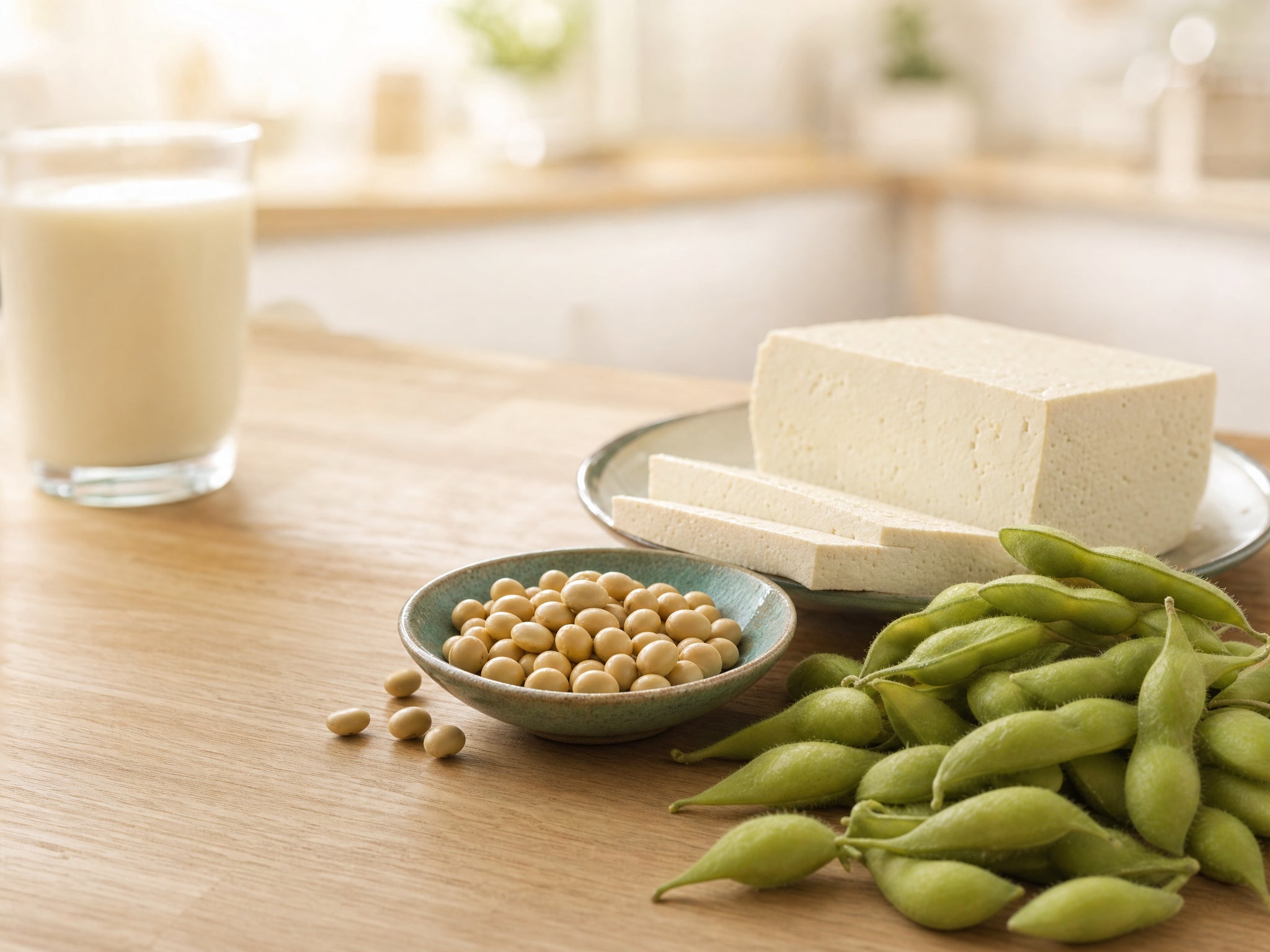
Few foods carry a worse reputation in the gym than soy, and the story behind it is quickly told: soy contains plant compounds that resemble the female hormone oestrogen, so soy supposedly makes men feminine, lowers testosterone and ruins muscle growth. It sounds logical, it gets repeated endlessly, and it is still wrong on nearly every count.
The myth sticks around because a few of its building blocks are genuinely true. Soy isoflavones really are phytoestrogens, they really do bind to oestrogen receptors, and there really are a handful of spectacular case reports in the literature. The thing is, those building blocks simply do not add up to what bro-science makes of them.
What actually happens when a man eats soy, what sets phytoestrogens apart from the body's own oestrogen, and whether soy protein puts the brakes on your muscle growth: we sort that out here with meta-analyses rather than hearsay. One bit of housekeeping up front: SYNTYZE is soy-free, but not because soy is dangerous. The reason is a different one, and we come back to it at the end.
- Soy does not lower testosterone in men. A meta-analysis of 41 studies in 1,753 men found no effect of soy protein or isoflavones on testosterone, oestradiol or SHBG, regardless of dose or duration (Reed 2021).1
- Isoflavones are phytoestrogens, yet they act differently than the body's own oestrogen: they bind preferentially to oestrogen receptor beta rather than alpha, which is why researchers class them as selective modulators rather than hormone copies (Messina 2025).3
- For muscle growth, what counts is leucine, not the hormone. With leucine matched, soy protein builds just as much lean mass and strength as whey (Lynch 2020, RCT).5
- The breast cancer worry is laid to rest too: in a study of 300,000 women, moderate soy intake did not raise the risk and if anything nudged it slightly the other way (Wei 2019).9
Contents
Where does the myth that soy feminises men come from?
The myth has three roots: animal experiments using extremely high isoflavone doses, two heavily cited case reports, and the simple word "phytoestrogen". Line those hints up against controlled human trials and population data, and they fall apart (Messina 2025).3 The most spectacular individual cases also involved men who were drinking several litres of soy milk a day, many times the usual amount.
The word "oestrogen" in the name does the rest. When a compound is called that, it sounds inevitable that it triggers something feminine in a man. That linguistic shortcut is the real engine of the myth, not the evidence.
The assumption that soy feminises men rests mainly on rodent studies using very high doses and on isolated case reports. It does not transfer to ordinary intakes: in clinical trials in humans, the presumed hormonal effect failed to appear (Messina 2025, review).3
What do the studies on soy and testosterone say?
They say it very plainly: nothing happens. The largest analysis to date pooled 41 studies and measured testosterone in 1,753 men. Neither soy protein nor isolated isoflavones changed testosterone, free testosterone, oestradiol or the binding protein SHBG, and that held regardless of dose or trial length (Reed 2021).1
This is not a single study that happened to find nothing. It is decades of evidence bundled together. The lead study is worth a closer look, because its size is the reason the question counts as settled.
Reed and colleagues (Reproductive Toxicology) analysed 41 clinical trials in which men consumed soy foods, soy protein or isoflavone extracts. Testosterone was measured in 1,753 men, oestradiol in 1,000 and SHBG in 967. Across every statistical model, there was no significant effect on any of these markers. A sub-analysis by dose and duration changed nothing about that.1
This work did not stand alone. Back in 2010, the same research circle had already published a first large meta-analysis, with 15 placebo-controlled comparison groups and the very same finding: no influence of soy or isoflavones on testosterone, free testosterone or SHBG. The myth has not just been refuted since yesterday, then, but for over a decade (Hamilton-Reeves 2010).2
Notice something? If an effect were real and as dramatic as gym folklore claims, it would have to show up somewhere across 41 studies. It does not. That is almost too clear-cut to be interesting anymore.
An updated meta-analysis of 41 clinical trials in 1,753 men found no significant influence of soy protein or isoflavones on total testosterone, free testosterone, oestradiol or SHBG, regardless of dose or trial length (Reed 2021). An earlier meta-analysis had already reached the same result in 2010 (Hamilton-Reeves 2010).12
Why phytoestrogens act differently than the body's own oestrogen
Because they dock onto a different switch. Isoflavones do resemble oestrogen in structure, but they bind preferentially to oestrogen receptor beta rather than to receptor alpha, the one that drives the classic female effects. That is why researchers class them as selective oestrogen receptor modulators rather than straight hormone copies (Messina 2025).3
The distinction sounds technical, yet it is the heart of the reassurance. The body's own oestradiol binds alpha and beta roughly equally. Isoflavones favour beta, a receptor type that sits in tissues which have little to do with feminisation. Older biochemical work already described this preference for the beta receptor among isoflavones from soy and red clover, and classed them as modulators that can act oestrogen-like or in the opposite direction depending on the tissue (Beck 2005).4
A selective modulator is not an on-off switch but a compound that acts differently depending on the tissue and the hormonal context. That is precisely why you cannot derive "makes you feminine" from "binds to an oestrogen receptor".
Isoflavones such as genistein and daidzein bind preferentially to oestrogen receptor beta rather than alpha, which is why they are regarded as selective oestrogen receptor modulators (SERMs). That selectivity explains why, despite their structural similarity to oestradiol, they do not produce a consistently feminising effect (Messina 2025, Beck 2005).34
Is soy protein worse for muscle growth?
It comes down to a single detail, and that detail is not "hormone" but leucine. In a 12-week controlled trial of 61 untrained people, the soy and whey groups built the same amount of lean mass and strength once both proteins were matched for 2 g of leucine per serving. The hormone question plays no role for muscle growth (Lynch 2020).5
Soy naturally carries slightly less leucine than whey. Leucine is the amino acid that triggers muscle growth. This is exactly where soy's real, small disadvantage sits, and exactly where the myth names the wrong culprit. We took apart how leucine sets off the build in our piece on leucine and muscle protein synthesis.
Lynch and colleagues (Int J Environ Res Public Health) followed 61 untrained men and women over 12 weeks, three supervised sessions a week, of whom 48 completed the trial. One group added 19 g of whey isolate, the other 26 g of soy isolate, both with exactly 2 g of leucine. Lean mass and peak leg-extension strength rose markedly in both groups, with no significant difference between soy and whey.5
There is a fair counterpoint, though: if you do not match the leucine, whey can come out ahead. In a nine-month trial, the whey group built more lean mass than the soy group, simply because whey delivered more leucine per serving and nothing was adjusted for it. The effect is real, but it is a leucine effect, not a soy-is-feminine effect (Volek 2013).6
A meta-analysis across ten studies paints the same picture at group level: whey raised lean mass measurably, while for soy the effect did not reach significance in the analysis (Piri Damaghi 2021).7 At first read that looks like a clear point for whey. Yet it is exactly the difference that matching the leucine in Lynch erases again.
And the protein quality? Here too, soy stands up better than its reputation might suggest. By the modern DIAAS benchmark, soy protein reaches the "high quality" category with a score of at least 75, just like whey, while many single plant proteins sit below that (Herreman 2020).8 The table below lines soy and whey up honestly side by side.
| Criterion | Soy protein | Whey protein |
|---|---|---|
| Effect on testosterone in men | No effect1 | No effect |
| Leucine per serving | Slightly less | Slightly more |
| Protein quality (DIAAS) | High (≥ 75)8 | High (≥ 75) |
| Muscle growth at matched leucine | Equivalent5 | Reference |
Soy and whey compared directly. The only real difference lies in leucine density, not in any hormonal action.
With leucine intake matched at 2 g per serving, soy and whey protein produced comparable gains in lean mass and peak strength over 12 weeks (Lynch 2020, RCT, n = 61). Without leucine matching, whey can come out ahead thanks to its higher leucine density (Volek 2013). The difference is a leucine question, not a hormone question.5
And in women? Soy and the breast cancer worry
Here too, the research points to reassurance rather than risk. In a prospective study of around 300,000 Chinese women, moderate soy intake was not linked to a higher breast cancer risk, and in the accompanying analysis a higher isoflavone intake even went hand in hand with a slightly lower risk (Wei 2019).9
This worry springs from the same logic as the testosterone myth: phytoestrogen sounds like a hormone, and a hormone sounds like breast cancer. The population data contradict that chain. A meta-analysis across 16 cohort studies with more than 11,000 cancer cases and over 648,000 participants found no risk-raising link, and at high soy intake rather the opposite (Zhao 2018).10 Two independent bodies of data, the same reassuring result.
In a prospective study of about 300,000 women, moderate soy intake was not linked to an increased breast cancer risk; each additional 10 mg of isoflavones per day went with around 3 % lower risk (Wei 2019). A meta-analysis of 16 cohorts with 648,000 participants likewise found no increased risk, and a reduction at high soy intake (Zhao 2018).910
The Bottom Line
The hormone fear around soy is bro-science, not a finding: 41 studies find no effect on testosterone, the beta-receptor mechanism explains why, and for muscle growth it is the leucine that decides, not the hormone. If you like soy, you can use it without a second thought. Reassuring for everyone who eats it, and a let-down for everyone who was hunting for a good scapegoat.
FAQ: soy, hormones and muscle growth
There is no solid evidence for that. The meta-analyses on soy and male hormones find no effect on testosterone, free testosterone or the binding protein SHBG (Reed 2021, Hamilton-Reeves 2010). The fertility worry rests on animal experiments using very high doses and on isolated case reports, not on controlled human trials at ordinary intakes.
Reviews of isoflavones take their bearings from an intake of around 50 mg of isoflavones per day, which corresponds to roughly two servings of traditional Asian soy foods (Messina 2025). In that range, the effects on male hormones sit at zero, and in population data moderate intake is safe for women too (Wei 2019). Anyone who eats tofu, edamame or soy milk on a regular basis stays within a well-studied range.
Because of taste, variety and the allergen profile, not out of fear of hormones. Soy is one of the most common food allergens, and many people simply dislike its characteristic taste. That is why SYNTYZE builds on pea and fava bean protein, keeps the leucine content at a solid 3 g per serving, and publishes the full amino acid profile. It is a choice for a particular recipe, not a warning against soy.
Soy is safe, that is the honest answer. If you still prefer not to have soy in your shake, whether for the taste, for variety, or because you want to avoid allergens, then SYNTYZE Plant Protein gives you the same performance base on a different footing: pea and fava bean, leucine-optimised, with a published amino acid profile. If the broader comparison interests you, we have set plant protein and whey side by side in detail, and we explain why the two-source blend works so well in our piece on pea and fava bean protein.
24 g protein and 3 g leucine per serving, from pea and fava bean. Soy-free, no sweeteners, with a published amino acid profile.
Share: