
62 % of a cohort of British professional athletes were below the threshold for adequate vitamin D status during the winter months. That number does not show up in any training app, but your body notices it directly: lower sprint speed, less vertical jump, weaker muscle function as soon as the sun disappears.3
If you eat plant-based and train three times a week, you stack two risk profiles in one. The athlete profile, where demand for several micronutrients sits above that of the general population. And the vegan profile, where intake of vitamin B12, iron, zinc, and omega-3 is structurally lower than on a mixed diet.
This article shows which micronutrients are actually critical for vegan athletes, what the research says about deficiency rates and performance impact, which blood markers are worth tracking, and where supplementation makes sense, instead of swallowing everything the health-food store carries.
Key Takeaways
- Vegan athletes carry a structurally elevated risk for deficiencies in vitamin B12, vitamin D, iron, zinc, calcium, and long-chain omega-3 fatty acids (EPA/DHA).1
- Vitamin B12 deficiency or depletion shows up in 11 to 90 % of vegetarians and vegans depending on the population (systematic review, Pawlak 2013), making it practically unavoidable without supplementation.2
- Iron deficiency without anemia is enough to measurably reduce aerobic performance. On a vegetarian diet, bioavailability is lower and iron stores (ferritin) typically sit below those of mixed-diet eaters.45
- Practical recommendations from the Rogerson 2017 review: supplement B12 (≥ 2.4 µg/day), pair iron with vitamin C, add EPA/DHA from algae oil, and dose vitamin D based on a blood test.6
- A plant-based diet and athletic performance are not at odds, given careful micronutrient planning. A recent review found no blanket disadvantage compared with a mixed diet.7
Contents
- Why athletes have higher micronutrient needs
- Vitamin D: the most common gap, in athletes and in vegans
- Vitamin B12 and iron: the critical values on a plant-based diet
- Zinc, omega-3, and calcium: the rest of the gap list
- Daily requirements, blood tests, and supplementation basics
- Frequently asked questions
Why athletes have higher micronutrient needs
Training shifts your micronutrient balance on several fronts at once. More muscle mass means a busier protein, iron, and zinc turnover. More sweat means greater mineral losses, especially of iron, zinc, and magnesium. And more oxidative stress in the muscle cell ties up co-factors such as B vitamins and antioxidants, which are continuously consumed in enzymatic reactions.6
At a daily protein intake of 1.6 to 2.0 g per kilogram of body weight, which is standard for many strength athletes, amino acid metabolism runs at a high level. That raises the functional demand for vitamin B6, B12, and folate, because these three vitamins occupy central positions in amino acid metabolism.
On top of that, training in a calorie deficit (a cutting phase, for instance) costs more than calories. It also costs micronutrient density. The simple math of "less food, fewer nutrients" is rarely balanced out in practice, especially when the diet is already plant-based and the food selection narrower to begin with. For a deeper read on how protein needs scale with training volume, our guide on how much protein you actually need per day walks through the meta-analyses.
The picture sharpens when you look honestly at where most vegan athletes actually stand. The biggest risk group is not the meticulously planned athlete with a sports nutritionist on call, but the ambitious recreational athlete who eats plant-based as a lifestyle choice, without ever having checked the critical nutrients systematically. That is exactly what this article is for: not as a warning, but as a map of which markers deserve a closer look.
Vitamin D: the most common gap, in athletes and in vegans
Vitamin D is the micronutrient with the largest suspected gap on this list. It is not specifically a vegan issue. In Central Europe, status in mixed-diet eaters is similarly problematic during winter. But vegan athletes combine two risk factors: almost no vitamin D from food (no fatty fish, no fortified milk in the routine) and, in many sports, limited direct sun exposure on top of that.3
Close et al. measured 25(OH)D status in 61 non-supplemented British professional athletes and 30 healthy controls during the winter months. 62 % of the athletes and 73 % of the controls were below 50 nmol/L (insufficiency). An 8-week supplementation with 5,000 IU/day vitamin D₃ raised values from 29 ± 25 to 103 ± 25 nmol/L, with significantly improved 10-meter sprint times and vertical jump compared with placebo.3
The data come from the UK at 53° north. Central Europe sits between 47° (Vienna) and 55° (Schleswig-Holstein), where winter sun is too low in the sky to produce meaningful amounts of vitamin D₃ in the skin. Realistically, anyone who trains from October through March without regular supplementation or a winter trip south has a high probability of a 25(OH)D below 50 nmol/L.
What this means functionally: vitamin D contributes to normal muscle function (EFSA, EU regulation 432/2012). Mechanistically, the vitamin D receptor sits in skeletal muscle cells and influences calcium handling, protein synthesis, and type-II fibre activity. In the Close study, this translated into measurably better sprint times, a concrete performance metric and not a surrogate marker.
The practical move: have 25(OH)D measured once a year, ideally in February or March when values hit their annual low. The sports-medicine target range is 75 to 125 nmol/L. A typical maintenance dose for German-speaking athletes lands between 1,000 and 2,000 IU per day during the dark half of the year, and higher under medical supervision when a deficiency is documented.
Vitamin B12 and iron: the critical values on a plant-based diet
Vitamin B12 is the micronutrient where the vegan conversation gets unavoidable. B12 in a form humans can use comes exclusively from animal foods and from foods fortified with B12. Plant sources such as algae or fermented products either deliver only traces or B12 analogs that do not act reliably in human metabolism.1
Pawlak et al. analyzed 18 studies that measured B12 status using methylmalonic acid, holotranscobalamin, or both. Deficiency or depletion rates were 62 % in pregnant vegetarians, 25 to 86 % in children, 21 to 41 % in adolescents, and 11 to 90 % in older vegetarians. Vegans were consistently more affected than vegetarians, and the duration on the diet correlated with deficiency.2
That spread of 11 to 90 % looks alarming at first glance, but it is easy to explain. Without supplementation, B12 deficiency in vegans is a question of when, not if. Anyone who has eaten vegan for years without ever taking or testing B12 belongs, with high probability, to the upper half of that statistic. Our pillar article on vegan muscle building and nutrition covers the complete protein and micronutrient framework that sits behind this.
Functionally, B12 matters for athletes for two reasons. It contributes to the reduction of tiredness and fatigue and to normal energy-yielding metabolism (EFSA). And a chronically elevated homocysteine level, an indirect marker of an untreated B12 deficiency, has effects on the endothelium and oxygen transport that can erode endurance performance over the medium term.
Rogerson 2017 recommends that vegan athletes supplement at least 2.4 µg of B12 per day (DRI), with some authors advising up to 6 µg per day.6 For a weekly high-dose protocol, a value of 2,000 µg has become established in practice. The higher weekly value accounts for the fact that the amount absorbed via the intrinsic factor is very small at large single doses.
Iron is the second critical front. Plant iron exists almost exclusively as non-heme iron, whose absorption depends heavily on inhibitors such as phytate, polyphenols, and calcium. Heme iron from meat is taken up largely independently of those factors.5
Hunt 2003 summarized: vegetarians in developed countries have lower iron stores (serum ferritin) but no marked increase in clinical iron-deficiency anemia. Women of childbearing age struggle to meet the vegetarian-adjusted iron recommendations through food alone. The author recommended monitoring hemoglobin in vegetarian children and women of childbearing age.5
For athletes, the stage below clinical anemia is more relevant than the diagnosis itself. Haas and Brownlie showed in their 2001 systematic review that iron deficiency without anemia (IDNA: low ferritin, normal hemoglobin) measurably impairs energetic efficiency and therefore endurance performance. With moderate iron-deficiency anemia, maximal oxygen uptake drops, and the data on correction are robust.4
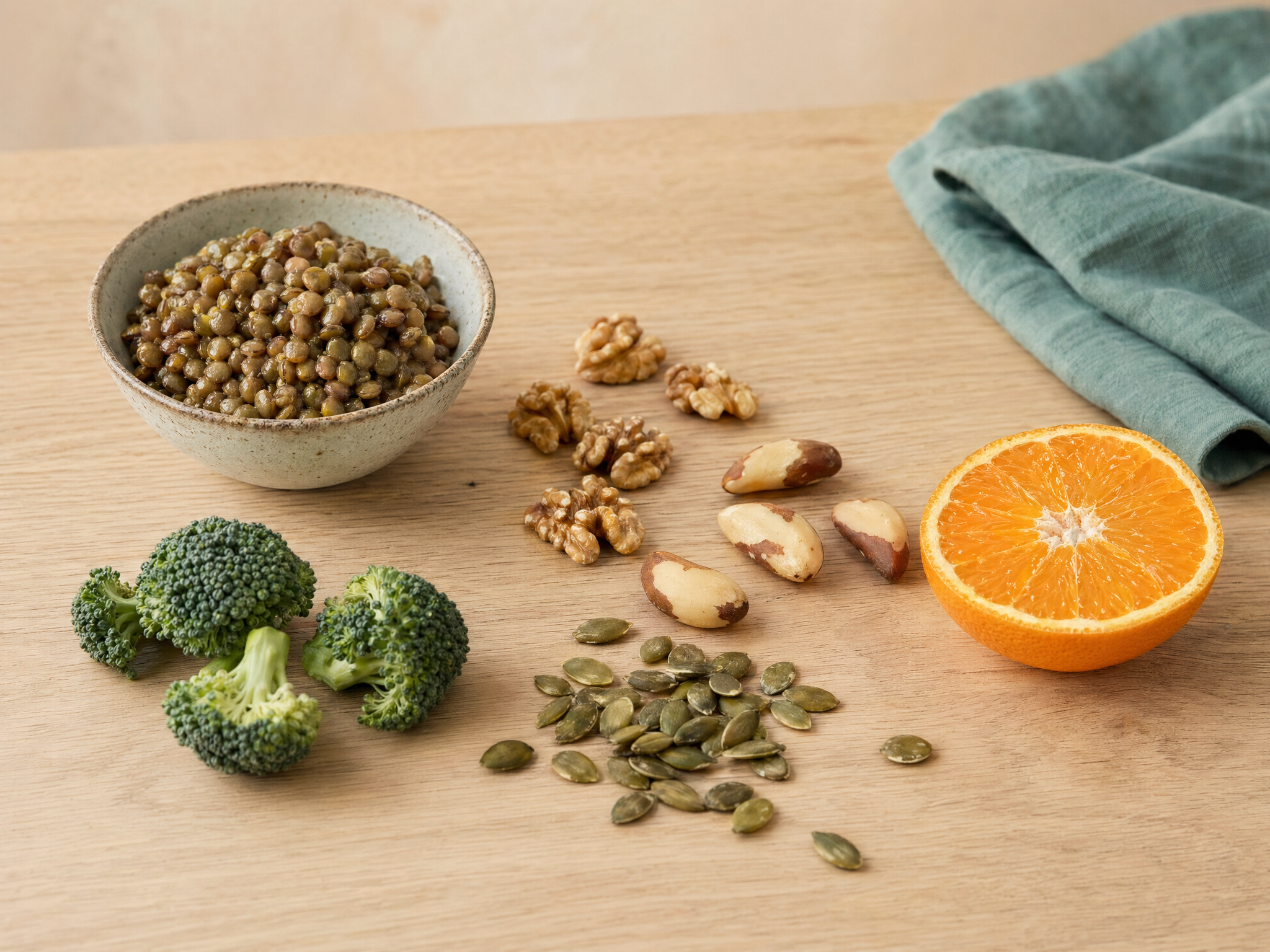
Three practical takeaways. First, pair iron-rich plant sources such as legumes and whole grains with vitamin C (a glass of orange juice with a lentil meal, for example). Second, reduce phytate load through soaking, sprouting, or sourdough fermentation. Third, keep a two-hour buffer between iron-rich meals and coffee or black tea. Blanket iron supplementation without a blood test is not advisable: high doses promote oxidative stress and can contribute to iron overload in men.
Zinc, omega-3, and calcium: the rest of the gap list
Zinc is the third mineral where phytate makes the difference. A vegan diet often contains more zinc than people assume, but bioavailability is lower. Legumes and whole-grain products carry plenty of zinc, but they also block part of the absorption. Zinc contributes to normal protein and DNA metabolism (EFSA), a relevant function for anyone who builds and breaks down muscle tissue regularly.5
The practical lever for zinc availability is the same food-prep approach as for iron: soak or sprout legumes, and choose sourdough over quickly leavened bread. These steps reduce phytate content significantly without affecting flavour.5
With omega-3, the situation is structurally awkward. Plant sources deliver alpha-linolenic acid (ALA, mainly from flax oil, walnuts, and chia). The body can convert ALA to EPA and DHA in small amounts, but the conversion rate is low and varies between individuals. For vegan athletes, the only reliable source of EPA and DHA is algae oil.6
EPA and DHA support membrane fluidity, inflammation regulation, and cardiovascular health. Supplementing 250 to 500 mg of EPA+DHA per day from algae oil covers most needs without raising oxidative-stress or bleeding-risk concerns. The EFSA position is sober: EPA and DHA contribute to normal heart function (at intakes of at least 250 mg/day).
Calcium, finally, is a matter of practice on a plant-based diet. Anyone who skips fortified plant drinks and high-calcium mineral waters (≥ 150 mg/L) can drop below the 1,000 mg/day requirement. Bone health is doubly relevant for athletes: impact loads and resistance training stress the bone, but the bone only rebuilds when calcium, vitamin D, and protein are all available. The combination of low calcium and low vitamin D is the most uncomfortable, because the two reinforce each other.1
A pragmatic rule of thumb: anyone who regularly uses fortified plant drinks (120 to 240 mg calcium per 100 ml), broccoli, calcium-set tofu, and calcium-rich mineral waters stays in the safe zone. If your routine is tap water and unfortified almond milk, it is worth running the numbers once.
Daily requirements, blood tests, and supplementation basics
If you eat plant-based and train, a manageable set of blood tests gets you most of the way. The table below summarizes the most relevant values, sensible markers, and a rough action column. The numbers are orientation, not a substitute for individual medical assessment.
| Nutrient | Daily requirement (DGE/EFSA) | Blood marker | Typical action |
|---|---|---|---|
| Vitamin B12 | 4 µg (DGE 2019) | Holo-TC, MMA, homocysteine | Permanent supplement (≥ 2.4 µg/day or 2,000 µg/week) |
| Vitamin D | 20 µg (800 IU) | Serum 25(OH)D | As needed: 1,000–2,000 IU/day in winter |
| Iron | 10–15 mg (women higher) | Ferritin, Hb, transferrin saturation | Food strategy first; supplement only when ferritin is low |
| Zinc | 7–10 mg | Plasma zinc (interpret cautiously) | Reduce phytate; supplement only when targeted |
| Omega-3 (EPA/DHA) | 250 mg EPA+DHA | Omega-3 index (HS-Omega-3 Index) | Algae oil 250–500 mg/day |
| Calcium | 1,000 mg | Rarely tested; assess via diet log | Fortified drinks, calcium-rich mineral water |
Values: D-A-CH reference values 2024 and EFSA Dietary Reference Values; markers and actions derived from the reviews cited in this article.
Three principles keep the effort low. First, B12 is non-negotiable: there is no clean way around supplementation on a strict vegan diet. Second, get vitamin D measured once a year, ideally in February or March. Third, address iron through food before reaching for a supplement (legumes plus vitamin C, reduce phytate), and supplement only when ferritin demands it.
If symptoms such as chronic fatigue, exertional shortness of breath, drop in concentration, or unexplained training plateaus persist beyond three or four months, this is not the moment to self-diagnose online. Ask your doctor for a micronutrient panel. Deficiencies in iron, B12, or vitamin D can present similarly, and the differential runs through blood markers, not self-observation.
One angle that often gets shortchanged in this logic: protein. It is not a micronutrient, but it is the central lever vegan athletes have to upgrade their overall nutrient intake. A well-formulated plant protein powder helps you cover your daily protein target without an extra trip to the store. SYNTYZE Plant Protein delivers 24 g protein and 3 g of leucine per serving. For an evidence-led look at how plant protein performs in training contexts, our overview on plant protein in sports walks through the 12-week RCT data on strength, endurance, and muscle growth.
Frequently asked questions
An annual micronutrient panel with five values is a sensible baseline: vitamin B12 (holotranscobalamin and methylmalonic acid are more informative than classic serum B12), ferritin (iron stores), 25(OH)D (vitamin D status), a complete blood count for hemoglobin and erythrocyte indices, and the omega-3 index. The last one is not offered in every clinic, but you can order it as a dried-blood-spot test from specialized labs.
Zinc is often included in the panel, but the plasma value is a fairly unreliable marker of tissue status. A dietary analysis is more telling: anyone who eats legumes, whole grains, nuts, and seeds regularly covers the requirement on paper almost every time, as long as phytate load is reduced.
If you want to extend the workup, add folate, selenium, and iodine to the order. Selenium in particular is low in European soils and therefore scarce in plant-based diets. This expanded panel is optional, not mandatory, and most relevant for ambitious athletes with specific concerns.
For vitamin B12, the answer is no. B12 in a form humans can use comes exclusively from animal foods and from B12-fortified products. If you eat strictly vegan and do not use fortified plant drinks or breakfast cereals, you have no reliable source. The Pawlak 2013 data show deficiency rates of 11 to 90 % depending on the population, which is not an acceptable risk to leave open.
For vitamin D, geography decides. In Central Europe, endogenous production through sunlight is essentially zero from October through March. Mixed-diet eaters have the same supply problem, and vegans are additionally disadvantaged by the absence of fatty fish.
Iron, zinc, and calcium can be covered through food in principle, provided the selection is broad and phytate-reducing prep is used (soaking, sprouting, sourdough). EPA and DHA, without an algae oil supplement, are only available via the low ALA conversion rate. A targeted supplement is the pragmatic route here.
Three standard supplements are worth running for vegan athletes without further diagnostics: vitamin B12 as a permanent supplement (≥ 2.4 µg/day or 2,000 µg/week), algae oil with 250 to 500 mg of EPA+DHA per day, and vitamin D during the dark half of the year (1,000 to 2,000 IU/day), ideally adjusted individually after a blood test.
For iron, zinc, and calcium, the order is reversed: review the diet first, then supplement. An iron supplement without documented deficiency can contribute to iron overload in men and promote oxidative stress. It is a tool for correcting, not for hedging. If symptoms such as unusual fatigue, pale mucous membranes, or shortness of breath at familiar workloads persist beyond two weeks, this is a job for a blood test, not self-diagnosis. Iron, B12, and vitamin D deficiencies can show overlapping symptoms that only blood markers can separate.
One athlete-specific add-on that is not covered in the brief but appears repeatedly in the research: creatine. Vegans have structurally lower muscle creatine stores, because the body produces only a limited amount endogenously and the rest would normally come from meat. Supplementing 3 to 5 g per day usually delivers larger effects in vegan athletes than in mixed-diet eaters, whose stores are already closer to the ceiling. More on this in our piece on creatine for vegans.
The Bottom Line
Vegan athletes do not have a general deficiency problem, but a precise one. Always supplement B12, measure vitamin D in winter and top up, cover EPA/DHA from algae oil, and pull iron, zinc, and calcium through food choices. Five blood values once a year and three standard supplements cover roughly 90 % of the relevant risks. The rest is on the plate.



Share: