
There's a simple reason vegan athletes often respond more strongly to creatine supplementation than their meat-eating training partners: if you skip meat and fish, you start with measurably lower creatine stores, which means there's more headroom to fill.
This isn't a marketing angle. It's a mechanism. Most dosing recommendations assume every athlete walks in with the same baseline. For vegans, that assumption doesn't hold. A plant-based diet delivers almost no dietary creatine, and that gap is exactly what makes supplementation more productive once it starts.
This article breaks down how creatine works inside the muscle, what recent studies tell us about vegan athletes, and how to set up your daily dose.
- Without supplementation, studies show vegans carry 7 to 26 percent lower free and 10 to 15 percent lower total creatine concentrations in muscle than omnivores, depending on the muscle group.2
- Creatine supplementation in vegetarians often pushes levels above those of omnivores, the clearest evidence for the baseline effect.2
- The only EFSA-authorized creatine claim applies to short-term, high-intensity exercise, and requires at least 3 g per day.
- Cognitive performance can benefit too: vegetarians outperformed omnivores on memory tasks after supplementation.5
- A 7-day loading phase measurably refills muscle creatine stores, but sprint gains only appear after longer adaptation.3
What is creatine, and what does it do in the muscle?
Creatine is a compound your body makes in the liver, kidneys, and pancreas from three amino acids: arginine, glycine, and methionine. Inside muscle tissue, most of it sits as phosphocreatine (PCr), and that form is the key to short, intense efforts.
The principle is simple. When you push through a heavy set or sprint, your body burns ATP faster than aerobic metabolism can resupply it. Phosphocreatine donates its phosphate group to ADP and regenerates ATP in seconds. The bigger your PCr pool, the longer you can draw on that short, high-intensity energy before fatigue sets in.
Omnivores take in 1 to 2 g of creatine per day from meat and fish, especially red meat and herring. The rest is produced internally. Vegans cover their entire creatine requirement through endogenous synthesis, which is biologically possible but metabolically expensive.
EFSA claim (EU Reg. 432/2012, GREEN), approved wording: Creatine increases physical performance in successive bursts of short-term, high-intensity exercise. Condition: at least 3 g of creatine daily.
Important: this claim covers short-duration efforts (sprints, heavy sets, plyometrics). The claim that creatine builds muscle directly is not approved wording and not supported by EFSA. What is measurable: more force across repeated short maximal efforts, and that is enough as a training stimulus.
Do vegans really have less creatine?
Yes, and the gap is measurable. A plant-based diet delivers almost no dietary creatine. Endogenous synthesis covers part of the shortfall, but not all of it: studies show vegans and vegetarians carry 7 to 26 percent lower free and 10 to 15 percent lower total creatine concentrations in muscle than omnivores, depending on the muscle group.2
In a 2019 review, Balestrino and Adriano noted something worth pausing on: vegans do synthesize all the creatine they need, but the process consumes most of their methylation capacity, and their muscle creatine levels still come in below those of meat eaters.4 Endogenous synthesis isn't a full replacement, it's an energetically costly workaround.
Gutiérrez-Hellín et al. (2024) summarize it clearly: vegans and vegetarians who don't consume animal-sourced creatine have reduced intramuscular creatine stores, and supplementation improves both physical and cognitive performance while supporting a plant-based lifestyle.1
That's the starting point. Not a deficiency, but a baseline with a clear consequence: whoever closes that gap has more to gain than someone whose stores are already partially topped up.
What do studies say about supplementation in vegans?
The evidence is unusually clean for a supplement topic. In 2020, Kaviani et al. systematically reviewed nine studies and landed on a clear finding: creatine supplementation raises total creatine and phosphocreatine concentrations in the muscles of vegetarians, often to levels that exceed those of omnivores.2
Kaviani et al. (2020), Int J Environ Res Public Health: 9 studies in vegetarians and vegans. Creatine supplementation increased muscle creatine and phosphocreatine, raised lean mass, type II fibre cross-sectional area, IGF-1, muscle strength, and endurance. In several studies, post-supplementation creatine levels surpassed those of omnivores. DOI: 10.3390/ijerph170930412
That's the core of the baseline effect. If you start with low stores, you benefit the most from filling them. Omnivores have less headroom left, because their diet has already partially topped them up.
But how fast do the stores actually refill? Bonne et al. tested that in 2025 with a controlled trial of 15 vegan and vegetarian participants over seven days.
Bonne et al. (2025), Physiological Reports: n = 15 vegans/vegetarians, randomized, double-blind, placebo-controlled. Creatine group (n = 7): 0.3 g/kg/day split into 4 daily doses for 7 days. Result: muscle creatine +18.8 mmol/kg (p < 0.05), fat-free mass +1.15 kg (p < 0.05). Sprint performance (peak and average power) stayed unchanged. DOI: 10.14814/phy2.705393
Here's a limitation worth stating plainly: the study is small (n = 15), and seven days clearly aren't enough to lift sprint performance. Stores fill quickly, but neuromuscular adaptation takes more time.
This doesn't change the overall picture, but it sharpens it: short-term, creatine supplementation in vegans boosts muscle stores and fat-free mass. Performance gains, think repeat-effort strength or high-intensity intervals, need at least four to eight weeks of consistent intake before they show up in training.
Cognition: an underrated benefit
Creatine isn't only active in muscle. In a 2018 systematic review (6 studies, 281 participants), Avgerinos et al. examined whether creatine affects cognitive performance, and short-term memory along with reasoning both improved measurably after supplementation.5 For vegans, this matters more than it might first seem. The brain is another energy-hungry organ, creatine supports ATP resynthesis there too, and vegans structurally run lower creatine levels because they don't get any from the plate.
Avgerinos et al. (2018), systematic review (6 studies, 281 participants): short-term memory and reasoning improved after creatine supplementation. Vegetarians responded more strongly on memory tasks than omnivores. DOI: 10.1016/j.exger.2018.04.0135
For other cognitive domains (long-term memory, attention, reaction time), the evidence was mixed. That's an honest result. Cognition is not an EFSA-authorized area of use for creatine, and sweeping claims would overreach. But the mechanism is biologically plausible, and for vegans who structurally take in less creatine, the room to benefit is larger than for omnivores.
Creatine dosing for vegans: loading or daily intake?
Creatine monohydrate is the standard form, and the one with the strongest evidence behind it. Gutiérrez-Hellín et al. explicitly recommend monohydrate as the preferred option, since every clinically relevant study was run with it.1 Other forms (creatine ethyl ester, creatine HCl, buffered creatine) promise more, but in head-to-head comparisons they don't consistently deliver better results.
7 days
Two routes get you to fully loaded creatine stores:
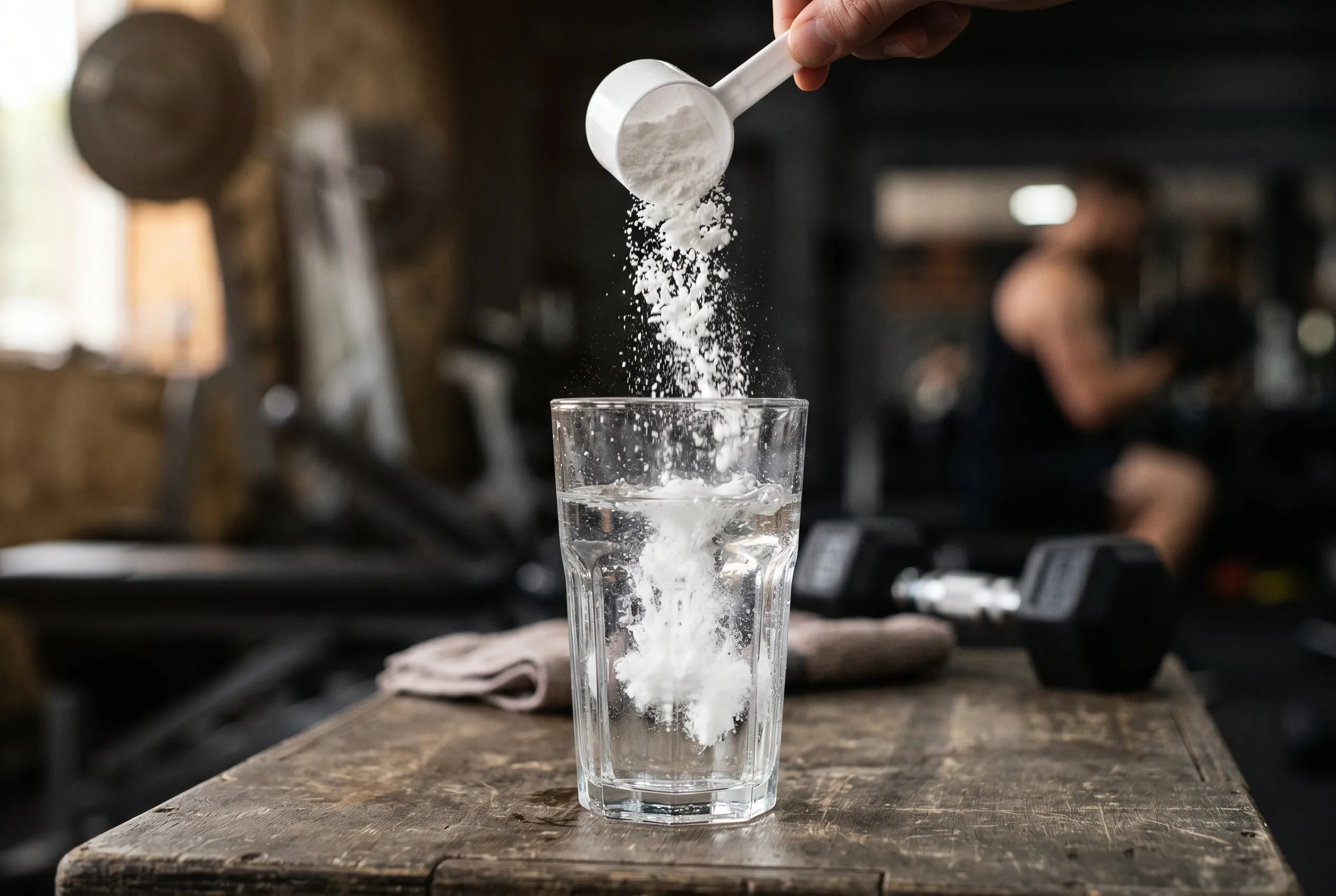
If you want to fill the stores quickly, say ahead of a competition window or an intense training block, loading makes sense: 0.3 g/kg of body weight per day, split across 3 to 4 doses, for 5 to 7 days. At 75 kg that comes out to about 22 g per day. After that, 3 to 5 g daily is enough for maintenance.
If you'd rather skip the loading phase, 3 to 5 g daily gets you to the same fill level in about three to four weeks. Slower, but with less of the stomach discomfort that high single doses occasionally cause.
For vegans, either route pairs well with a meal. The insulin response to carbohydrates supports creatine uptake into the muscle cell. Stirring a creatine monohydrate powder into your plant-based protein shake is practical and biologically sound.
One final point on safety: creatine is well-studied and safe in healthy individuals up to 20 g per day.4 Anyone with kidney issues should check in with a doctor first. For everyone else, creatine monohydrate is one of the most thoroughly studied supplements on the market.
FAQ: Creatine for vegans
Not necessarily higher, but the loading protocol is especially useful for vegans because baseline levels are lower. 0.3 g/kg/day for 5 to 7 days fills the stores measurably. Bonne et al. (2025) showed +18.8 mmol/kg of muscle creatine over that window.3 For ongoing intake, 3 to 5 g daily is enough, since once the stores are full they stay full. Important: after loading, you can drop to the lower maintenance dose.
That depends on the manufacturer. Creatine monohydrate is synthesized from sarcosine and cyanamide, and the process itself uses no animal-derived inputs. Check the manufacturer's purity certification, and look at whether any capsules use plant-based cellulose (HPMC) instead of gelatin. Powder without capsules is typically fine.
For classic endurance work (long runs, cycling over 30 minutes), the evidence is weak. Creatine is a system for short, intense energy output. For predominantly aerobic endurance, more PCr doesn't help much. It becomes relevant in endurance sports that include sprints, pace changes, or closing efforts, think soccer, basketball, or interval-based training. There, better repeat-effort strength makes a measurable difference.
The Bottom Line
For vegan athletes, creatine is the supplement with the strongest evidence base. Not because it was designed specifically for vegans, but because the baseline amplifies the effect. If you start with low stores, you have the most to gain from filling them.
The results are both grounding and freeing: no magic strength gains in seven days, but measurable increases in stores and a long-term improvement in short, high-intensity performance. 3 g per day, creatine monohydrate, taken consistently, that's the recommendation with the strongest backing in the literature.
Creatine for the intensity, protein for the rest. Plant-based training calls for both at the right dose. SYNTYZE protein powder delivers 24 g of protein and 3 g of leucine per serving, the base layer that lets creatine do its job.
Explore the protein powder →Plant-based · DigeZyme® enzyme complex (protease, amylase, cellulase, lipase, lactase) · 3 g leucine per serving · No artificial sweeteners


Share: