

On every other shelf in the gym, magnesium is sold as the fix for the night-time calf cramp. Cheap, convenient, seemingly harmless. The trouble is that this promise barely matches what the research actually shows.
That does not make magnesium irrelevant. The mineral sits right at the heart of the machinery that lets your muscles contract and relax, and a genuine deficiency costs you measurable performance. The two statements only seem to clash: magnesium is essential for muscle function, and yet an extra capsule does little for most athletes who are already well supplied.
This article keeps the two apart cleanly. You will learn what magnesium really does inside the muscle, how much you need as an active person, what the cramp question honestly answers, and which plant foods cover your needs without a supplement.
- Magnesium is directly involved in muscle contraction, ATP production and electrolyte balance. "Magnesium contributes to normal muscle function" is an officially authorised claim in the EU.1
- The daily requirement for healthy adults is 300 to 400 mg. Hard training raises that need by roughly 10 to 20 % through losses in sweat and urine.1,3
- Against muscle cramps, magnesium works more weakly than assumed: a Cochrane review of 11 trials found no clinically meaningful protection in older adults.4
- An extra dose mainly helps when you genuinely fall short. If you are well supplied, no performance gain is established.3,6
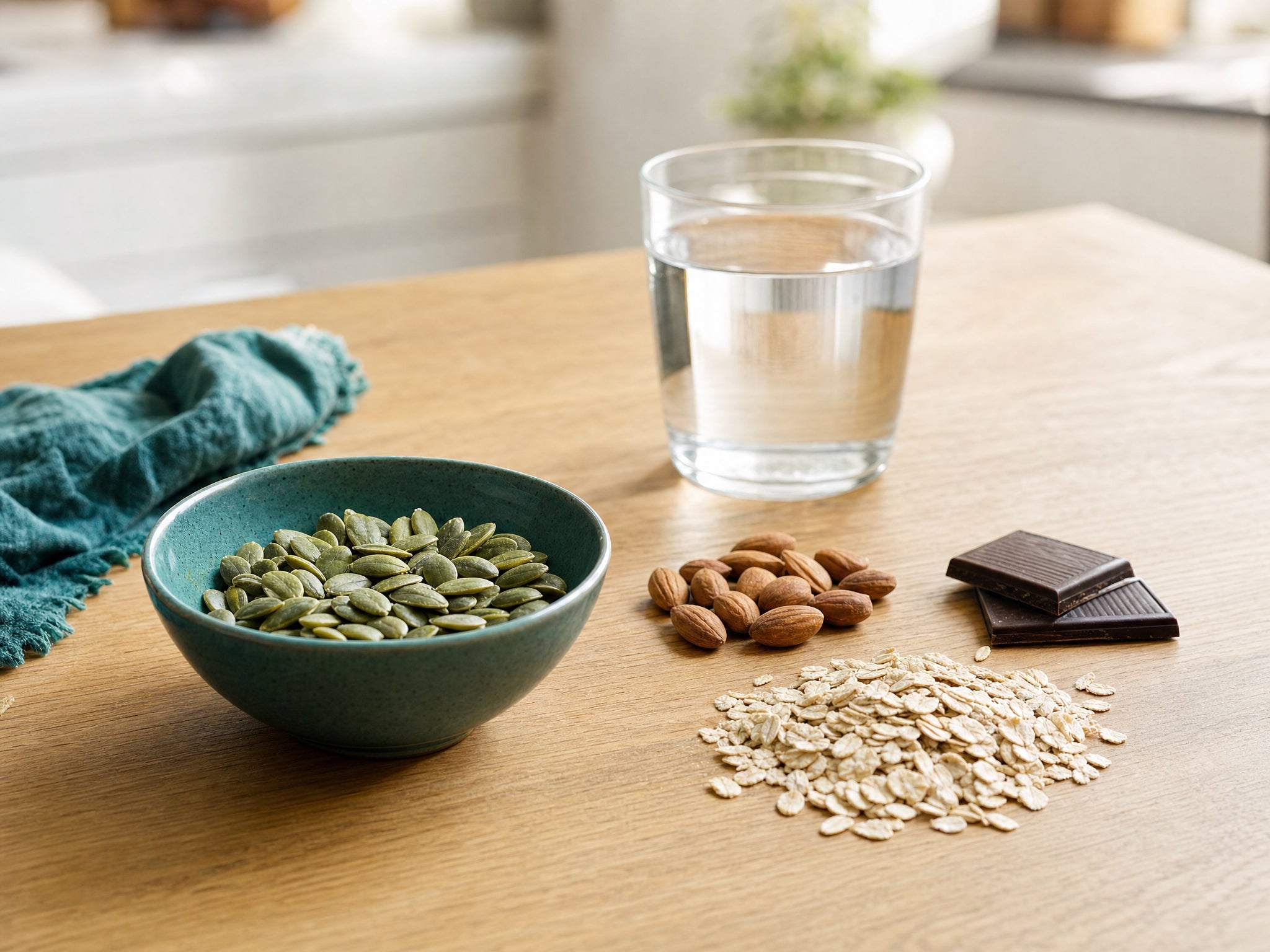
- You can cover your needs well from plants: pumpkin seeds, nuts, oats, pulses, wholegrains and cocoa are dense sources.
Contents
What magnesium really does in the muscle
Magnesium is a cofactor in more than 300 enzyme reactions, which puts it right in the middle of the energy metabolism of your muscle cells. Without magnesium, ATP production does not run, and ATP is the immediate fuel for every muscle contraction. That is precisely why a deficiency hits muscle function first.1
It gets interesting one level deeper, at the membrane of the muscle and nerve cell. There, magnesium acts as a natural stabiliser: it slows the calcium influx that triggers a contraction, and so makes sure the muscle lets go again after tensing.
Stanojević and colleagues (Biological Trace Element Research) describe magnesium as an essential regulatory cation of excitable membranes. It blocks voltage-dependent calcium channels, dampens acetylcholine release at the neuromuscular junction and stabilises excitation-contraction coupling. When magnesium is chronically lacking, this balance tips towards overexcitability. A subclinical deficiency, the authors note, is becoming increasingly common in the general population.2
From this dual role, supplying energy and dampening excitability, follows the entire link between magnesium and muscle function. It also explains why the symptoms of a deficiency are so non-specific: fatigue, muscle weakness, a higher cramp risk.
Several health claims are authorised for magnesium in the EU, among them: contributes to normal muscle function, to normal energy-yielding metabolism, to electrolyte balance, and to the reduction of tiredness and fatigue. These claims apply to the nutrient itself, not to any specific product.
Magnesium is central to muscle function on two fronts: as a cofactor in ATP production it supplies the energy for contraction, and as a membrane stabiliser it dampens the calcium-driven excitation signal and allows relaxation. A chronic deficiency shifts this balance towards overexcitability and weakness (Stanojević et al. 2024; Dominguez et al. 2025).1,2
How much do you really need as an athlete?
The daily requirement for healthy adults is estimated at 300 to 400 mg. Anyone who trains hard sits nearer the top end: intense exercise drives magnesium out of the body through sweat and urine and can raise the need by around 10 to 20 %.1,3
men (mg/day)
daily need
daily need
Where the critical lower limit sits can be put into numbers. Anyone who stays below it long-term risks a deficient status, and that is exactly when performance suffers.
Nielsen and Lukaski (Magnesium Research) summarise that strenuous exercise increases magnesium losses through urine and sweat and can raise the requirement by 10 to 20 %. An intake below 260 mg per day in men and 220 mg in women can lead to a deficient status. A marginal deficiency impairs performance and amplifies the oxidative stress of training.3
In practice this means the number that matters is not the capsule dose but your total daily intake from food plus anything you add on top. Anyone who already eats a varied diet is often within the target range. For how to keep the other critical nutrients of a plant-based sports diet in view, we have broken it all down in our overview of micronutrients for vegan athletes.
Healthy adults need around 300 to 400 mg of magnesium per day, and active people tend to need more. Hard training raises the requirement by roughly 10 to 20 % through losses in sweat and urine, and an intake below 260 mg (men) or 220 mg (women) can encourage a deficiency (Dominguez et al. 2025; Nielsen & Lukaski 2006).1,3
Does magnesium help against muscle cramps?
Here comes the uncomfortable answer: for the classic night-time calf cramp, the benefit is weakly supported. The most thorough overview on this is a Cochrane review that pooled 11 randomised trials with 735 people. In older adults with idiopathic cramps, it found no clinically meaningful effect.4
Garrison and colleagues (Cochrane Database of Systematic Reviews) analysed 11 RCTs with 735 people. In idiopathic cramps of older adults, no cramp measure was significantly better than placebo: the percentage change in cramps per week came to a mean difference of −9.59 % (95% CI −23.14 to 3.97), and the proportion with at least 25 % fewer cramps to a risk ratio of 1.04 (95% CI 0.84 to 1.29). For exercise-associated cramps in sport, there was no RCT at all. The authors' conclusion: a clinically meaningful protection against cramps for older adults is unlikely.4
One point many people miss: an extra portion of magnesium is not free of side effects. In the same review, more people in the magnesium group had mild side effects, mostly diarrhoea. So anyone who doses the mineral high risks a trip to the toilet rather than calm calves.
The popular shortcut through the skin does not hold up either. Magnesium sprays and gels are marketed on the promise of fast absorption through the skin, yet the evidence speaks against it.
Coates and colleagues (Int J Sport Nutr Exerc Metab) tested a commercial magnesium gel against placebo in 35 active people, randomised and double-blind, after a 40-minute downhill run. The gel had no effect on a single measure: not on muscle soreness, not on knee-extensor strength, creatine kinase or interleukin-6. Topically applied magnesium reduced neither muscle soreness nor markers of damage.5
For the night-time calf cramp in older adults, magnesium is not a reliable remedy on the best available evidence: the Cochrane review of 11 RCTs found no clinically meaningful protection, and for exercise-associated cramps in sport not a single randomised trial exists so far (Garrison et al. 2020).4
Muscle building and recovery: what the evidence shows
Magnesium does not build muscle, that is the job of training and protein. But among the many minerals linked to performance, it is one of the few with solid evidence behind it. That is shown by a systematic review which sifted through the entire body of mineral research.6
Heffernan and colleagues (Nutrients) screened more than 17,000 articles to the PRISMA standard and included 130 experiments from 128 studies. Their finding: for most minerals, the data on performance enhancement is thin. Only iron and magnesium reached a rating of "strong". Magnesium is therefore among the best-evidenced minerals, even though the evidence overall remains limited.6
The benefit shows up mainly as an association, not as a guaranteed effect. Cross-sectional data link a good magnesium status to better muscle performance, from grip strength to jump performance.
Zhang and colleagues (Nutrients) gathered animal and human studies. Several cross-sectional studies showed a positive link between magnesium status and muscle performance, for instance in grip strength, lower-leg power, knee-extension torque and jump performance. In intervention studies, magnesium supplementation improved functional measures such as quadriceps torque, and in older women also gait speed and chair-rise time.7
Under extreme load there is even a hint of a protective effect, modest as it is. In a controlled study of professional cyclists, a marker of muscle damage came out lower in the supplemented group.
Córdova and colleagues (Nutrients) followed 18 professional cyclists through a three-week stage race, nine of them on 400 mg of magnesium per day. The rise in myoglobin, a marker of muscle damage, came out lower in the magnesium group than in the control. The authors read this as a modest protective effect. Limitations: a small sample and a study design with additional supplements in both groups.8
The honest reading of all three findings: magnesium is a building block of good muscle function, not an amplifier that keeps delivering more performance beyond your normal requirement. Anyone already well supplied gains nothing from the next capsule.
Magnesium ranks alongside iron as one of the few minerals with "strong" evidence for athletic performance, and a good magnesium status goes hand in hand with better muscle performance (Heffernan et al. 2019; Zhang et al. 2017). The effect stays a building block, not a performance booster beyond your normal requirement.6,7
Plant-based magnesium sources for your needs
The good news for anyone eating plant-based: magnesium is plentiful in plant foods. Seeds, nuts, wholegrains, pulses and cocoa are among the densest sources there are. A handful of pumpkin seeds already covers a sizeable part of the daily requirement.
| Food | Magnesium per 100 g | In context |
|---|---|---|
| Pumpkin seeds | ~535 mg | very dense source |
| Almonds | ~270 mg | a handful is enough |
| Dark chocolate (70 %+) | ~210 mg | cocoa as the carrier |
| Oats | ~140 mg | breakfast staple |
| Wholemeal bread | ~90 mg | everyday source |
| Lentils (cooked) | ~36 mg | quantity makes the contribution |
Reference values from food composition tables, rounded. Actual values vary by variety, growing conditions and preparation.
The point behind it: anyone who eats a varied diet usually manages without a supplement. A breakfast of oats with nuts, pulses at lunch, a square of dark chocolate in the afternoon, and the daily requirement is realistically covered. It is the same logic you use to calculate your macros for muscle building. Both run through food, not through a single tub.
To supplement or not?
The decision hangs on a single question: do you genuinely fall short? The research is unusually clear here. Magnesium supplementation improves performance in people with a deficiency, but shows no effect in those already well supplied.3
Magnesium supplementation improves physical performance in people with a magnesium deficiency. In physically active people with an adequate magnesium status, no performance-enhancing effect is established (Nielsen & Lukaski 2006).3
From that follows a sober plan. Eat the sources from the table first, varied and spread across the day. If you suspect a deficiency, say from a one-sided diet, heavy sweating or persistent fatigue, it is worth checking your blood values with a doctor rather than supplementing blindly. A supplement is the gap-filler, not the standard add-on for everyone.
This "only with a proven deficiency" logic does not apply equally to all supplements. Creatine, for instance, works even in well-supplied athletes, and vegans in particular benefit above average, as we have shown in our article on vegan creatine. Magnesium does not belong in that category: here the status counts, not the principle.
The Bottom Line
Magnesium and muscle function belong together inseparably, but not as a shortcut to more performance. The mineral is essential for contraction, energy metabolism and relaxation, and a genuine deficiency costs you performance. Against the night-time cramp, an extra capsule does little on the evidence, and if you are well supplied, more magnesium brings nothing. Sobering for the supplement industry, reassuring for you: a varied plant-based diet already covers the need in the vast majority of cases.
FAQ: magnesium, training and intake
Timing is secondary; what counts is the total daily amount. Magnesium builds up in the body and does not act acutely like a pre-workout. If you supplement, simply take it consistently with a meal you would never skip. Some tolerate it better in the evening, as larger single doses can irritate the gut. More important than timing is that your intake from food and supplements sits in the 300 to 400 mg per day target range (Dominguez 2025).
For the common night-time calf cramp, the benefit is weakly supported. A Cochrane review of 11 randomised trials with 735 people found no clinically meaningful protection over placebo in older adults, and for exercise-associated cramps in sport there is not a single randomised trial so far (Garrison 2020). That does not mean magnesium is useless, only that it is not a reliable cramp remedy. Anyone who cramps regularly should have the cause checked by a doctor rather than relying on magnesium alone.
Typical signs are muscle weakness, frequent fatigue and a higher cramp risk, all of them non-specific and explainable by other things too. The main risk is a persistently low intake, below roughly 260 mg per day for men and 220 mg for women, plus heavy sweating in training (Nielsen & Lukaski 2006). Only a blood test at the doctor gives certainty. Since magnesium sits mostly inside the cells, the serum value alone is not always informative, which is why the interpretation belongs in a doctor's hands.
24 g protein and 3 g leucine per serving. Plant-based, no sweeteners. Get your magnesium straight from food.



Share: