

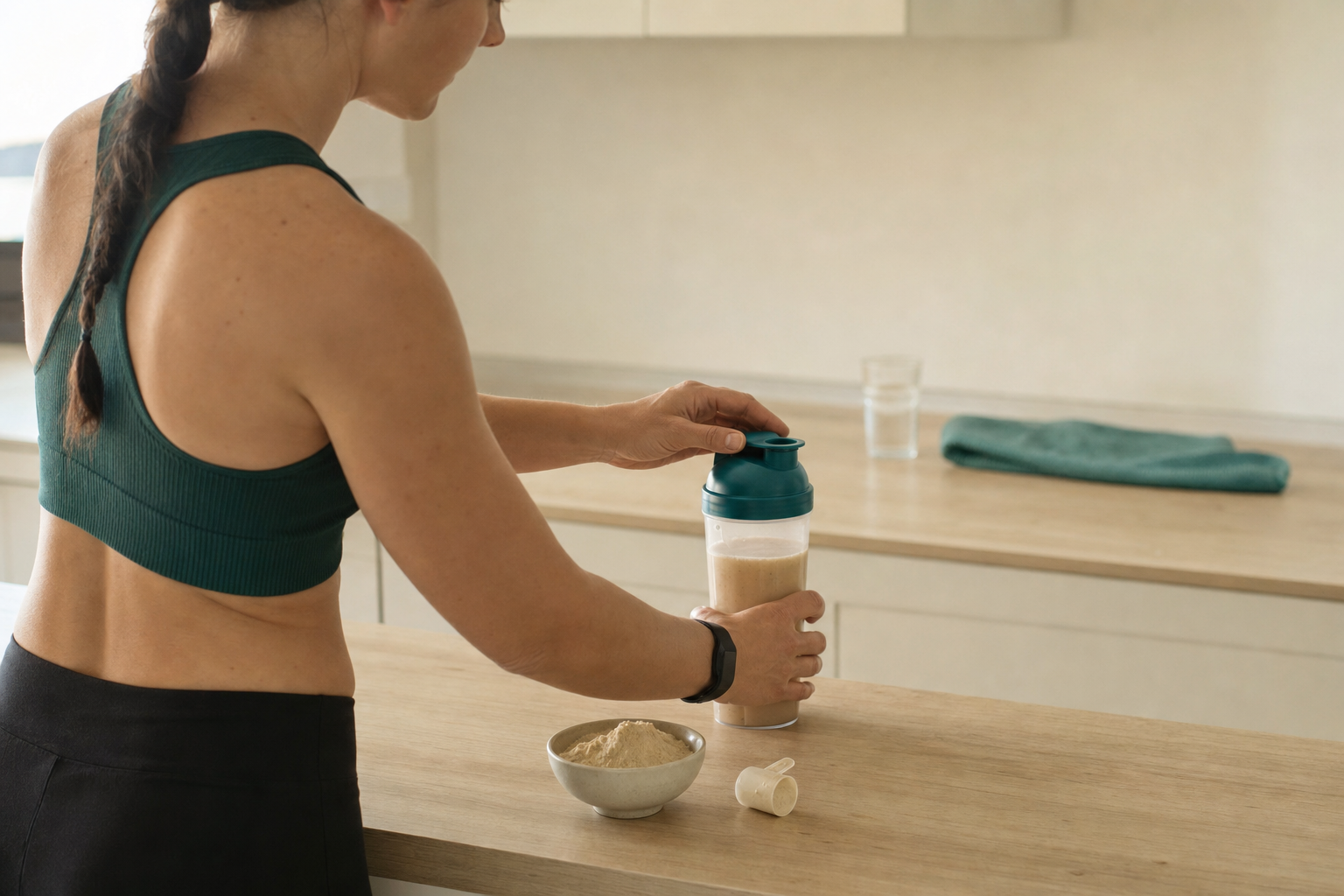
You are standing in the kitchen after training, shaking your plant-based shake and wondering whether it actually does the job. The tub says there is enough protein in it. But not all protein is equal, and the one amino acid that decides whether your body even switches into build mode is not printed in big letters on the label. It is called leucine.
Leucine is the trigger, not just a building block. It determines whether a meal kicks off muscle protein synthesis or simply fills you up. This is exactly where it gets interesting for plant-based athletes, because per gram of protein, plant sources usually deliver less leucine than whey or egg. So the question is not whether you need leucine, but how much and from where.
We will settle three things with numbers rather than gut feeling: how much leucine you need per day, how much has to sit inside a single meal, and whether plant protein realistically clears that threshold. The answers come from position stands, a meta-analysis and controlled trials, not from supplement-industry marketing.
- Leucine triggers muscle protein synthesis (MPS) through the mTORC1 pathway. The effect is dose-dependent, and leucine is the primary trigger, not "protein in general" (Stokes 2018, review).2
- Each meal should land at roughly 700 to 3000 mg of leucine (about 2 to 3 g), wrapped inside 20 to 40 g of protein, ideally spread every 3 to 4 hours (Jäger 2017, ISSN position stand).1
- Daily target for muscle building: 1.4 to 2.0 g of protein per kg of body weight. Above roughly 1.62 g/kg, extra protein adds nothing further for lean mass (Morton 2018, meta-analysis, 49 RCTs).5
- More leucine on its own is not a lever: 10 g of added leucine per day brought no benefit for mass or strength when protein intake was already sufficient (de Andrade 2020, RCT).4
- Plant protein delivers less leucine per gram on average, yet at a sufficient dose it can stimulate MPS on par with whey (West 2023, RCT; Reidy 2016, review).7,3
Contents
- What is leucine and why does it decide your muscle growth?
- The MPS threshold: how much leucine a meal needs
- Leucine daily intake for athletes: what the ISSN data shows
- Plant-based leucine sources: do they really cut it?
- How to spread your leucine across the day
- FAQ: daily amount, plant sources and supplements
What is leucine and why does it decide your muscle growth?
Leucine is one of the three branched-chain amino acids (BCAAs), it belongs to the nine essential amino acids, and among them, it plays a special role. While every amino acid serves as a building block for new muscle protein, leucine doubles as a signal. It tells the cell: there is enough material now, the build can start.
Specifically, leucine activates the mTORC1 pathway, the central switch for muscle protein synthesis. Stokes and colleagues summarised in their review that this effect is dose-dependent and that leucine is the primary agonist of the response. Resistance training amplifies the whole thing on top. In plain terms: it is not the sheer amount of protein that ignites MPS, but above all the leucine within it.
Leucine is the amino acid with the strongest anabolic signalling effect. It activates mTORC1 and, with it, muscle protein synthesis in a dose-dependent way. Other amino acids are needed as building material, but leucine is the trigger that gets the build process going at all (Stokes 2018, review).2
We pulled apart the exact molecular sequence, from the leucine signal through mTOR to the finished muscle fibre, in our article on leucine and muscle protein synthesis. For the daily requirement, the core idea is enough: leucine is the door opener. And a door opener has to be present in a certain amount, otherwise the door stays shut.
The MPS threshold: how much leucine a meal needs
Muscle protein synthesis responds to leucine in a dose-dependent way. At very low amounts per meal, little happens; above a reference value discussed in the research, it responds strongly (age-dependent, not a universal cutoff). That is why distribution across the day matters, not just the raw daily total.
The position stand of the International Society of Sports Nutrition (ISSN) gives concrete numbers. A meal meant to maximally stimulate MPS ideally contains 700 to 3000 mg of leucine. That sits inside 20 to 40 g of high-quality protein, or roughly 0.25 g of protein per kg of body weight. These doses should be spread as evenly as possible, every 3 to 4 hours across the day.
Jäger and colleagues summarise the state of research on protein and training for the ISSN. Key points on dosing: 20 to 40 g of high-quality protein per meal (or 0.25 g/kg), with 700 to 3000 mg of leucine per dose, spread every 3 to 4 hours. The anabolic effect of a training session lasts at least 24 hours; there is no narrow "anabolic window".1
One more detail: older and less-trained people tend to need more leucine per meal to trigger the same MPS response, a phenomenon known in the research as anabolic resistance.
Rule of thumb per meal: roughly 2 to 3 g of leucine inside 20 to 40 g of protein, three to four times across the day. If you eat plant-based, you have to push the protein amount towards the upper end, because the leucine density is lower.
Leucine daily intake for athletes: what the ISSN data shows
On daily intake, leucine and total protein often get muddled. There is no meaningful standalone daily leucine recommendation, because leucine is practically always consumed as part of protein. The figure that holds up is therefore daily protein intake, and the data on that is surprisingly solid.
The ISSN position stand recommends 1.4 to 2.0 g of protein per kg of body weight per day for active people who want to build or maintain muscle mass.1 For a 75 kg person, that works out to roughly 105 to 150 g of protein a day. During phases with a calorie deficit, such as fat loss, the requirement can sit at the upper end or slightly above, to protect muscle mass.
active people
muscle building
in a deficit
Where does the middle value come from? From the most thorough analysis on the topic to date. In 2018, in the British Journal of Sports Medicine, Morton and colleagues pooled 49 randomised controlled trials with 1,863 participants and looked for the point at which more protein no longer brings a measurable extra benefit.
Morton and colleagues (Br J Sports Med) analysed 49 RCTs on protein intake and resistance training. The additional gains in lean mass from more protein plateaued at around 1.62 g of protein per kg of body weight per day. On average, higher intakes brought no further statistically detectable benefit. The effect of protein intake declines with age and is somewhat larger in trained individuals.5
This is exactly where a popular assumption falls apart. If protein above 1.62 g/kg adds nothing, surely at least extra leucine should help, given that it is the trigger? Plausible, but wrong. A controlled trial tested precisely that.
De Andrade and colleagues (Med Sci Sports Exerc) gave 25 trained men either 10 g of added leucine or an alanine placebo daily over 12 weeks, at a protein intake of around 1.8 g/kg/day. The result: no difference. Leg-press maximal strength and muscle cross-sectional area rose practically the same in both groups (1RM plus 19 versus 21 percent, cross-section plus 8.0 versus 8.4 percent). With sufficient protein intake, added free leucine brings no benefit.4
The lesson is liberating: you do not have to tip extra leucine powder into your shaker. If your daily protein amount is right and every main meal clears the threshold, the build signal is set. That lines up with the question of how much extra amino acid supplements actually do, which we worked through in detail using the example of BCAA effects on muscle building.
Plant-based leucine sources: do they really cut it?
Now to the sore spot. Per gram of protein, plant proteins carry a lower leucine density on average than animal ones. That is not a marketing myth, it is measurable. The most precise comparison data comes from an analysis out of Maastricht that ran 16 protein isolates through the same lab method.
Gorissen and colleagues (Amino Acids) determined the amino acid profiles of plant and animal protein isolates by mass spectrometry. Leucine content varies widely: from 5.1 percent in hemp through 7.6 percent in human muscle protein up to 13.5 percent in corn. Whey protein sits at 11.0 percent. On average, plant proteins delivered 7.1 percent leucine, animal ones 8.8 percent. Methionine and lysine tend to be scarcer in plant sources.6
What that means in practice shows up best against a reference point. 25 g of whey protein delivers around 2.7 g of leucine, an amount that reliably triggers MPS. To get those same 2.7 g of leucine from plant sources, you need more protein depending on the source. The table below uses exactly that logic.
| Protein source | Protein for 2.7 g leucine | Context |
|---|---|---|
| Corn | 20 g | highest leucine density (13.5%) |
| Whey (reference) | 25 g | the animal benchmark (11.0%) |
| Potato | 33 g | strong for a plant (8.3%) |
| Brown rice | 37 g | solid, low in lysine |
| Pea protein | 38 g | good lysine, low methionine |
| Soy protein | 40 g | well balanced |
| Wheat protein | 45 g | tight on lysine |
| Hemp protein | 54 g | lowest density (5.1%) |
Amount of protein needed to deliver 2.7 g of leucine (the leucine in 25 g of whey). Data: Gorissen et al. 2018.6
Pea protein, the base of many plant-based shakes, needs around 38 g of protein for the threshold amount. That is more than whey, but no big deal. On top of that comes the second issue: pea is high in lysine but low in methionine. Which amino acids typically run short on a fully plant-based diet, and how to combine them, is covered in detail in our article on vegan amino acids.
The decisive question, though, is not the leucine density in the powder, but what actually reaches the muscle cell. And here a recent study shows that the lower density is no obstacle at a sufficient dose.
West and colleagues (Am J Physiol Endocrinol Metab) gave 33 trained individuals 25 g of protein after resistance training, from mycoprotein, pea protein or a blend of the two. All three variants stimulated myofibrillar protein synthesis to a comparable degree. Myofibrillar synthesis was measured over four hours after training; the lower methionine content of pea did not limit this acute MPS response. Note: a mycoprotein maker was involved in the study, though the result used here concerns the pea protein.7
That fits the bigger picture from the review by Reidy and Rasmussen: across different protein sources, there were no differences in strength and mass gains, as long as the leucine threshold per dose was reached.3 Translated: plant protein works when the dose is right. It just leaves less room for sloppiness on the amount.
How to spread your leucine across the day
The theory is clear; in practice, distribution is where it often comes apart. Many athletes load most of their protein onto the plate in the evening and eat a carb-heavy breakfast. That leaves several meals across the day under the threshold, so the build signal fires only once or twice instead of three to four times.
A Japanese study on swimmers documented this pattern cleanly. Breakfast, lunch and dinner reached the amounts for maximal MPS stimulation; four other eating occasions across the day did not. Researchers from an amino acid manufacturer (Ajinomoto) were involved in the study, which is worth keeping in mind when interpreting it.8 The underlying pattern, a distribution gap between main meals, nonetheless matches the general recommendation from exercise physiology.
The fix is rarely a higher total amount, but better distribution. That distribution and timing of protein intake matter alongside the dose is discussed in the review by Morton and colleagues.9 In practice, that means: do not plan the 20 to 40 g of protein per meal from the ISSN standard1 for the evening alone, but spread it across four occasions. With that amount, you clear the leucine threshold reliably, even with plant sources.
Practical anchor for 75 kg: four meals with around 30 g of protein each, every one carrying a leucine-rich component. If you eat plant-based, plan closer to 35 to 40 g of plant protein per meal, or reach for a leucine-optimised source to hit the threshold reliably.
This is where the plant-based day gets concrete. Three to four meals with 35 g of pea or soy protein each are doable, but not always practical. A leucine-optimised shake closes the gap after training, when quick availability and a predictable dose are what count.
The Bottom Line
Leucine is the trigger of muscle protein synthesis, not just a building block. Per meal, what counts is roughly 2 to 3 g of leucine inside 20 to 40 g of protein; across the day, 1.4 to 2.0 g of protein per kg, with a plateau at around 1.62 g/kg (Morton 2018). Extra leucine powder does nothing when protein is already sufficient (de Andrade 2020). Plant sources carry less leucine per gram, but clear the threshold with a little more volume and then stimulate MPS just the same (West 2023). Sobering for the powder industry, liberating for your planning.
FAQ: daily amount, plant sources and supplements
There is no meaningful standalone daily leucine target, because leucine is always consumed as part of protein. The reliable figure is protein intake: 1.4 to 2.0 g per kg of body weight per day for muscle building (Jäger 2017, ISSN). More important than a daily leucine sum is that each main meal clears the threshold of roughly 2 to 3 g of leucine. If you hit the protein amount and spread it across three to four leucine-rich meals, you cover the requirement automatically.
Yes, with a little more volume. Plant sources deliver less leucine per gram on average (around 7.1 percent versus 8.8 percent for animal sources, Gorissen 2018). Pea protein needs about 38 g to provide the 2.7 g of leucine found in 25 g of whey. In controlled trials, pea protein at a sufficient dose stimulated muscle protein synthesis comparably to animal sources (West 2023; Reidy 2016). The practical lever is the dose per meal, not avoiding plant protein.
Usually not, if your protein intake is already adequate. In a 12-week RCT, 10 g of extra leucine per day at a protein intake of around 1.8 g/kg produced no advantage for muscle mass or strength over placebo (de Andrade 2020). Extra leucine can help in edge cases, such as very low total protein intake or anabolic resistance with age. For most active people it is simpler to optimise protein amount and distribution than to buy free leucine.
24 g of protein and 3 g of leucine per serving. Plant-based, with no sweeteners.

Share: