

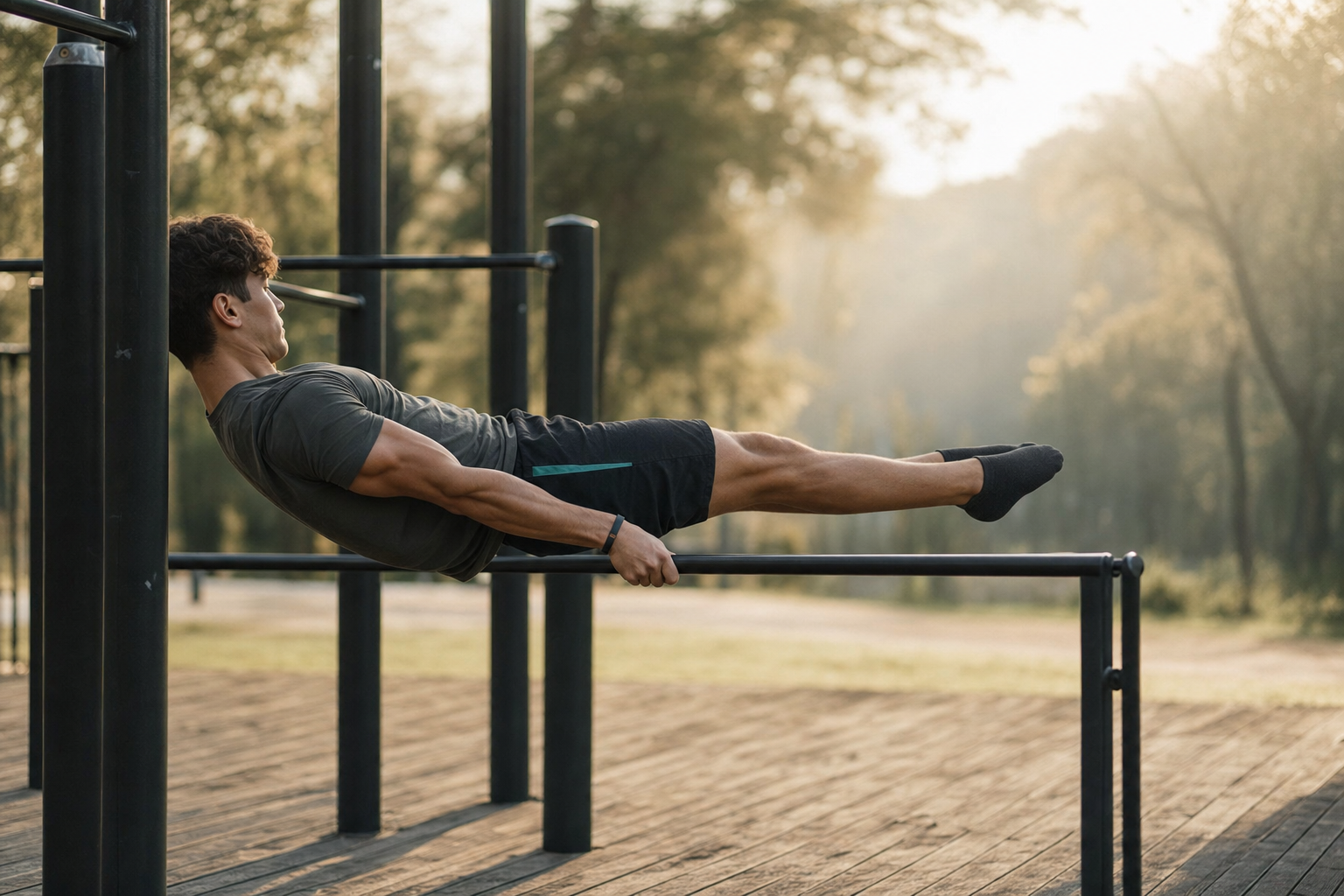
"Calisthenics athletes need less protein because they only lift their own bodyweight." It is one of those arguments that surfaces in movement forums on a regular basis, sounds plausible enough that few people question it, and quietly falls apart the moment you check the data on muscle protein synthesis. The underlying assumption is that skipping the barbell means a smaller stimulus on the muscle, which then means less raw material for repair.
Calisthenics differs from gym-based strength training in its load pattern, not in the magnitude of mechanical tension. A clean front lever, a controlled muscle-up negative or a 60-second handstand hold produce tension peaks that are on par with an 80 percent bench press rep. The primary driver of muscle protein synthesis is mechanical tension at the fibre, and bodyweight training with maximised leverage delivers exactly that.
The scale of the requirement comes from one of the largest meta-analyses on protein intake under resistance training. The 1.62 g/kg plateau reported by Morton et al. (2018) was quantified across 1,863 participants in 49 randomised trials. It applies to trained adults under a genuine resistance training stimulus, regardless of whether the load is held by a barbell, a pull-up grip or a set of rings.1
This article spells out how much protein you actually need for calisthenics, why the leucine content per meal still matters without a barbell, how plant protein performs during bodyweight skill sessions and when extra carbohydrates genuinely change the picture. With concrete numbers from the primary literature and a daily structure that fits a real calisthenics routine.
- Protein requirements for calisthenics sit in the same range as gym strength training: roughly 1.6 g per kg of bodyweight per day, with a plateau at 1.62 g/kg in Morton et al. (2018, n = 1,863).1
- The leucine reference value discussed in research (about 2.5–3 g per meal, age-dependent) holds regardless of training mode. It is reached across four to five meals of 25 to 40 g of protein each, not crammed into a single shake.3
- Plant protein matches animal protein for hypertrophy outcomes once daily dose and a sufficient per-meal leucine content are in place.1 4
- Long skill sessions or pure volume days benefit from 5 to 8 g of carbohydrates per kg of bodyweight. For 45-minute sessions, normal daily intake is enough.3
Contents
- What separates calisthenics from gym strength training physiologically
- How much protein you actually need for calisthenics
- Why the leucine content per meal applies to calisthenics
- Plant protein and calisthenics performance
- When you need more carbohydrates
- Florian's calisthenics nutrition setup
- FAQ: Whey, carbohydrates and 1 g/kg
What separates calisthenics from gym strength training physiologically
Calisthenics has three load characteristics that distinguish it from typical barbell work without altering the underlying training physiology. First, load is modulated through leverage rather than absolute weight. Second, isometric holds take up a larger share of the training volume. Third, the skill component demands tighter attention to technique, which caps volume spikes.
What does not change is the stimulus pathway itself. Muscle protein synthesis is triggered by mechanical tension in the muscle fibre, not by the source of that tension. A front lever progression that gradually extends the lever arm is, in physiological terms, a resistance training stimulus with progressive overload. The barbell is simply absent.
Morton et al. (2018) pooled 49 randomised trials on the effect of protein intake on resistance training-induced gains in lean mass and maximal strength. Trained participants benefited more from protein supplementation than untrained ones (+0.75 kg fat-free mass). The authors frame the conclusion explicitly for any form of resistance training that loads the muscle sufficiently.1
The practical consequence: anyone running a serious pull-push skill routine three times a week, with holds, negatives and difficult progressions, carries the protein requirement of a gym athlete. Anyone doing a handful of pull-ups in the park once a week carries the requirement of a moderately active adult. The dividing line is not the equipment, it is the actual stimulus produced.
How much protein you actually need for calisthenics
For calisthenics practitioners with a real training stimulus, protein intake lands at 1.6 to 1.8 g per kilogram of bodyweight per day. That is the plateau range from Morton et al. (2018, n = 1,863), above which no additional gains in fat-free mass were measured. In a deficit, that is during recomposition phases or when skill progression at a lower bodyweight is the goal, recommendations climb to 2.3 to 3.1 g per kg of fat-free mass.1 2
adults
plateau
recomp
In absolute numbers, that means roughly 112 g of protein per day in a building phase for a 70 kg calisthenics practitioner, or 140 to 160 g during a recomp. Achievable on plant sources with the right choices and a spread across four to five meals. Equally workable with animal sources with three to four meals plus a pre-sleep portion.
Morton et al. analysed 49 randomised resistance training trials (n = 1,863, training duration of six weeks or more). Main finding: protein intake above 1.62 g/kg/day produced no additional gains in fat-free mass. Supplementation worked harder in trained participants (+0.75 kg) and tapered with age. The conclusion applies to any form of progressive resistance training with sufficient mechanical tension.1
In practice: you do not need to eat more protein because you are doing calisthenics instead of bench press. You also do not need to eat less. The threshold sits at 1.6 g/kg, and anything beyond it is comfort, not a real lever.
Why the leucine content per meal applies to calisthenics
The daily total is one half of the equation, the distribution across the day is the other. The ISSN position stand on nutrient timing sets the per-meal dose at 0.25 to 0.40 g of protein per kg of bodyweight, with the goal of driving a strong muscle protein synthesis response at every feeding.3
Kerksick et al. (2017) ISSN position stand: 20 to 40 g of high-quality protein every three to four hours maximises the muscle protein synthesis response. A 0.25 to 0.40 g/kg dose per meal is the working size, spread evenly across four meals for the strongest 24-hour stimulation. A pre-sleep casein portion (30 to 40 g) can support overnight synthesis rates.3
For a 70 kg calisthenics practitioner that translates to 18 to 28 g of protein per meal, with a leucine share in the discussed reference range (about 2.5–3 g, age-dependent). Animal sources clear that with a 25 g whey portion or 100 g of lean chicken. Plant sources turn portion size into the real lever: a 25 g pea protein serving delivers roughly 1.9 g of leucine, while a 35 to 40 g serving or a powder fortified with L-leucine lands in the reference range.
Rule of thumb for calisthenics practitioners: 1.6 g/kg/day, spread across four meals of 25 to 40 g of protein each, with a leucine share in the discussed reference range (about 2.5–3 g per meal). An optional pre-sleep portion (casein or leucine-fortified plant protein) can shore up the daily distribution.
The role of leucine as the central activator of muscle protein synthesis is covered in our piece on leucine and muscle protein synthesis. For calisthenics in practice the takeaway is simpler: a meal below the reference range is not "wasted", it just falls short of its anabolic potential.
Plant protein and calisthenics performance
The most common worry in calisthenics communities is that plant protein is "not strong enough" for bodyweight skill work. The data does not back that concern, provided two conditions are met. First, a daily intake in the 1.6 g/kg range. Second, a per-meal leucine content in the discussed reference range, reached either through portion size, source combination or fortification.1 5
A useful reference here is an RCT done with animal milk protein on barbell-trained athletes that nonetheless exposes the deciding pattern: two strategic protein doses per day plus sufficient daily intake produce measurable gains in lean mass and maximal strength versus a pure carbohydrate placebo. That the protein source can be plant rather than animal without changing the outcome much is shown by the head-to-head in the SYNTYZE article on plant protein versus whey.
Pourabbas et al. (n = 30 trained young men) ran a six-week comparison of high-protein dairy milk (60 g/day in two strategic doses, post-workout plus pre-sleep) against an isocaloric maltodextrin placebo under progressive resistance training. The protein group showed significantly greater gains in lean mass, maximal strength and power (each p < 0.05) along with more favourable endocrine markers (IGF-1, testosterone, lower myostatin).5
Transferred to calisthenics, the picture is clear: the effect comes from two strategic protein doses per day, post-training and pre-sleep, both in the discussed leucine reference range. That pattern can also be implemented with plant protein: 30 g of plant protein with added L-leucine after the skill session, 30 g before bed, with the casein role substituted by a leucine-fortified plant formula.
For a head-to-head plant versus whey comparison, the SYNTYZE article on plant protein versus whey walks through the full evidence. As that comparison shows, with standardised daily protein intake (1.6 g/kg) and a matched per-meal leucine dose, no meaningful difference in hypertrophy or strength gains is to be expected.
That allows a clean conclusion. Plant protein is not a performance liability for calisthenics athletes, provided the daily total is in place and every main meal lands in the discussed leucine reference range. The question is not "plant or animal" but "dose and distribution dialled in or not".
When you need more carbohydrates
Most calisthenics sessions run 45 to 90 minutes and overlap with the normal glycogen demand of an active adult. Carbohydrates only become a lever of their own when session length or volume actually taps the endogenous glycogen pool. The ISSN position stand sets the daily requirement for serious trainees at 8 to 12 g per kg of bodyweight, although that upper end is aimed at high-volume work.3
In calisthenics practice that translates to a baseline of 5 to 6 g/kg/day for a typical 60-minute skill session with a pull-push mix. On volume days with long hold series, high rep counts or endurance intervals (burpees, skipping, mountain-climber clusters), the requirement climbs to 7 to 8 g/kg. On pure skill days with mobility, technical drills and short holds, 4 to 5 g/kg is plenty.
Kerksick et al. (2017) ISSN position stand on nutrient timing: endogenous glycogen stores are covered by 8 to 12 g of carbohydrates per kg of bodyweight per day, with the upper end reserved for high-volume work. Intense sessions running past 70 minutes benefit from 30 to 60 g of carbohydrates per hour combined with electrolytes.3
In practical numbers for a 70 kg calisthenics athlete on a normal training day: 350 to 420 g of carbohydrates spread across three to four main meals, with a slight bias towards the pre-workout window (1 to 2 g/kg in the two to three hours before the session). The classic anabolic window, the idea that protein and carbohydrates have to be in within the first 30 minutes after training, was statistically dismantled by Schoenfeld, Aragon and Krieger (2013).4
Schoenfeld, Aragon and Krieger (2013) analysed 23 randomised hypertrophy and strength studies (n = 525 for hypertrophy, n = 478 for strength). Once daily total protein intake was controlled for, the effect of the "anabolic window" disappeared entirely. Daily total emerged as the strongest predictor of hypertrophy, not per-meal timing. The authors' conclusion: pre/post-workout anxiety over the 30-minute rule is unnecessary.4
That is good news for calisthenics practitioners with jobs, families or irregular training schedules. The practical version: eat a main meal two to three hours before the session, a second one within two to three hours after, and the daily total takes care of itself.
Florian's calisthenics nutrition setup
What the data resolves to for a 70 kg person on a typical training day: 112 g of protein (1.6 g/kg per the Morton plateau), 350 g of carbohydrates (5 g/kg per Kerksick), 70 g of fat, spread across four meals plus a pre-sleep shake. The skill session sits in the late afternoon, around 16:30.1 3
Aragon, Schoenfeld et al. (2017) ISSN position stand on diets and body composition: an even spread of protein across four to five meals over the day delivers the most stable anabolic response. In a deficit, the recommended daily total climbs to 2.3 to 3.1 g/kg of fat-free mass to protect muscle mass under reduced calorie intake.2 The per-meal dose itself (0.25 to 0.40 g/kg) comes from the ISSN nutrient timing stand and is not deficit-specific.3
| Time | Meal | Protein | Focus |
|---|---|---|---|
| 07:30 | Breakfast (oats, soy yoghurt, berries, 40 g PLANT PROTEIN) | ~ 30 g | Day start, slow carbs |
| 12:30 | Lunch (lentil curry, rice, vegetables) | ~ 25 g | Complementary sources |
| 14:00 | Pre-workout (banana, oats, small snack) | ~ 8 g | ~ 1 g/kg carbs for the session |
| 17:00 | Post-workout PLANT PROTEIN (40 g serving, 24 g protein, 3 g leucine) | ~ 24 g | Post-workout, 3 g leucine |
| 19:30 | Dinner (tofu pasta, tomato sauce, olive oil) | ~ 28 g | Main protein meal |
| 22:30 | Pre-sleep shake (40 g PLANT PROTEIN, with water) | ~ 24 g | Overnight MPS |
Four main meals, one snack and the pre-sleep shake combine for roughly 139 g of protein, six leucine servings in the reference range across the day, and a carbohydrate volume that covers a 60 to 90-minute session on the glycogen side. In a deficit, the snack drops and the lunch carbohydrates are trimmed, with the protein distribution kept intact.
For a deeper look at macro distribution and step-by-step calculation, the SYNTYZE guide on the nutrition plan for muscle building walks through the full logic. The same principles apply to calisthenics athletes, with slightly lower carbohydrate intake on pure skill days.
FAQ: Whey, carbohydrates and 1 g/kg
No. Once your daily total sits at 1.6 g/kg and every meal lands in the discussed leucine reference range (about 2.5–3 g), hypertrophy and strength gains track each other closely. The direct soy-versus-whey comparison at standardised daily intake is worked through with the studies in our article on plant protein versus whey. Plant protein powders with added L-leucine or source combinations like pea plus rice cover the anabolic stimulus without animal sources.
For a typical 60-minute skill session, 5 to 6 g per kg of bodyweight per day is enough. On volume days with high rep counts, long holds or endurance intervals, the requirement can climb to 7 to 8 g/kg. That sits at the lower end of the ISSN recommendation (8 to 12 g/kg/day) for trained athletes under high volume.3 On pure mobility or technique days, 4 to 5 g/kg covers it. A pre-workout meal with 1 to 2 g of carbohydrates per kg, two to three hours before the session, handles the acute load.
No. 1 g/kg sits clearly below the plateau Morton et al. (2018) identified across 49 randomised resistance training trials. Trained participants benefit from added protein up to 1.62 g/kg/day, with measurable effects on fat-free mass and maximal strength.1 The added requirement is not tied to the equipment but to the size of the mechanical stimulus. A serious calisthenics routine with holds, negatives and progressive skill stages compares with the gym as a resistance training stimulus. The added need above sedentary baseline is real, smaller than most assume, but not zero.
The Bottom Line
Protein requirements for calisthenics land at roughly 1.6 g per kg of bodyweight, spread evenly across four meals of 25 to 40 g each, with a leucine share in the discussed reference range (about 2.5–3 g). The source is secondary: plant protein matches animal protein for hypertrophy outcomes when dosed correctly. The real lever is not the equipment, it is the daily structure.

Share: