

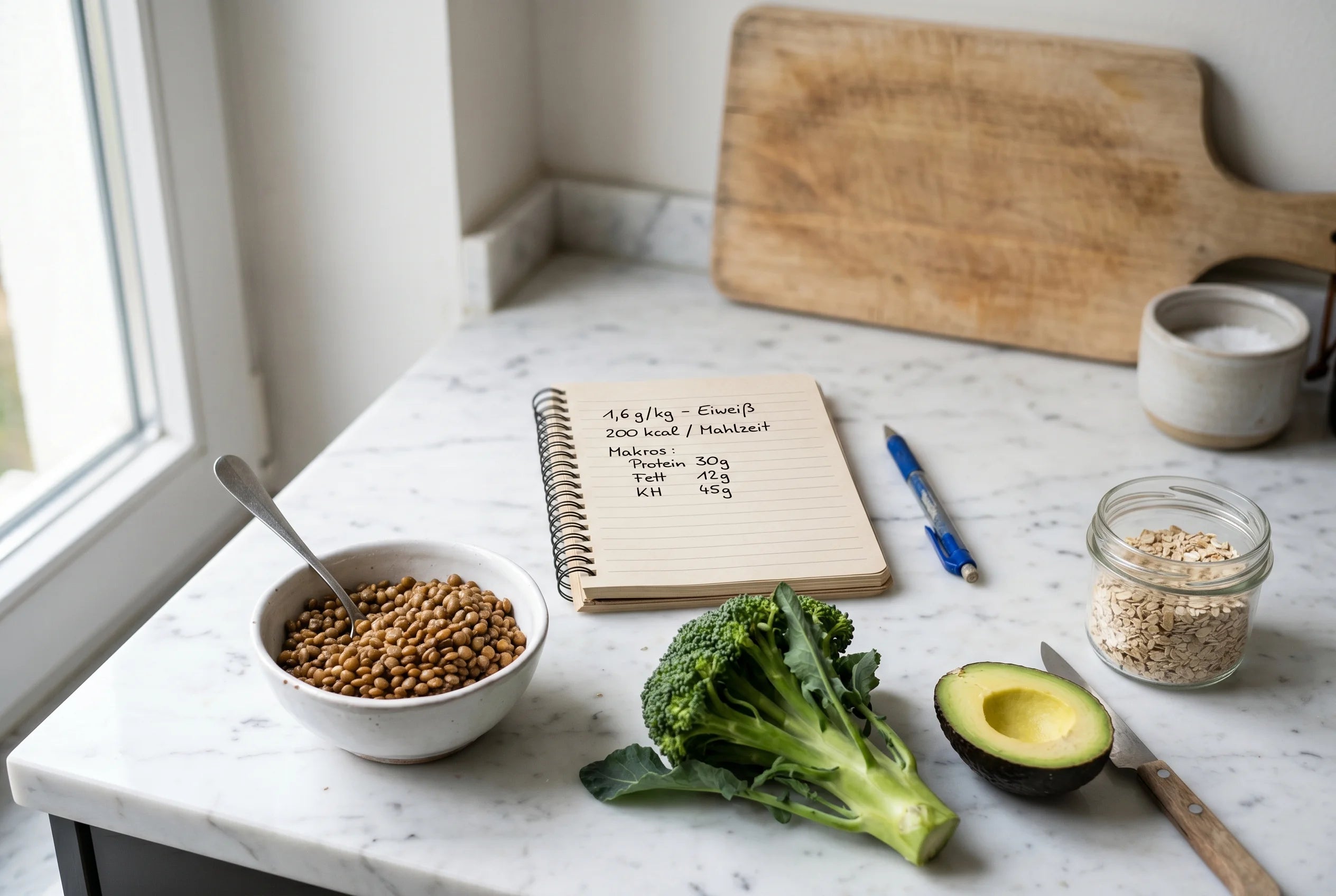
Eat more, build more muscle. That rule of thumb is the foundation of every beginner fitness forum, and in broad strokes it is not wrong. The problem: eating more without a plan usually means putting on fat, not muscle. And in the first training months, when the body is most responsive, an unstructured approach wastes that window.
The research is clearer than most fitness guides suggest. It is not about how much you eat. It is about what you eat and in what ratios. Protein has a ceiling above which more gives you nothing. The calorie surplus has to exist, but it has to stay controlled. Carbs and fats play roles that get flattened to "filler" far too often.
No lifestyle preaching, no motivation talk. Concrete numbers from sports nutrition research, translated for beginners.
- A meta-analysis of 49 studies found that intakes above 1.62 g protein per kg body weight per day produced no statistically significant additional muscle gain.1
- A moderate calorie surplus of 200 to 300 kcal per day is enough for beginners. Higher surpluses mostly add body fat, not muscle.
- Protein contributes to the growth of muscle mass (EFSA-approved claim, EU Regulation 432/2012).
- Carbs are the primary fuel source for intense resistance training. Cutting them undercuts your training progress.
- Roughly 0.4 g protein per kg body weight per meal stimulates muscle protein synthesis (MPS) efficiently. Going much higher per sitting adds little.2
Contents
Why a nutrition plan for muscle building is more than "eat more"
Muscle tissue is not built from calories alone. It is built from amino acids, hormonal signals, and mechanical load. Calories set the frame: too few, and no new tissue gets laid down because the body routes the material elsewhere. But even with enough calories, the macronutrient mix decides whether your body puts on muscle or fat. Protein contributes to the growth of muscle mass1, an EFSA-reviewed relationship, not a marketing line.
That sounds like an academic footnote. It is not.
A daily surplus of 200 to 300 kcal combined with adequate protein (1.6 to 2.0 g/kg) supports muscle gain with minimal fat gain. The ACSM position stand recommends matching energy intake to individual total expenditure rather than relying on fixed numbers.4
Beginners usually fall into one of two traps: too little protein and too many empty calories, or barely any carbs because low-carb is stuck in their head. Both cost progress, for measurable and well-documented reasons.
The American College of Sports Medicine recommends 1.4 to 2.0 g protein per kg body weight per day for strength-trained athletes, with fat providing at least 20 % of total calories. Carbs make up the bulk of the energy.4
A nutrition plan does not force discipline on you. It gives you direction: what do I need, how much, and when? Once those three questions are answered, the rest mostly runs itself.
Calculate your calorie surplus: how much you actually need
Building muscle costs energy. The body needs more calories than it burns. The good news for beginners: that extra demand is smaller than most people assume. A controlled surplus of 200 to 300 kcal per day is enough for solid muscle growth with minimal fat gain. That baseline comes from the ACSM sports nutrition position stand.4
Your starting point is total daily energy expenditure. That is resting metabolism plus the energy you spend on training and daily activity. Several formulas estimate it well. The Mifflin-St Jeor equation is one of the most validated:
Mifflin-St Jeor (men): (10 × body weight in kg) + (6.25 × height in cm) − (5 × age) + 5
Mifflin-St Jeor (women): (10 × body weight in kg) + (6.25 × height in cm) − (5 × age) − 161
Multiply the result by an activity factor (1.375 for 2 to 3 training sessions per week) to get total daily expenditure.
Add 200 to 300 kcal on top. That is your target intake for muscle gain. More is not automatically better. Any calories the body does not use for muscle protein synthesis end up as fat. Beginners also get a window called the "newbie bonus": in the first training months, the nervous system and the muscles adapt so efficiently that growth happens even on a small surplus.
One caveat: these numbers are starting points, not absolutes. If your weight stalls after four weeks, and you see little progress, add another 100 kcal. If your waist grows faster than you want, pull back a little. The body gives you feedback. The math gives you the frame.
Macronutrients for muscle building: distributing protein, carbs, and fats
The three macros play clearly different roles in muscle growth. They do not substitute for each other, and none of them can be trimmed at will. Each one does a job the other two cannot. The ACSM position stand on sports nutrition lays out the baseline ratios clearly.4
Protein supplies the amino acids that make up new muscle tissue. The evidence-based recommendation for strength-training beginners sits at 1.6 to 2.0 g per kg body weight per day. Above that, studies show no meaningful added muscle gain.1
Plant-based protein sources cover this target fully when the daily dose is right. More on that in the next section.
Carbs are the preferred fuel when you train hard. They get stored as glycogen in muscle and liver, and they get used first at high intensity. Training low-carb means training on reserves. Performance drops, fatigue climbs.
For beginners, 3 to 5 g carbs per kg body weight per day is a solid target. Protein fills in the next portion of your calories, fat takes the remainder.
Fats drive the production of testosterone and other anabolic hormones. ACSM recommends at least 20 % of total calories from fat. Drop below that line and hormone balance starts to strain.4 This is not a case for a high-fat diet. It is a floor you should not cross.
Good sources: nuts, avocado, olive oil, flaxseed, hemp seed. On a plant-based diet, these tend to show up naturally.
active athletes
muscle gain
in a deficit
A quick example for a 75 kg person with a 2,800 kcal target:
- Protein: 75 kg × 1.8 g = 135 g per day (540 kcal)
- Carbs: 75 kg × 4 g = 300 g per day (1,200 kcal)
- Fats: remainder = 2,800 − 540 − 1,200 = 1,060 kcal or 118 g per day
This is a starting split, not a rule. Individual preferences can shift the ratio. If you feel better on more protein, take slightly fewer carbs, and vice versa. Just hold the floor: at least 1.6 g/kg protein and at least 20 % of calories from fat.
Calculating protein intake step by step
Protein is the most critical macro in any muscle-building plan, and the one beginners tend to get wrong most often. Either too little (below 1.0 g/kg) or piled into a single meal, which drops how efficiently the body uses it.
Research gives us two concrete anchor points:
Morton et al. pooled data from 1,863 participants across 49 resistance training studies. The result: the protein plateau sits at an average of 1.62 g/kg body weight per day. Above that threshold, no statistically significant additional muscle gain showed up. Their practical recommendation: 1.6 to 2.0 g/kg to account for individual variation and uneven meal distribution.1
That is a reality check for anyone shoveling down 250 g of protein a day. More protein is not actively harmful, but the extra cost and planning effort does not translate to extra muscle.
Schoenfeld and Aragon showed that roughly 0.4 g/kg protein per meal maximally stimulates muscle protein synthesis. Across four meals a day, that lands at 1.6 g/kg, which lines up exactly with the meta-analysis. Higher per-meal amounts are not harmful, but the MPS response plateaus.2
That turns into a practical formula:
Beginner protein intake:
Body weight (kg) × 1.6 to 2.0 g = daily target in grams
Daily target ÷ 3 to 4 meals = protein per meal (aim for roughly 0.4 g/kg)
For a 70 kg person: 70 × 1.8 g = 126 g per day. Split across four meals, that is about 32 g per meal. That is realistic, and easy to hit with decent sources.
What about plant-based protein? It works, as long as the total dose is there and the amino acid profile checks out. The Morton meta-analysis of 49 studies pulled in a wide range of protein sources: once the daily intake was adequate, the source mattered little for muscle gain.1 The key levers are total amount and a leucine reference value of about 2.5 to 3 g per meal that research discusses (age-dependent, not a universal cutoff), around which muscle protein synthesis responds strongly.
For a deeper look at plant protein sources and how their amino acid profiles compare, see our article on vegan muscle building.
Leucine per serving: SYNTYZE protein powder delivers 3.0 g leucine per 40 g serving.6
Post-workout protein: One more data point concerns timing. Witard et al. showed in a randomized trial that 20 to 40 g protein after training maximally stimulates MPS, depending on body size.5 Beyond 40 g, the excess in that acute window gets oxidized rather than used for MPS. That is not a reason to set a stopwatch. Timing matters less than the daily total. But landing a sensible post-training serving is still a solid habit. More on that in our article on the anabolic window.
Total daily protein intake correlates more strongly with muscle gain than meal timing. 1.6 to 2.0 g/kg per day, spread across 3 to 4 meals, covers a beginner's needs fully.1,2
FAQ: common beginner mistakes on a muscle-building plan
No, but it helps at the start. Most people underestimate how much protein they actually eat and overestimate how many calories they burn. A couple of weeks with a tracking app sharpens your intuition. After that, a rough rule of thumb works for most.
If you do not want to track: build every main meal around a palm-sized portion of a protein-rich food. On a plant-based diet, that lands somewhere around 150 to 200 g of legumes, tofu, or tempeh per meal. A protein shake fills the gap when a meal runs short.
For complete beginners, body recomposition is possible: adding muscle and losing fat at the same time on a flat calorie balance. It works best in the first training months, with a higher starting body fat, or after a longer training break.
Over the medium term, though, targeted muscle growth needs a small surplus. Without extra energy, the body cannot lay down new tissue. 200 to 300 kcal above maintenance is the target that supports growth without piling on excess fat.
Helms et al. (2014) also showed that a genuine calorie deficit is where higher protein intake (above 1.8 g/kg) protects muscle mass. Relevant for anyone trying to shave off body fat at the same time.3
The formula does not change: 1.6 to 2.0 g protein per kg body weight per day. Plant protein sources tend to carry slightly less leucine per gram of protein than whey. The fix is either larger portions (to reach the discussed leucine reference value of about 2.5 to 3 g per meal) or combining sources with a higher leucine density.
A multi-component protein powder blending pea and fava bean protein brings both benefits: an optimized amino acid profile and 3.0 g leucine per serving. For more on sources that work well day to day, see our article on daily protein needs.
One supplement particularly worth considering on a plant-based diet: creatine. Vegans tend to have lower muscle creatine stores than omnivores, which can translate to a larger response from supplementation. See our article Creatine for Vegans.
The Bottom Line
A muscle-building nutrition plan does not run on complicated logic, but it needs clarity on three things: enough protein (1.6 to 2.0 g/kg per day), a moderate calorie surplus (200 to 300 kcal), and a macro split that treats carbs as real training fuel. Everything beyond that is fine-tuning. Start with these numbers, and you have everything you need for the first step.



Share: