

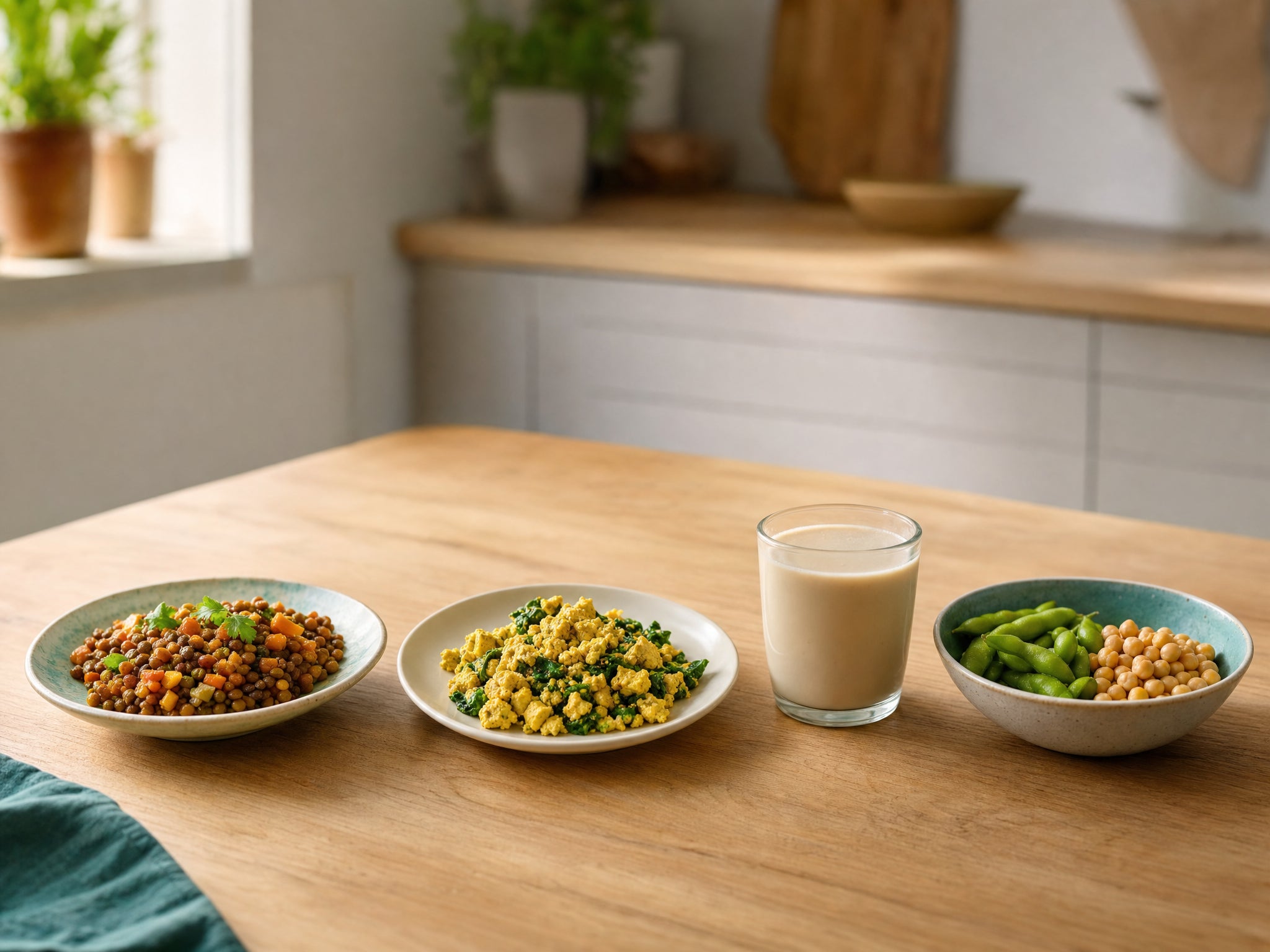
Around 0.4 grams of protein per kilogram of body weight is enough to fully switch on muscle building in a single meal, and anything well beyond that adds surprisingly little extra per meal.
That one number changes how you should think about your protein day. Your body does not build muscle from one big daily pot; it responds to each meal on its own. Eat 90 grams in one evening sitting and almost nothing during the day, and you probably leave gains on the table, even when the daily total is spot on.
So the more interesting question is not how much protein you need per day, but how you spread it: how much belongs in one meal, and across how many meals?
Key Takeaways
- Around 0.4 g of protein per kilogram of body weight per meal maximally stimulates muscle protein synthesis; spread across roughly four meals, that adds up to the recommended daily intake.1
- Across 24 hours, an even distribution produced about 25 % more muscle protein synthesis in a trial than the same amount eaten mostly in the evening.7
- Total daily intake remains the strongest lever. A meta-analysis of 49 studies sees gains plateau at roughly 1.62 g per kilogram per day.2
- For plant protein, a large enough portion matters even more, because the per-meal anabolic response tends to be a little weaker.9
Contents
Why the daily total is not the whole picture
The daily total decides whether there is enough building material at all. How well your body uses it depends on the distribution. After a protein-rich meal, muscle protein synthesis rises sharply within 45 to 90 minutes in a clinical trial, then drops back to baseline even while amino acids in the blood stay elevated.3
Researchers call this the "muscle-full" effect: after a solid protein portion the muscle is briefly saturated and barely responds to more protein piled on top. More in the same meal then does little. Only a new meal, a few hours later, can trigger the response again. That is exactly why it is not the same whether your protein sits in two portions or in four. Distribution is a real lever.
Muscle protein synthesis responds to a protein meal like a switch that peaks 45 to 90 minutes in and then falls back, even with plenty of amino acids still circulating. This "muscle-full" effect explains why several moderate portions set more stimuli across the day than a few very large ones.3
Before that gets misread: the overarching dial is still the total amount. A meta-analysis pooling 49 studies and 1,863 participants shows that added protein increases muscle mass and strength, but the gains plateau at roughly 1.62 g per kilogram of body weight per day.2 Distribution is therefore the second lever, the one that only kicks in once the total is in place. It does not replace it.
Morton et al. analysed 49 studies with 1,863 participants. Protein supplementation increased fat-free mass by 0.30 kg and one-rep-max strength by 2.49 kg on average. Above roughly 1.62 g of protein per kilogram of body weight per day, no further benefit was measurable.2
How much protein per meal? The 0.4 g/kg rule
As a practical guide, roughly 0.4 g of protein per kilogram of body weight per meal has become the benchmark.1 For a 75 kg person that is about 30 g per meal. Dose-response studies show that muscle protein synthesis maxes out around this amount and rises little beyond it.
The clearest evidence comes from a dose-response study with whey protein. After exercise, it measured myofibrillar muscle protein synthesis at 0, 10, 20 and 40 g. The jump happened between 10 and 20 g, while doubling to 40 g added almost nothing and instead drove amino acid oxidation up.5
An earlier study with whole egg painted the same picture: muscle protein synthesis peaked at about 20 g, with extra protein ending up mostly in oxidation rather than muscle.4 More was not better here. Both studies, though, measure only the acute response over a few hours, not muscle growth over months. They tell you how much per meal makes sense, not that one perfect meal decides the whole year.
per meal
per meal
per meal
The scale turns the 0.4 g/kg rule into concrete grams per meal. It is a target, not a ceiling. Eating more wastes no protein, it just yields little extra synthesis per meal. Intake has a saturation point.
In dose-response studies, myofibrillar muscle protein synthesis after exercise maxed out at roughly 20 g of high-quality protein. Doubling to 40 g mainly raised amino acid oxidation rather than the synthesis rate, which supports around 0.4 g per kilogram of body weight as a sensible per-meal benchmark.5
Protein distribution: how many protein meals are optimal?
About four protein meals a day is a solid benchmark. The guidance of roughly 0.4 g per kilogram of body weight across at least four meals works out to the daily target.1 In a controlled study, an even pattern of four times 20 g every three hours beat both eight small portions and two very large ones for muscle protein synthesis across twelve hours.6 Too many mini-portions fail to trigger the response properly; too few large ones waste opportunities.
Areta et al. compared three distribution patterns of the same total (80 g whey) over twelve hours: eight portions of 10 g, four of 20 g and two of 40 g. The even pattern of four times 20 g stimulated myofibrillar muscle protein synthesis the most, clearly above both extremes.6
The pattern behind it is simple: it is not about eating as often as possible, but about hitting the necessary per-meal threshold several times a day. A second study had participants eat either evenly or with their protein skewed towards the evening for a week.
At the same daily total, a balanced spread of around 30 g of protein per main meal led to about 25 % more muscle protein synthesis over 24 hours than an evening-heavy pattern with little protein at breakfast and one large portion at night.7
In practice that means: if your breakfast is currently low in protein and most of your intake lands in the evening, this is your easiest lever. Breakfast often makes the biggest difference. That said, these are again acute synthesis measurements over hours to days. Over very long periods the weight shifts back to the total amount, so treat distribution as fine-tuning, not as the foundation.
Can the body only use 30 g of protein at once?
No. The body uses far more than 30 g of protein per meal; it just does not build muscle ever faster from it. The 30 g limit is a mix-up: roughly that amount maximises muscle protein synthesis per meal, but the surplus protein is not lost, it is simply used elsewhere.1
A headline-grabbing study from 2023 tested the myth head-on. Participants had either 25 g or 100 g of protein after training. The result dismantled the rigid ceiling.
Trommelen et al. compared 25 g and 100 g of protein after resistance exercise. The 100 g portion triggered a larger and, above all, longer-lasting anabolic response over more than twelve hours. The researchers found no meaningful upper limit beyond which protein is simply wasted.8
The anabolic response to a protein meal has no fixed ceiling. In a controlled study, a 100 g portion produced a greater response lasting over twelve hours than 25 g, with negligible oxidation of the surplus protein.8
That softens the distribution logic somewhat: a large portion is not "too much at once". Even so, the practical advice holds, because several moderate meals keep synthesis elevated more reliably across the day than a single giant portion. For everyday life, even distribution is simply the more robust route, not because the body otherwise throws protein away, but because it responds better to repeated stimuli. How soon after training you eat matters less than long claimed, as our article on the anabolic window after training shows.
What does this mean for plant protein?
For plant protein, a large enough portion counts a little more. Plant sources tend to have a lower leucine content per gram and are sometimes digested less efficiently, so the per-meal anabolic response can be weaker.9 The fix is not a different strategy, but the same strategy applied more consistently: an adequate dose per meal and a leucine-rich amino acid profile.
Leucine is the amino acid that flips the switch for muscle protein synthesis. A plant portion should therefore carry enough of it to trigger the response reliably each meal. How much leucine makes sense per meal and across the day is covered in our article on leucine daily intake for athletes. A direct comparison shows that well-dosed plant protein works.
Pinckaers et al. compared 30 g of potato protein with 30 g of milk protein. At rest and during recovery from exercise, muscle protein synthesis rose equally in both groups, with no detectable difference between the plant and animal source.10
The picture is not always that clear-cut, though, and fairness matters. In another study, the anabolic response to a complete vegan meal was lower than that of a matched mixed meal containing meat.
In older adults, an omnivorous meal with 100 g of beef triggered about 47 % more muscle protein synthesis than a vegan meal matched for calories and protein. The source and its quality per portion decide, not the gram count on the label alone.11
So the honest takeaway is this: plant protein is not automatically equivalent, but it becomes so when dose and leucine per meal are right. The portion is what counts. This is exactly where a well-designed plant protein powder earns its place, delivering a predictable amount of protein and leucine per serving and covering one of your roughly four protein meals without any mental maths.12
The Bottom Line
Lock in your daily total first, then spread it across roughly four meals of about 0.4 g of protein per kilogram of body weight each. If your breakfast has been low in protein, that is where your biggest gain sits. For plant-based eaters, what matters most is that every portion carries enough leucine-rich protein.
Frequently asked questions
No. Around 30 g (roughly 0.4 g per kilogram of body weight) maximises muscle protein synthesis per meal, but surplus protein is not wasted. A 2023 study showed that a 100 g portion even triggers a longer-lasting anabolic response over more than twelve hours, with no detectable upper limit. For muscle building, the moderate, distributed portion is still the more practical route, because it sets the stimulus several times a day.
It helps, but it is not a must at all costs. At the same daily total, an even distribution produced about 25 % more muscle protein synthesis over 24 hours in one study than an evening-heavy pattern. The biggest gain usually comes from upgrading a low-protein breakfast. Over long periods the daily total remains the dominant factor, with distribution as the fine-tuning on top.
About four is a good benchmark. In a controlled study, four portions of 20 g every three hours stimulated muscle protein synthesis more than eight very small or two very large portions. What matters is that each of these meals hits the required per-portion amount, rather than splitting protein into many mini-snacks.
Yes, and it counts even a little more. Because plant sources often deliver less leucine per gram and are sometimes digested less efficiently, a large enough, leucine-rich portion per meal is the key. At an adequate dose, plant protein reaches a comparable muscle protein synthesis to animal protein, as a direct comparison of potato and milk protein shows.



Share: