


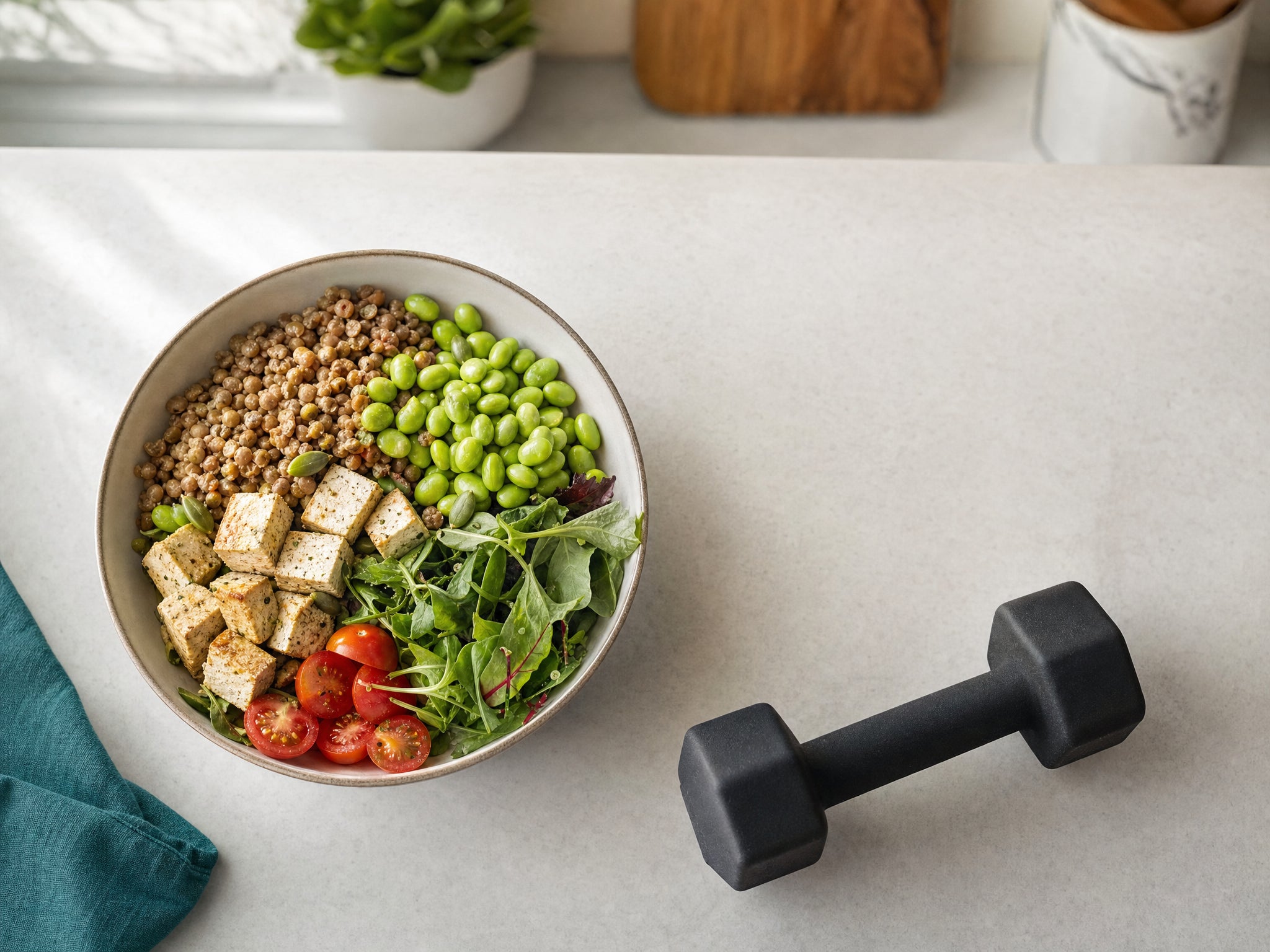
Two people start the same diet and lose exactly the same amount on the scale over twelve weeks. Yet one ends up looking lean and strong, the other just smaller and softer. Same weight on the scale, completely different result. How is that possible?
The scale only knows one number. Whether those lost kilos came from fat or from hard-earned muscle is something it never tells you. That is exactly what separates these two people, and it decides far more than how they look. It shapes metabolism, strength and how easily the weight comes back later.
The good news: the kind of weight you lose is not down to luck. Three levers control it, and all three are backed by hard numbers from the research. Those are what we are going to walk through.
- In a calorie deficit you almost always lose muscle along with fat, not just fat. Resistance training is the strongest protection: a meta-analysis of 25 RCTs shows a clear effect in favour of fat-free mass (Binmahfoz 2025).2
- Protein needs rise in a deficit. Position stands recommend 2.3 to 3.1 g per kg of fat-free mass, more than you need at a stable weight (Helms 2014, Murphy 2014).4,5
- Do not overdo the deficit: a loss of 0.5 to 1.0% of body weight per week protects muscle best (Helms 2014).4
- Building muscle in a deficit is possible. On 2.4 g/kg of protein plus intense training, one group gained 1.2 kg of lean mass while losing 4.8 kg of fat (Longland 2016, RCT).1
- Plant protein stimulates muscle protein synthesis just as strongly as whey, as long as there is enough leucine (Lim 2024, RCT).8
Contents
- Why you lose muscle when you diet, and why that is a problem
- Resistance training in a calorie deficit: the strongest muscle protection
- How much protein when losing weight? The numbers from the studies
- How big should the calorie deficit be?
- Can you build muscle in a deficit at all?
- Plant protein in a deficit: why leucine is the deciding factor
- FAQ: protein amount, cardio and body recomposition
Why you lose muscle when you diet, and why that is a problem
When you lose weight in a calorie deficit, you do not just shed fat. You also lose fat-free mass, meaning muscle. With no countermeasures in place, a sizeable share of that weight loss can come straight from muscle tissue. In one controlled study, the low-protein group lost an average of 1.6 kg of lean mass in just two weeks of dieting.3
Cutting calories reduces body fat but breaks down fat-free tissue at the same time. In trained athletes on a short deficit, the control group eating roughly 1.0 g of protein per kg lost far more lean mass than the high-protein group, a difference of 1.6 versus 0.3 kg (Mettler 2010, RCT).3
Why is that bad? Muscle is more than just looks. It is metabolically active, it keeps you strong and capable in everyday life, and it is the main reason someone comes out of a diet looking firm rather than "skinny fat". Lose muscle and your resting metabolic rate drops too, which makes keeping the weight off later that much harder.
There is one special case that makes the problem worse. People who lose weight on GLP-1 medications such as Ozempic or Wegovy tend, according to newer data, to lose an especially high share of fat-free mass. That is a chapter of its own, one we broke down in detail in our article on GLP-1 and muscle loss. For the natural route through diet and training, the message is this: the levers are in your hands.
Resistance training in a calorie deficit: the strongest muscle protection
If you get only one thing right, make it this: lift weights while you diet. It is the most effective lever for holding on to muscle. A meta-analysis of 25 randomised trials found that resistance training during diet-induced weight loss protects fat-free mass and even increases fat loss.2
The mechanism is simple. A calorie deficit tells the body to shed tissue it considers expensive, and muscle is expensive to maintain. Resistance training sends the opposite signal: these muscles are needed, do not break them down. Without that stimulus, the body has no reason to hold on to muscle.
Binmahfoz and colleagues (BMJ Open Sport Exerc Med) analysed 25 RCTs in people living with overweight or obesity. Adding resistance training to a diet protected fat-free mass (standardised mean difference 0.40, p = 0.0003, moderate evidence) and increased fat loss (difference -0.36, p < 0.00001, high evidence). It barely moved the needle on body weight overall, because more muscle and less fat partly cancel each other out on the scale.2
An honest caveat belongs here: this meta-analysis looked at people with overweight, not seasoned athletes. The principle, though, runs right through the literature, from diet studies in people with overweight to work on strength athletes. The mechanical stimulus that preserves muscle works in both groups.
In practice that means prioritising lifting over cardio. Cardio burns calories but protects no muscle. Two to four strength sessions a week built around heavy compound lifts are the real muscle protection; cardio is the optional add-on for the deficit.
How much protein when losing weight? The numbers from the studies
In a deficit, protein needs climb above what is enough at a stable weight. Reviews recommend 2.3 to 3.1 g of protein per kg of fat-free mass for athletes who are dieting5, which works out to roughly 1.8 to 2.7 g per kg of body weight. For elite athletes, other reviews name a slightly lower range of 1.6 to 2.4 g per kg of body weight, with the upper end reserved for a large deficit.6
Protein intakes above the recommended daily allowance preserve fat-free mass during energy restriction, especially when paired with training. Athletes who want to lose fat while holding muscle should aim for roughly 2.3 to 3.1 g per kg of fat-free mass (Murphy 2014, review).5
It is worth pausing on an apparent contradiction here. At a stable weight, the benefit of extra protein for fat-free mass plateaus at around 1.62 g per kg of body weight, as the large meta-analysis by Morton and colleagues7 of 49 studies shows. In a deficit, the requirement sits higher. The reason: when less energy comes in, the body burns amino acids for fuel more readily, so it needs more protein to keep muscle protected.
What the right amount actually buys you shows up in a head-to-head comparison from a controlled study. More protein, with everything else about the deficit held equal, cut lean mass loss dramatically.
Mettler and colleagues (Med Sci Sports Exerc) put 20 trained athletes into a deficit for two weeks. One group ate around 1.0 g of protein per kg, the other 2.3 g/kg. The result: the high-protein group lost only 0.3 kg of lean mass, the control group 1.6 kg, with comparable fat loss. More protein shifted the weight loss away from muscle and toward fat.3
For everyday use you do not need decimal places. Anchor to fat-free mass if you know it, otherwise to body weight. How much protein makes sense in general, and how the requirement shifts depending on your goal, we worked through in full in our article on how much protein per day.
moderate deficit
in a deficit
aggressive deficit
Recommended protein intake in a deficit, in g per kg of fat-free mass per day (Helms 2014, Murphy 2014).4,5
Spread the total across the day rather than loading it all onto your plate at night. Three to six meals of roughly 0.4 to 0.55 g of protein per kg each are treated in the literature as a sensible structure for triggering muscle protein synthesis several times a day.9
How big should the calorie deficit be?
Bigger is not better. Too aggressive a deficit speeds up muscle loss and saws away at training performance and hormones. The recommendation from competition and diet research sits at 0.5 to 1.0% of body weight per week.4
Rule of thumb: at 80 kg that is around 0.4 to 0.8 kg per week. Lose faster than that, and you tend to give up more muscle, even on plenty of protein and training. Patience here is not a nice-to-have, it is part of the muscle protection.
A moderate rate of weight loss protects muscle. Reviews on diet design in strength sport recommend losing 0.5 to 1.0% of body weight per week to keep the loss of fat-free mass as small as possible (Ruiz-Castellano 2021, review).9
The leaner you already are, the more the slow pace matters. With fewer fat reserves to draw on, the body reaches for muscle sooner, so it is better to shrink the deficit than to stretch it out.
Can you build muscle in a deficit at all?
Yes, under the right conditions you can do both at once: lose fat and build muscle. The phenomenon is called body recomposition. In one controlled study, a group gained 1.2 kg of lean mass despite a 40% calorie deficit while losing 4.8 kg of fat, and the deciding factor was a high protein intake of 2.4 g/kg.1
This study is perhaps the most striking evidence that a calorie deficit is not an automatic death sentence for muscle growth. Young men trained six times a week for four weeks, combining resistance training with high-intensity intervals, all on sharply reduced calories. The difference came down almost entirely to protein.
Longland and colleagues (Am J Clin Nutr) placed 40 young men into a 40% energy deficit with intense training, six days a week. The high-protein group (2.4 g/kg) gained 1.2 kg of fat-free mass and lost 4.8 kg of fat. The control group (1.2 g/kg) only held lean mass (up 0.1 kg) and lost 3.5 kg of fat. Identical training, identical deficit, double the protein, a completely different body-composition result.1
Now the honest framing, because it does not run this dramatically for everyone. The subjects were young men, the training was unusually intense, and the study ran only four weeks. Body recomposition on this scale happens most readily in training beginners or people with a higher body-fat percentage. If you are already lean and well trained, "holding muscle" in a deficit is the realistic goal, not "building muscle".
Even so, the message holds firm: even under the harsh conditions of a 40% deficit, muscle loss was not a foregone conclusion. With enough protein and a genuine training stimulus, you can nudge body composition in the right direction even when calories are tight.
Plant protein in a deficit: why leucine is the deciding factor
Plant protein can support your muscle in a deficit, provided one condition is met: enough leucine. The direct evidence comes from muscle protein synthesis, the first step toward holding muscle. In one controlled study, plant protein with added leucine stimulated muscle protein synthesis just as strongly as whey protein; without the leucine adjustment, the response came out weaker.8
That is the soft spot of many plant sources: on average they deliver slightly less leucine per gram of protein than whey. In a deficit, where every meal counts, that gap becomes more relevant. The fix is not to drop plant protein, it is a big enough dose and an eye on the leucine content.
Lim and colleagues (Curr Dev Nutr) compared plant protein, plant protein with added leucine and whey protein in a double-blind crossover design with young men and women. All three raised muscle protein synthesis, but the leucine-enriched plant version worked just as strongly as whey and more strongly than plant protein with nothing added. Enough leucine, in other words, evens out the disadvantage.8
Plant proteins with enough leucine stimulate muscle protein synthesis to a similar degree as animal proteins. In a crossover study in young adults, plant protein with added leucine produced the same muscle protein synthesis response as whey protein (Lim 2024, RCT).8
This is exactly where SYNTYZE protein powder comes in. A leucine-optimised plant-based protein powder makes it easier to hit the protein you need in a deficit without drowning in calories. Protein contributes to the maintenance of muscle mass, and in a deficit that is exactly what counts. Whether plant protein makes sense for losing weight in general, we covered separately in our article on plant protein powder for weight loss.
The Bottom Line
When you diet, it is not the number on the scale that decides the outcome but what that number is made of. Three levers protect your muscle: resistance training as the strongest stimulus, enough protein (2.3 to 3.1 g/kg of fat-free mass) and a moderate deficit of 0.5 to 1.0% per week. Get all three right and even simultaneous muscle gain is on the table. More effort than simply eating less, but the payoff is a different body, not just a smaller one.
FAQ: protein amount, cardio and body recomposition
In a calorie deficit the requirement is higher than at a stable weight. Reviews recommend 2.3 to 3.1 g of protein per kg of fat-free mass for athletes, which works out to roughly 1.8 to 2.7 g per kg of body weight (Murphy 2014). The more aggressive the deficit, the closer to the upper end. For a 75 kg person with a moderate body-fat percentage, that is roughly 130 to 180 g of protein a day. Spread the total across three to five meals rather than bunching it in the evening.
Resistance training, clearly. A meta-analysis of 25 RCTs shows that lifting during a diet protects fat-free mass and increases fat loss (Binmahfoz 2025). Cardio burns extra calories but provides no stimulus that preserves muscle. In practice that means resistance training is the base, two to four sessions a week with heavy compound lifts. Cardio is the optional add-on to widen the deficit without eating even less. If you are short on time, prioritise the barbell.
Yes, it is possible, and it is called body recomposition. In one controlled study, the high-protein group gained 1.2 kg of lean mass despite a 40% deficit and lost 4.8 kg of fat (Longland 2016). It works best in training beginners, people with a higher body-fat percentage, or after a longer break from training. If you are already lean and well trained, set "holding muscle" as the realistic goal in a deficit, since simultaneous gain becomes difficult. The prerequisite in every case: plenty of protein, resistance training and a deficit that is not too extreme.
24 g protein and 3 g leucine per serving, plant-based and free from sweeteners. Protein contributes to the maintenance of muscle mass.
Share: