

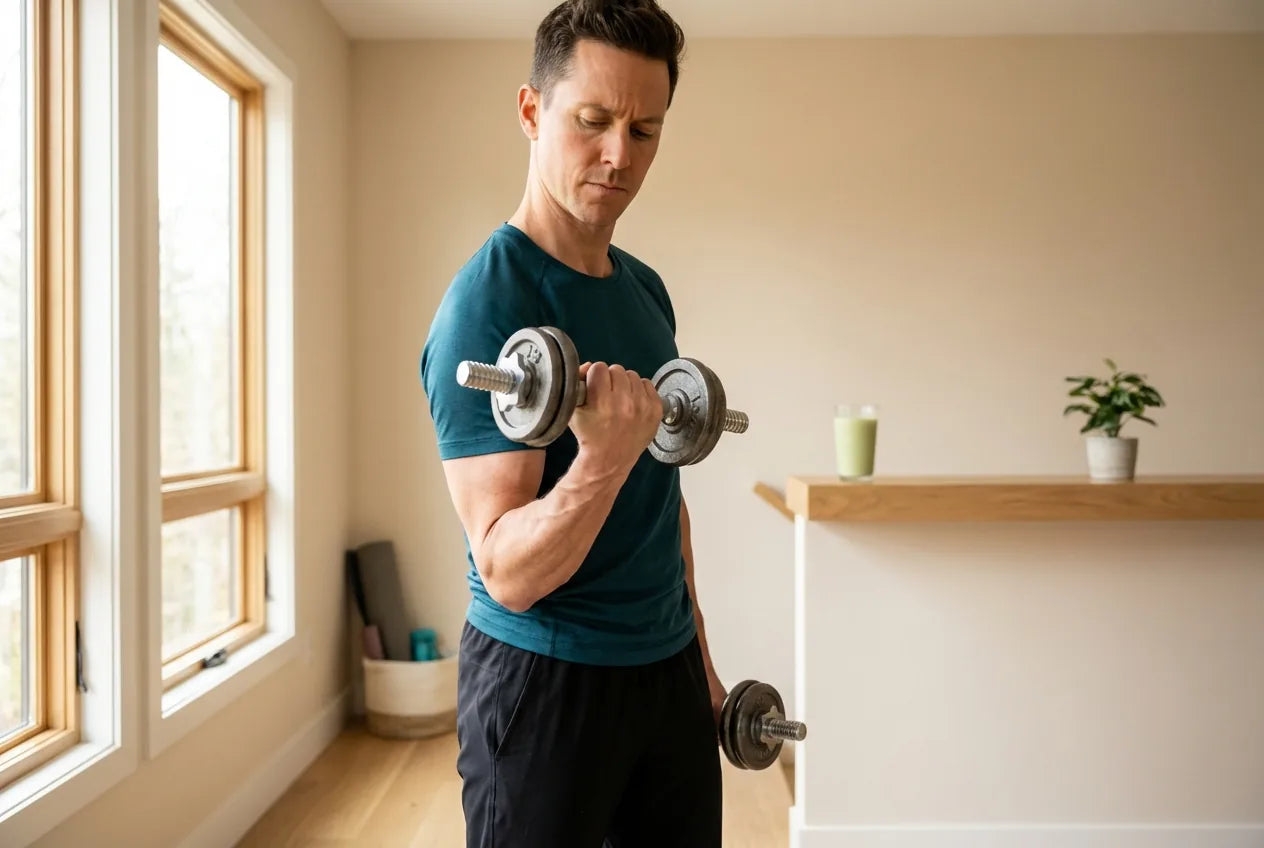
Take the shot, feel less hungry, lose weight almost automatically. GLP-1 medications like Ozempic and Wegovy sound like the simplest solution ever invented. And the results are real: 15 to 25% weight loss in clinical trials. No wonder the topic is everywhere right now.
But it's not as simple as it sounds. One detail missing from most reports: part of the weight that disappears isn't fat. It's muscle mass. And depending on how you handle it, that can become a real problem.
We looked at the data. It's clearer than you might expect. And it reveals two levers that determine whether you lose weight in the right places after your therapy or whether that weight loss comes at the cost of your health.
- GLP-1 medications like Ozempic and Wegovy drive 15 to 25% weight loss, but Dubin et al. (2024) report that 20 to 40% of that comes from fat-free mass; for semaglutide up to ~45% (Ryan et al.).
- For 15 kg of weight loss, that means up to 3 to 6 kg of muscle, equivalent to around 20 years of age-related muscle loss compressed into months.
- Morton et al. (2018) show 1.6 g protein per kg body weight combined with resistance training is the optimal range to preserve fat-free mass.
- Each meal should provide 25 to 30 g of protein; for leucine, research discusses a reference value of about 2.5 to 3 g per meal (age-dependent) to strongly drive muscle protein synthesis.
- The three-pillar plan: sufficient protein, 2 to 4 resistance workouts per week, and physician-monitored body composition checks every three months.
Contents
What GLP-1 medications do to your body composition
GLP-1 receptor agonists like semaglutide (Ozempic, Wegovy) or tirzepatide (Mounjaro) work primarily by suppressing appetite. They slow gastric emptying, signal satiety to the brain, and reduce what's known as food noise. The result: fewer calories, weight loss.
The problem isn't pharmacological. It's physiological. Every caloric deficit costs more than just fat. Your body also breaks down fat-free mass when it receives less energy than it burns. That's true regardless of whether the deficit comes from medication, a diet, or simply eating less.
Tinsley & Heymsfield explain that part of the fat-free mass loss during GLP-1 therapy is "obligatory": it is structurally tied to the reduction of fat tissue. This portion can be limited with protein and resistance training, but not entirely prevented.1
That doesn't mean muscle loss on GLP-1 is inevitable. But it does mean that some loss of fat-free mass isn't a failure of your nutrition or training. It's a physiological side effect that can be minimized but not fully eliminated.
Dubin et al. (2024) analyzed 28 studies on GLP-1 receptor agonists: 20 to 40% of total weight loss comes from fat-free mass. Ryan et al. estimate the proportion at around 45% for semaglutide and 25% for tirzepatide. Mechanick et al. put it in perspective: comparable to around 20 years of age-related muscle loss compressed into a few months.
The problem in numbers: how much muscle mass is actually lost
Weight loss sounds positive at first. But the composition of that loss determines whether you end up healthier or weaker in the long run.
Dubin et al. analyzed 28 studies on GLP-1 receptor agonists and body composition. Result: 20 to 40% of total weight loss consists of fat-free mass. The range depends heavily on the measurement method (DXA vs. BIA vs. direct muscle analysis).2
What does that mean in practice? With 15 kg of weight loss on semaglutide, potentially 3 to 6 kg of fat-free mass is lost. Ryan et al. estimate the fat-free mass proportion at roughly 45% for semaglutide and around 25% for tirzepatide.3
= fat-free mass
with 15% weight loss
loss in months
Mechanick et al. put it in perspective: the muscle loss during GLP-1 therapy can be equivalent to what the body normally loses over around 20 years of aging. Compressed into a few months.4
See the problem? The medication solves one issue (excess fat) but can create another (too little muscle). That's especially relevant for older adults and anyone with already low muscle mass.
GLP-1 medications aren't the problem. Uncontrolled muscle loss is. The solution isn't stopping the medication. It's building the right support strategy around it.
Why protein on GLP-1 is not optional
When your body receives less energy than it burns, it taps into reserves. Fat tissue provides energy. But your body also breaks down muscle protein to supply amino acids for essential processes. The deeper the caloric deficit, the more aggressive this breakdown.
Protein counteracts this in two ways: it provides the amino acids your body would otherwise pull from muscle tissue. And it stimulates muscle protein synthesis (MPS), the process that repairs damaged muscle and builds new tissue.
Morton et al. evaluated 49 RCTs (1,863 participants). Result: protein intake combined with resistance training significantly increases fat-free mass. Optimal range: approximately 1.6 g protein per kg body weight per day. Going higher showed no additional benefit.5
1.6 g per kilogram. At 80 kg, that's 128 g of protein per day. Sounds like a lot, but it's achievable with a conscious diet and targeted supplementation.
On GLP-1 therapy, this recommendation becomes even more relevant. Appetite is reduced, total calorie intake drops, and protein intake often drops with it. A vicious cycle if not actively broken.
Longland et al. split 40 men into two groups: one at 2.4 g/kg protein, one at 1.2 g/kg. Both trained intensely under an aggressive caloric deficit of -40%. The high-protein group gained 1.2 kg of fat-free mass. The low-protein group: just 0.1 kg. At the same time, the high-protein group lost more fat (-4.8 kg vs. -3.5 kg).6
That's an RCT under extreme deficit. The takeaway: even at -40% calories, you can maintain or even build muscle mass if protein intake is high enough and you train. Without training and without protein, you don't stand a chance.
Keep the leucine threshold in mind. Leucine is the amino acid that activates the mTOR signaling pathway and triggers muscle protein synthesis. Research discusses a reference value of about 2.5 to 3 g of leucine per meal (age-dependent, not a universal cutoff) to strongly flip that switch.7
Plant-based protein sources typically have lower leucine density than whey. A pea protein isolate delivers about 1.6-1.8 g leucine per 25 g protein. That's not enough. The solution: larger serving sizes or a blend that optimizes leucine content.
Leidy et al. (2015) summarize the evidence on protein and weight loss. Key finding: 1.2 to 1.6 g/kg protein per day shows the strongest evidence for muscle preservation during weight loss. Per meal, aim for at least 25 to 30 g protein to maximize satiety and MPS stimulation.8
The practical takeaway: spread your protein across 3 to 4 meals, each with at least 25 g. If you struggle to eat enough on GLP-1 therapy, a quality protein shake is one of the most efficient ways to hit your target without adding volume to your stomach.
Locatelli et al. (2024) summarize the evidence: resistance training over at least 10 weeks can produce a 3 kg fat-free mass gain and a 25% strength increase, even during weight loss. Murphy & Koehler (2021) caution that beyond a 500 kcal daily deficit, gaining fat-free mass is virtually impossible even with training.
Resistance training: the factor no medication can replace
Protein alone isn't enough. Without the training stimulus that signals to your muscles they're needed, you're missing the strongest argument against breakdown.
Locatelli et al. summarize the evidence: resistance training over at least 10 weeks can produce a fat-free mass gain of approximately 3 kg and a strength increase of around 25%. This holds true even in the context of weight loss therapies.9
3 kg of muscle mass in the other direction. That's not a marginal effect. It's the difference between a healthier and a more fragile body after therapy.
The SEMALEAN study provides an important data point directly from the GLP-1 context.
Alissou et al. followed 106 patients on semaglutide 2.4 mg over 12 months. Fat-free mass dropped by roughly 3 kg in the first 7 months and stabilized afterward. Grip strength increased by +4.5 kg by month 12. The proportion with sarcopenic obesity fell from 49% to 33%.10
The stabilization at month 7 is the key point. The body adapts. And functionality (measured by grip strength) can actually improve, even as absolute fat-free mass declines. That suggests training improves the quality of the remaining muscle.
Notice the pattern? The combination of caloric deficit (via GLP-1) and resistance training can simultaneously reduce fat and preserve muscle function. But only if both come together: the deficit and the training stimulus. One without the other isn't enough.
Murphy & Koehler analyzed studies and showed: at an energy deficit above 500 kcal per day, gaining fat-free mass is virtually impossible even with resistance training. Below 500 kcal per day, resistance training preserves fat-free mass significantly better.11
That has a direct consequence for GLP-1 patients: the speed of weight loss affects its composition. Losing too fast (more than 1 kg per week) means disproportionately more muscle loss. A moderate rate combined with training and protein gives the body its best chance to preserve muscle.
What you can do: the three-pillar plan
The research distills into three key measures. None of them are optional if you want to preserve muscle mass during GLP-1 therapy.
Spread your protein across 3 to 4 meals with at least 25 g each. Pay attention to leucine content, especially with plant-based sources. When appetite is low, protein shakes are the most efficient supplement: high protein density at low volume. Discuss your exact target with your doctor, as different guidelines apply if you have kidney issues.
Progressive overload is the key. Increase weight or reps over time. Full-body programs or upper/lower splits both work. What matters is consistency over at least 10 to 12 weeks. If you're new to resistance training, get guidance from a qualified trainer, especially if you're taking a medication that affects your energy intake.
Have your body composition checked every 3 months (DXA or bioimpedance). The scale alone says nothing about your fat-to-muscle ratio. Discuss your nutrition and training plan with your prescribing physician. GLP-1 medications are prescription drugs, and the support strategy should be part of the therapy, not a solo effort in a vacuum.
The three pillars are non-negotiable. Protein provides the building material. Training sets the stimulus. Monitoring ensures the plan works. And your doctor has the final say.
A note on the evidence: most data on protein and resistance training during weight loss doesn't come specifically from GLP-1 studies. No large RCT has systematically tested what 1.6 g/kg protein plus 12 weeks of resistance training does in semaglutide patients. The recommendations are based on combining protein research (Morton, Leidy, Longland), resistance training research (Locatelli, Murphy & Koehler), and GLP-1-specific observational studies (Alissou, Dubin). Together, they paint a coherent picture, but not a perfect proof.
Frequently Asked Questions
Yes, if the dose is right. Plant protein sources like pea and fava bean protein provide all essential amino acids. The leucine content per gram of protein is lower than whey. That means you need either larger servings or a blend that lands in the discussed leucine reference range (about 2.5 to 3 g per meal, age-dependent). Kerksick et al. confirm: at adequate dosing, plant proteins stimulate muscle protein synthesis comparably.7
Some degree of fat-free mass loss occurs with any caloric deficit, not just GLP-1 therapy. Studies show a range of 20 to 45%, depending on the medication, measurement method, and individual factors like age, baseline muscle mass, and training behavior. With the right support strategy (protein + resistance training), the loss can be significantly limited.29
Murphy & Koehler's meta-analysis shows: an energy deficit above 500 kcal per day makes it nearly impossible to maintain or build fat-free mass, even with resistance training. A moderate weight loss of 0.5 to 1 kg per week gives your body the best chance to preserve muscle. Discuss the rate of loss with your doctor, as medication dosage directly affects the pace.11
The Bottom Line
GLP-1 medications work. But 20 to 45% of the weight lost can be muscle mass. The countermeasure is clear: 1.2 to 1.6 g protein per kg body weight, spread across 3 to 4 meals. Resistance training 2 to 4 times per week. Regular monitoring. And medical guidance. The combination protects what the medication alone cannot.
Share: