

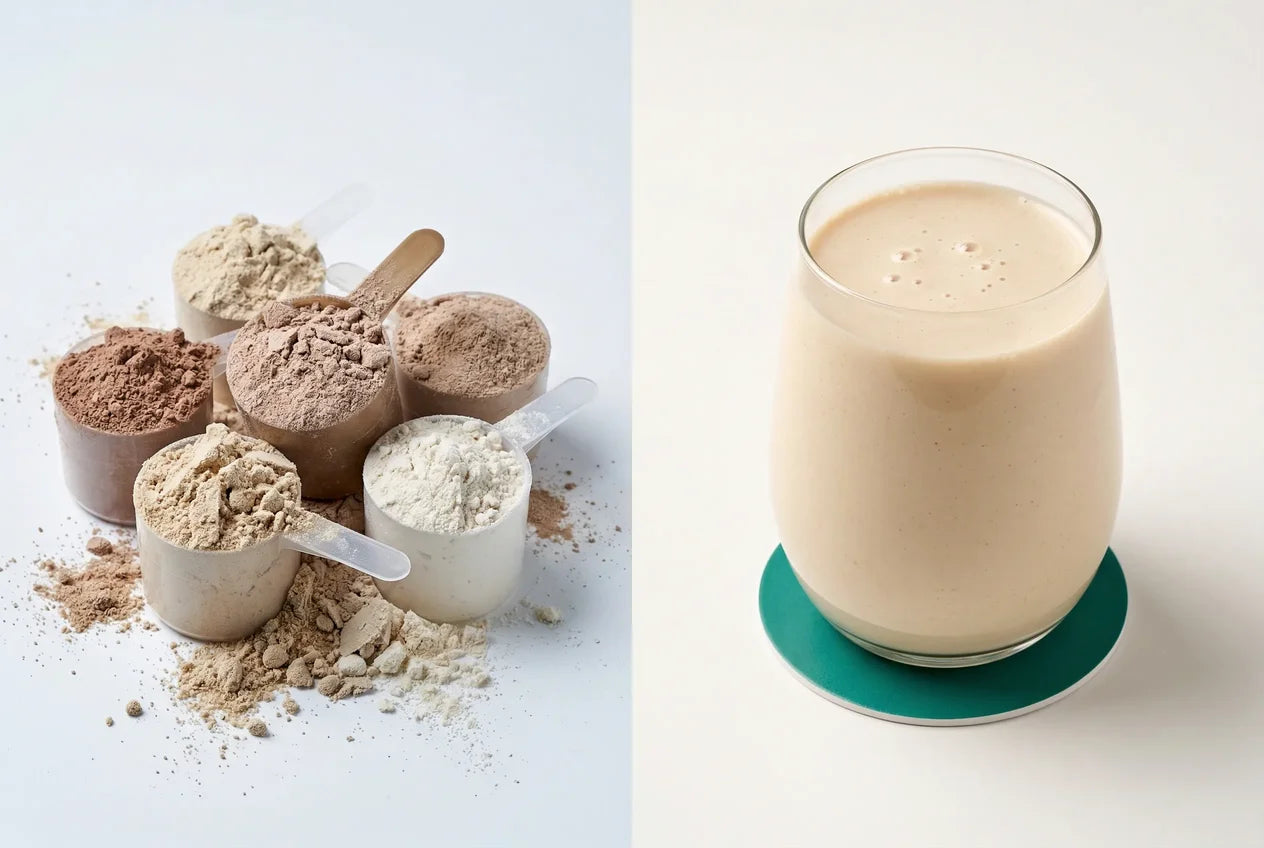
The shake tastes like nature. The ingredient list looks clean. And you drink it because it's the right thing to do – for your training, for the planet, for the bigger picture. But then it happens: The grumbling. The bloating. The uneasy feeling after every serving. Eventually you stop asking yourself why this is supposed to be so good and start asking why it feels so bad.
The answer is surprisingly simple: The problem usually isn't the plant itself. It's everything else around it.
What's really happening in your gut? What role do enzymes, leucine, and fibre play? And what does current research actually say about it?
- Plant proteins digest more slowly because of complex structures and antinutrients like phytic acid and trypsin inhibitors that delay enzyme work.
- Mendes et al. (2025) found no significant disadvantage for plant protein in muscle protein synthesis across 9 of 12 studies (ES = 0.004).
- Three levers make the difference: digestive enzymes, leucine in the reference range (about 2.5–3 g per meal, age-dependent), and well-tolerated fibre sources.
- 68 to 75% of Germans fail to reach the 30 g daily fibre recommendation, with the average sitting at just 18 to 19 g.
- Above a total intake of 1.6 g protein per kg body weight, the individual source becomes increasingly irrelevant if meals are well composed.
Digesting Plant Protein: What Happens Differently in Your Gut
Plant-based protein sources like peas, soy, or faba beans are biochemically different from whey or casein. That sounds obvious. But the consequences aren't – because these differences directly affect how your body processes the protein. Three factors are crucial: protein structure, natural digestive barriers, and the speed of amino acid absorption. A deeper look at the biological value of plant-based proteins shows how these points specifically relate.
Plant-based proteins have more complex structures. Your digestive enzymes need longer to break them down into individual amino acids.
A systematic review from 2025 analyzing clinical studies on protein digestion confirms exactly that: amino acid absorption after plant-based meals happens more slowly, and blood concentrations stay lower than after animal-based meals.1
Then there are antinutrients – natural compounds in legumes like phytic acid and trypsin inhibitors that can further slow digestion. A recent review in Applied Sciences shows these factors reduce enzyme accessibility and therefore need to be specifically addressed, for example through enzymatic hydrolysis or fermentation.2
Plant-based protein isn't worse. It's different. And when you understand where the bottlenecks are, you can fix them deliberately.
Mendes et al. (2025) searched five databases for direct comparisons of plant and animal protein on muscle protein synthesis. Across 12 studies, the measured effect was statistically meaningless (ES = 0.004), and 9 of 12 found no significant advantage for animal protein. Reid-McCann et al. (2025) found a small but significant advantage for animal protein on muscle mass (SMD -0.20; p=0.02); for soy protein and for adults over 60, no significant difference from animal protein was seen.
75% of Studies Show No Disadvantage – Here's Why
Despite these structural disadvantages, research shows something that seems surprising.
Mendes and his team searched five databases and filtered all available studies through October 2024 that directly compared plant-based and animal-based proteins for their effects on muscle protein synthesis. The result from 12 studies: the measured difference was statistically meaningless (ES = 0.004). In 9 of 12 studies (75%), there was no significant difference between plant-based and animal-based.3
That's paradoxical at first glance: slower absorption, lower amino acid concentrations in the blood – and yet the same muscle-building effect. This suggests that it's not absorption speed that matters, but something else: the total amount and composition of protein.
Reid-McCann and colleagues examined in Nutrition Reviews the effect of plant-based versus animal-based proteins on muscle mass, strength, and physical performance. Reid-McCann et al. (2025) found a small but significant advantage for animal protein on muscle mass (SMD -0.20; p=0.02); for soy protein and for adults over 60, no significant difference from animal protein was seen.4
But: These 75% are an average. In the remaining 25% of studies, a significant difference was found, and that's where it gets concrete. Three factors determine whether plant-based protein works optimally.
Three Factors That Upgrade Plant Protein
If plant-based proteins are broken down more slowly, the solution is literally nearby: help the enzymes along. A double-blind crossover trial (so far only published as a conference abstract) examined exactly that – adding an enzyme blend to plant-based protein. The result: differences in amino acid availability between plant-based and animal-based reduced significantly.5 You can learn more about these connections in our article on the role of digestive enzymes in protein powder.
Another study from 2024 with 15 healthy subjects over 15 days supported the approach: pea protein combined with an enzyme blend showed a trend towards improved amino acid absorption (not statistically significant on the primary endpoint).6
Enzymes like protease, amylase, and lipase specifically support the breakdown of plant-based protein structures. This isn't marketing. It's biochemistry.
Leucine is the amino acid that gives the start signal for muscle building. Many plant-based proteins naturally deliver less leucine than whey. The solution: either larger portions, combining different plant sources, or consciously choosing high-leucine options. You can learn about the full connection in our article on leucine and muscle protein synthesis.
But here it gets complicated. A 2021 systematic review shows: the leucine threshold hypothesis is actually only relevant in older adults and with isolated proteins. In younger people and in the context of real meals, leucine content is a weak predictor of muscle building.7
That means concretely for you: yes, leucine is important. But it's not everything. At total protein intake of at least 1.6 g per kg body weight, the individual source becomes increasingly irrelevant. Still, it's worth staying in the discussed reference range of about 2.5–3 g leucine per meal – especially at 40+.
Many people think plant-based protein inherently causes digestive problems. The truth is more specific: the problem is often missing or poorly tolerated fibre. Soluble fibre from sources like acacia fibre is associated with significantly better tolerability. A clinical study showed: acacia fibre causes barely any bloating or discomfort even at high doses (up to 30 g daily).8
This clearly distinguishes acacia fibre from other sources, which cause bloating at half this amount.
A SHIME model study looked at the combination of baobab and acacia fibre and found that both fibres complement each other in their fermentation profile.9
Three factors decide whether plant protein performs optimally: digestive enzymes like protease and amylase showed a trend towards improved amino acid absorption of pea protein in a 2024 trial with 15 subjects (not statistically significant on the primary endpoint). Acacia fibre stays well-tolerated even at 30 g per day. And a leucine reference value of about 2.5–3 g per meal becomes especially relevant from 40 onwards (age-dependent).
The invisible fibre gap
While we're on the topic: there's a problem that goes far beyond protein powder. German nutrition guidelines recommend at least 30 g fibre per day. Reality looks different.
daily fibre
actually eat
the recommendation
According to the National Nutrition Survey II, the average is 18 g (women) or 19 g (men) daily. Between 68 and 75 percent of the German population don't reach 30 g.10 Especially affected: people between 18 and 35.
Plant-based protein powders could close part of this gap if they include soluble fibre. Not as a vegetable replacement. But as a realistic everyday supplement.
Counterpoint: Does Everyone Need All Three Factors?
The reality: not everyone has problems with plant-based protein. Tolerability is highly individual.
It depends on your own enzyme capacity, your gut microbiome, how long you've been eating plant-based. Some people tolerate pea protein without issues. Others don't. That's normal.
Processing technology has also improved massively. Modern isolation and fermentation techniques break down antinutrients in the factory. A pea protein isolate from 2025 is biochemically different from one from 2015.2
And the leucine discussion puts itself in perspective with higher total protein intake. A perspective paper (2024) in the American Journal of Clinical Nutrition shows: leucine alone isn't the whole point. In the context of real meals and mixed protein sources, you often see no clear correlation between leucine levels and muscle building.11
So: if you don't have digestive problems, get enough total protein, and eat varied foods, you might not need these extras. But if you're one of many people who experienced problems after switching to plant-based protein, or if you want to maximize results – then these three factors make a measurable difference.
Conclusion: What This Means for Your Protein Choices
Quick reference values:
At this amount, the protein source becomes increasingly unimportant. For muscle building, optimal: 1.6–2.2 g per kg.
Especially at 40+. In younger people and mixed meals less decisive, but a good guideline.
Most people hit 18–19 g. Every serving helps close the gap.
When you choose a plant-based protein powder, pay attention to four things: does it have digestive enzymes like DigeZyme®? Is the leucine content at least 2.5 g per serving? Does it bring well-tolerated fibre like inavea™ BAOBAB ACACIA with it? Does it combine different plant sources (pea + faba bean) to make the amino acid profile complete?
These four factors together make the difference. It's never about a single ingredient – it's about the formula.
The Bottom Line
In 75% of studies, plant-based protein performs as well as animal-based protein when amount and composition are right. The most common problems (digestive discomfort, lower bioavailability) respond directly to enzymes, sufficient leucine, and well-tolerated fibre. Quick reference values: 1.6 g protein per kg body weight, 2.5–3 g leucine per meal, 30 g fibre daily.



Share: